What the alternatives cost: delivery platform and booking portal commissions
According to its price list, Uber Eats takes 30%, Wolt in Czechia has cited around 30% and Booking.com typically takes around 15%. What third-party sales channels cost and what the hotel gets from them.

If a hotel does not offer food to the room, the guest orders it elsewhere. The delivery platform takes a commission from the restaurant, the restaurant gets the rest and the hotel gets nothing. And delivery platform commissions are not small: according to Uber Eats’ official price lists, in ten EU countries they amount to 30% of an order delivered by the platform’s courier1. On top of that, the hotel pays booking portals a commission on the rooms it sells: at Booking.com, according to press reports, 15% on average and sometimes more than 20%2.
This article compares what third-party sales channels cost, what the hotel gets from them and when it makes sense to work with delivery platforms. It is part of a series in which we calculate how much revenue slips away from a hotel room when the guest has no way of ordering directly from the hotel.
Europe: guests are having food delivered to their rooms
Delivery platforms are paying more and more attention to hotels. In Spain, the platform Just Eat announced in September 2026 that orders to nine hotels of the tent chain (seven of them in Mallorca) had risen by 60% in a year. Dinner accounts for 55% of orders, and pizza, burgers and Chinese food are the most popular3. These are platform data, not an independent measurement.
Large hotel groups are taking different approaches. In April 2026, Accor and Uber announced that members of the ALL loyalty programme will also earn points for orders via Uber Eats, initially in France, Germany and Poland from the second half of 2026. This is a loyalty partnership, not in-room ordering4. In the USA, the Wyndham chain has been working with the Grubhub platform in almost 6,000 hotels since July 20255. In Belgium, the platform Deliveroo launched ‘on-demand room service’ with about a dozen hotels as early as 2019. It was aimed at small hotels for which running their own room service is resource-intensive6.
In the United Kingdom, half of hotel guests said in a survey by Zonal and CGA by NIQ (5,000 respondents, 2024) that they are likely to order a food delivery or eat elsewhere during their stay. Of those surveyed, 35% consider room service too expensive7. As early as 2019, 66% of hotel guests in a British survey by HGEM said they had at some point had food delivered to their room via a delivery service; among 26- to 35-year-olds, the figure was 71%8. We did not find a comparable survey for EU countries.
We look at why hotels are cutting back their own room service and what is replacing it in our article on how hotel room service is changing.
Delivery platform commissions: official rates in ten EU countries
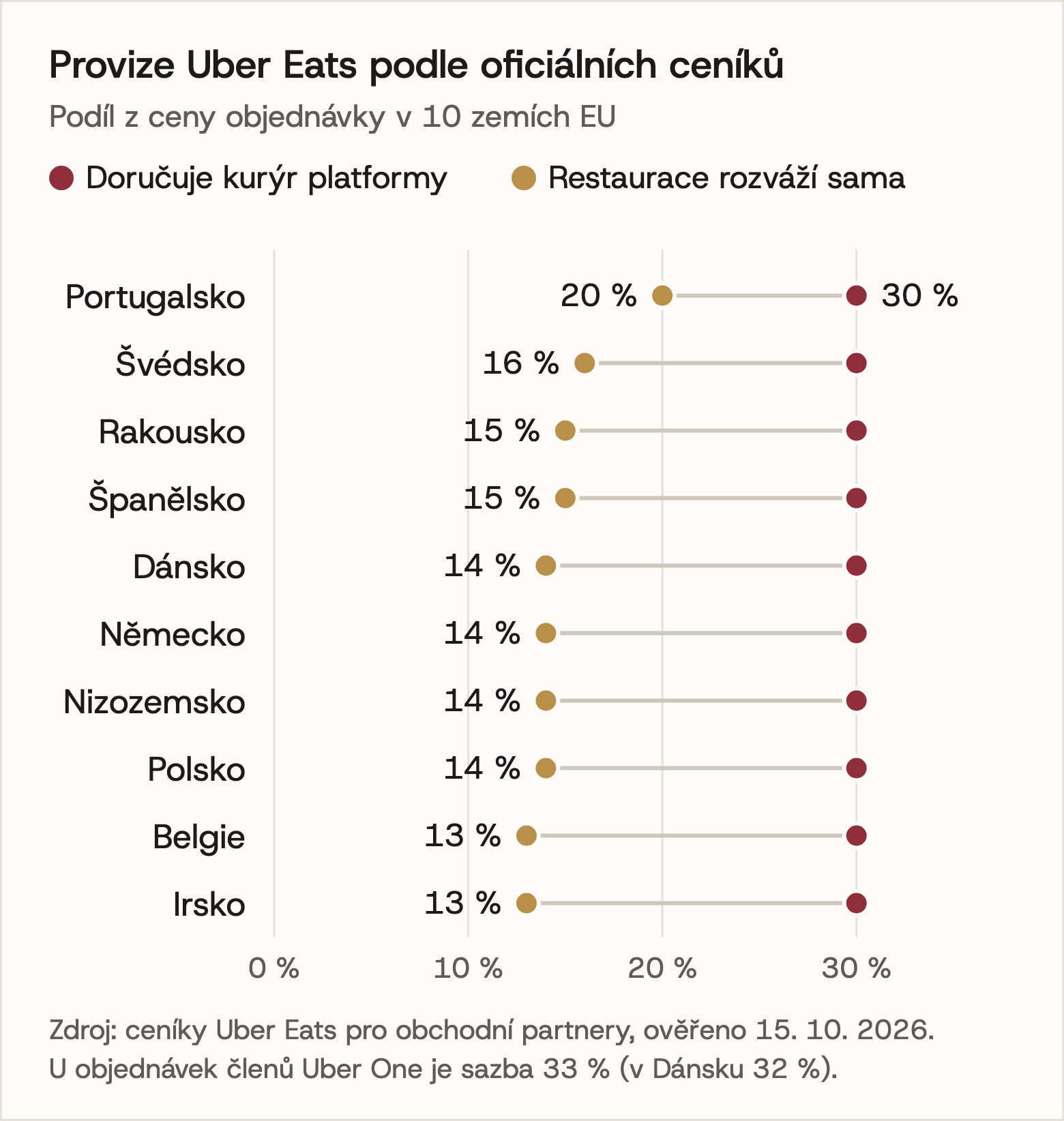
Uber Eats publishes its rates for restaurants. On its merchant pages in ten EU countries, the same rule applies. When the food is delivered by an Uber Eats courier, the commission is 30% of the order, or 33% for orders from Uber One subscription members (32% in Denmark). When the restaurant delivers itself, it pays 13–20%, and 13–16% for pickup orders1.
| Country | Platform courier | Own delivery |
|---|---|---|
| Germany | 30% | 14% |
| Austria | 30% | 15% |
| Netherlands | 30% | 14% |
| Belgium | 30% | 13% |
| Spain | 30% | 15% |
| Portugal | 30% | 20% |
| Poland | 30% | 14% |
| Ireland | 30% | 13% |
| Sweden | 30% | 16% |
| Denmark | 30% | 14% |
In five countries, a one-off fee is payable on top of the commission: €400 in the Netherlands, PLN 1,000 in Poland, €650 in Ireland, SEK 3,500 in Sweden and DKK 2,500 in Denmark. In Belgium and Portugal, there is a weekly fee of €3.99 and €3.49 respectively1.
Authorities and the press in other countries report similar or even higher rates. In 2025, the Finnish competition authority stated that Wolt takes approximately 20–30% from restaurants and holds about 70–80% of the market9. In Austria, according to press reports from 2024, Foodora charges at most 30% and Lieferando 13% on average, to which it adds 17 percentage points when its own courier delivers. One Viennese restaurateur spoke of as much as 35% and summed it up by saying that ten per cent is something you can live with, but anything above 18 per cent is unaffordable10. In Poland, the press reported commissions of up to 37% in 202011. In Spain, in an example given by Catalan television in 2020, the platform Glovo charged 35% plus €50 every fortnight, which together came to almost 43% of the restaurant’s delivery revenue12.
Just under a third of the order is the price of the app, marketing, payment and delivery. For the restaurant, this can make sense, because it reaches customers it would not otherwise reach. For the hotel whose guest is ordering the food, it means only one thing: the revenue bypasses the hotel.
Czechia: Wolt, Foodora and what we know about commissions
Public data for Czechia are scarce. The most recent verified figure dates from 2020. At the time, the head of Wolt’s Czech branch told Seznam Zprávy that the commission was ‘in the region of 30 per cent’. The article estimated the main platforms’ commissions at 25–30% and worked through an example: from a CZK 120 meal, the restaurant keeps CZK 84 at a 30% commission13.
We did not find a more recent Czech figure for Wolt, Foodora or any other platform in public sources. We did not check the Czech Uber Eats price list. For guidance, that leaves data from other European markets: approximately 20–30% for Wolt, according to the Finnish authority9, and at most 30% for Foodora, according to the Austrian press10. If you are considering working with a platform, ask for the current terms in writing and check the fees on top of the commission itself as well.
Booking portals: around 15% of the room price
Hotels are familiar with a similar mechanism from selling rooms. According to the HOTREC study prepared by Roland Schegg of the HES-SO Valais-Wallis university of applied sciences, booking portals accounted for 29.6% of hotel nights in Europe in 2023. In 2013, the figure was 19.7%14.
Czechia is among the countries with the fastest growth. In 2023, 35.7% of hotel nights here went through portals, compared with 18.1% in 201314. Czechia also has the highest share of the Booking Holdings group in portal business among the EU countries surveyed: 76.4%, of which Booking.com alone accounts for 75.0% (a sample of 55 Czech hotels). The average for the European sample is 71.0%14. Small hotels depend most on portals. Overall, 20% of all hotels get more than half of their nights from them, but among hotels with fewer than 20 rooms the figure is 27%14. And commission is not the only cost. Four in ten hotels in the study report that portals offer their rooms more cheaply than the hotel itself sells them (16% often, 27% occasionally). Three out of four of the hotels affected had not agreed to this, and for more than half of them the difference was 6–10%14.
Booking.com does not publish its rates. Press reports give an average of 15% in Europe, noting that the commission can exceed 20%2. In 2021, the head of the Estonian Hotel and Restaurant Association cited 15–18%15. According to press reports, more than 10,000 accommodation establishments from 30 countries have joined a collective action for damages against Booking.com2. In Switzerland (outside the EU), the federal Price Supervisor ordered Booking.com in May 2025 to cut its commissions for Swiss hotels by almost a quarter for three years16. According to press reports, Booking.com has announced an appeal, so the reduction may not take effect.
With a room, the hotel pays a commission for a guest it might not have won without the portal. With food to the room, the situation is different: the guest is already in the hotel. If they order through a delivery platform, the hotel pays no commission but loses the entire revenue.
What the hotel keeps from a CZK 300 order
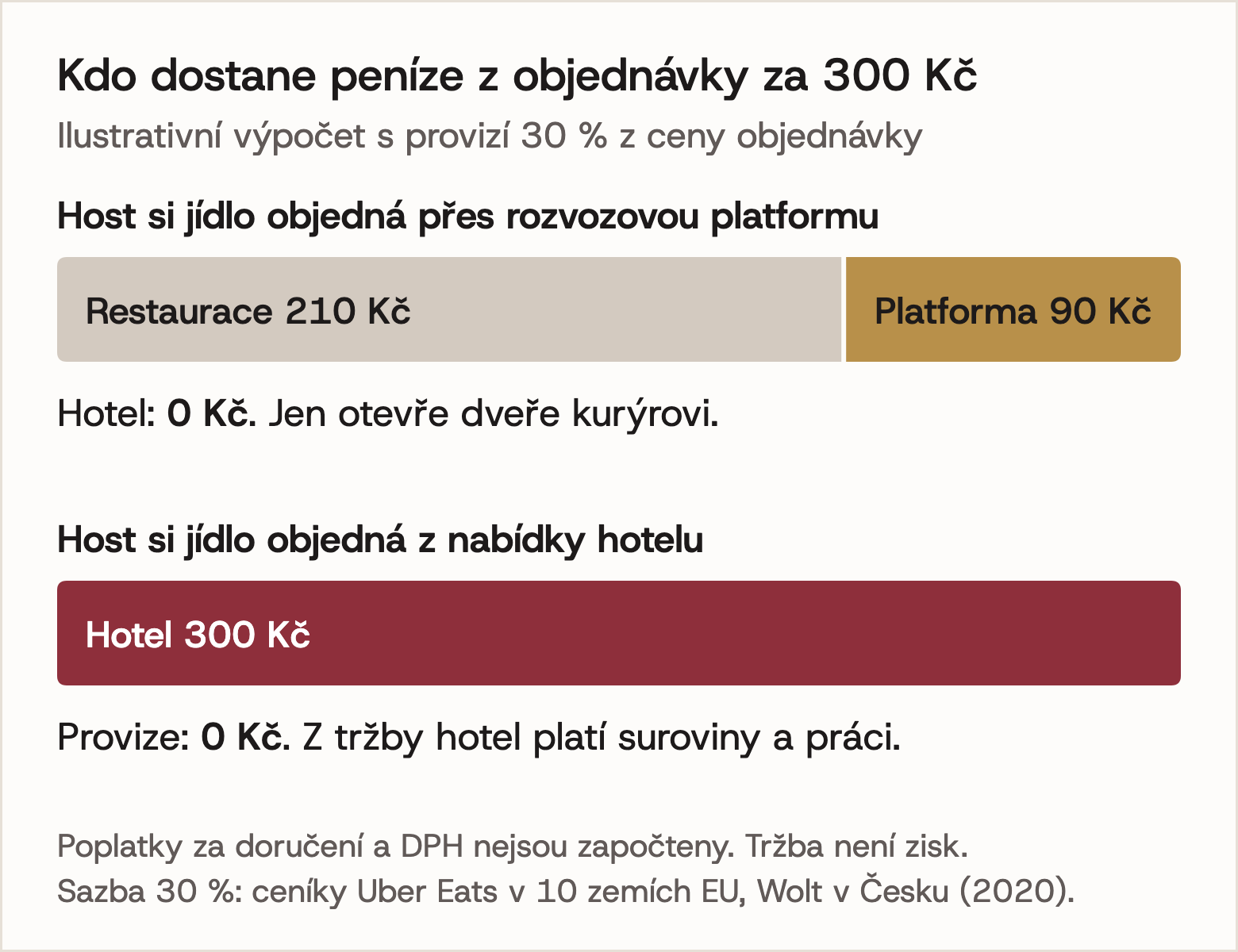
Take a CZK 300 dinner that a guest orders to their room. We calculate in the same way as Seznam Zprávy did in its example of a CZK 120 meal13: a commission of 30% of the order price, which is the Uber Eats rate for delivery by the platform’s courier1. For simplicity, we do not include delivery fees or VAT.
| Via a delivery platform | From the hotel’s offer | |
|---|---|---|
| Guest pays | CZK 300 | CZK 300 |
| Platform commission (30%) | CZK 90 | CZK 0 |
| Restaurant revenue | CZK 210 | CZK 0 |
| Hotel revenue | CZK 0 | CZK 300 |
Revenue is not profit. Out of the CZK 300, the hotel pays for ingredients, labour and the time of the staff member who delivers the order. The difference lies elsewhere: with its own offer, the hotel decides on the revenue, the prices and the range. Via a platform, it gets nothing from its own guest’s order, even when it has to let the courier into the building and show them the way to the room.
How many orders a hotel can expect in a year and how much it keeps from them after costs is shown in our model calculation for a 40-room hotel.
Partner with delivery platforms or build your own offer? A comparison
Delivery platforms are not the enemy. A hotel without a kitchen cannot offer a hot dinner at eleven at night, and a guest who orders one through a platform is at least fed and satisfied. So the decision is not ‘either/or’. Leave to the platform what the hotel cannot handle. Build your own offer on what it can.
| Delivery platform | Hotel’s own offer | |
|---|---|---|
| Who sells to the guest | The restaurant, via the platform | The hotel |
| What the hotel gets from the order | Nothing | All the revenue, out of which it pays the costs |
| Who sets the offer and prices | The restaurant and the platform | The hotel |
| What the hotel needs | Just to let the courier in | Stock or a kitchen, and someone to deliver the order |
| Where the guest orders | In a third-party app | On the hotel’s page |
| When it makes sense | Hot meals at night, a wide choice of cuisines | Drinks, breakfast, simple dishes, extra services |
If guests are already ordering through platforms, it pays to have clear rules for it:
- Set a handover point. The courier does not need to walk the floors. Reception takes the food and the guest collects it, or staff take it to the room.
- Watch what guests order. The bags at reception are cheap market research. They show what guests would also buy from you.
- Offer your own basics. Even a hotel without a restaurant can manage drinks, in-room breakfast and one or two simple dishes.
- Consider a direct arrangement with a nearby restaurant. If the hotel sells the partner’s dishes under its own brand, the revenue is split between two parties, not three.
For its own offer, a hotel does not need a commission-based platform. GuestVero, for example, costs CZK 1.60 per active room per day and takes no commission on guest orders. The hotel remains the seller and receives payments itself17. For comparison: by our calculation, a single €15 commission to a booking portal (15% of a €100 night) pays for roughly 228 days of GuestVero for one active room, at the ECB rate of 14 October 2026 (CZK 24.357 per euro)18. We explain exactly what the price includes and how to calculate it for a whole hotel in our article on what in-room ordering costs.
Work out what third-party channels cost you and how much you would keep. You will find a step-by-step method in our model calculation for a 40-room hotel. You can then check your own figures in the GuestVero trial, which has no time limit.
Sources
- Uber Eats: price lists for merchants (Germany, Austria, the Netherlands, Belgium, Spain, Portugal, Poland, Ireland, Sweden, Denmark), checked 15 October 2026
- European hotels’ collective action against Booking.com (report on commission levels)
- Just Eat: delivery orders to tent hotels in Mallorca
- Accor and Uber sign new multi-market strategic partnership
- Hotels integrieren Lieferdienste stärker in ihre Angebote
- Deliveroo collaborates with hotels to offer on-demand room service
- Half of hotel guests prefer to order takeaway or eat elsewhere, research shows
- Food deliveries replace hotel room service (HGEM survey)
- Platform company Wolt ceased competition-restricting terms during FCCA investigation
- Wiener Wirte klagen bei Regierung über hohe Lieferdienst-Gebühren
- Uber Eats, Glovo i Wolt na celowniku UOKiK. Chodzi o wysokość prowizji
- El mal negoci del delivery per als restaurants: Glovo i Deliveroo es queden fins el 40 %
- Spása hospod, nebo parazit? Restauratéři se hádají s rozvozy o peníze
- European Hotel Distribution Study 2024 (R. Schegg, HES-SO Valais-Wallis)
- Online platforms take significant percentage of hotels' profits
- Medienmitteilung: Verfügung Booking
- GuestVero: in-room ordering via QR code, pricing
- Euro foreign exchange reference rates: Czech koruna (CZK)
Frequently asked questions
How much does Wolt take from an order?
In 2020, the head of Wolt’s Czech branch told Seznam Zprávy that the commission was around 30%. No more recent Czech figure is publicly available. In 2025, the Finnish competition authority stated that Wolt takes approximately 20–30% from restaurants.
How much does Uber Eats take?
According to the official price lists, 30% of the order in ten EU countries if the food is delivered by an Uber Eats courier, and 33% for orders from Uber One members. When the restaurant delivers itself, it is 13–20%. We did not check the Czech price list.
How much does Booking.com take?
Booking.com does not publish its rates. Press reports give an average of 15% in Europe, noting that the commission can exceed 20%.
What share of hotel nights in Czechia is sold through booking portals?
According to the HOTREC study, booking portals accounted for 35.7% of hotel nights in Czechia in 2023, compared with 18.1% in 2013.
Does GuestVero take a commission on orders?
No. The commission on guest orders is 0%. The hotel pays CZK 1.60 per active room per day, remains the seller and receives guest payments itself.