Hotel room service: why hotels are cutting it back and what is replacing it
Why hotels are cutting back room service, what the Hotelstars criteria require and what a night shift costs in Czechia and across the EU. Data and options.
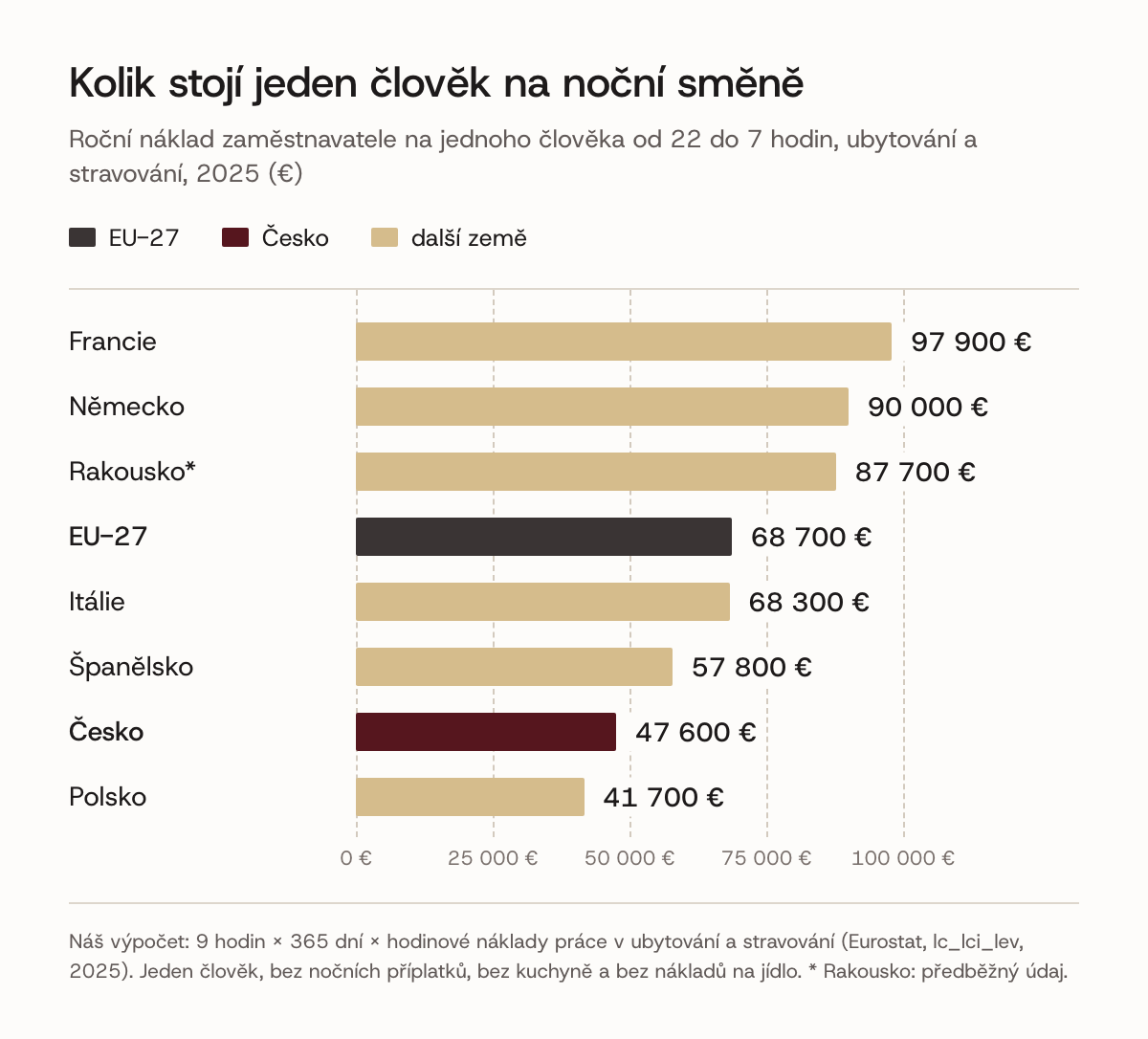
Room service is one of the traditional hotel services, but it is expensive to run. Someone has to take the order, the kitchen has to prepare it and someone has to deliver it, often at night as well. Just one person on the night shift costs the employer about €68,700 a year on average across the EU (our calculation from Eurostat data for 2025)1. Classification rules in Europe are therefore gradually easing the requirements, and hotels are looking for cheaper ways to provide the service.
This article shows what the Hotelstars criteria require today, what one night shift costs in Czechia and other EU countries, and what options a smaller hotel has. Room service is one of the sources of what we calculate in the main article of this series: how much revenue slips away from a hotel room.
Room service in Europe: a requirement the rules are easing
The Hotelstars Union classification system is used by 16 EU member states, including Czechia, Germany, Austria and Poland2. Its new criteria for 2025–2030 have applied since 1 January 20253.
The Austrian Federal Economic Chamber (WKO) sums them up as a relaxation: the number of criteria fell from 247 to 239, and the requirements for the opening hours of reception, room service and the restaurant were eased4. At four stars, a self-service kiosk can now replace the minibar, maxibar or room service4; according to the criteria catalogue, this applies only to the drinks requirement, and a kiosk does not replace food via room service (criterion 200)3. For hotels, this means fewer hours in which staff have to be on hand.
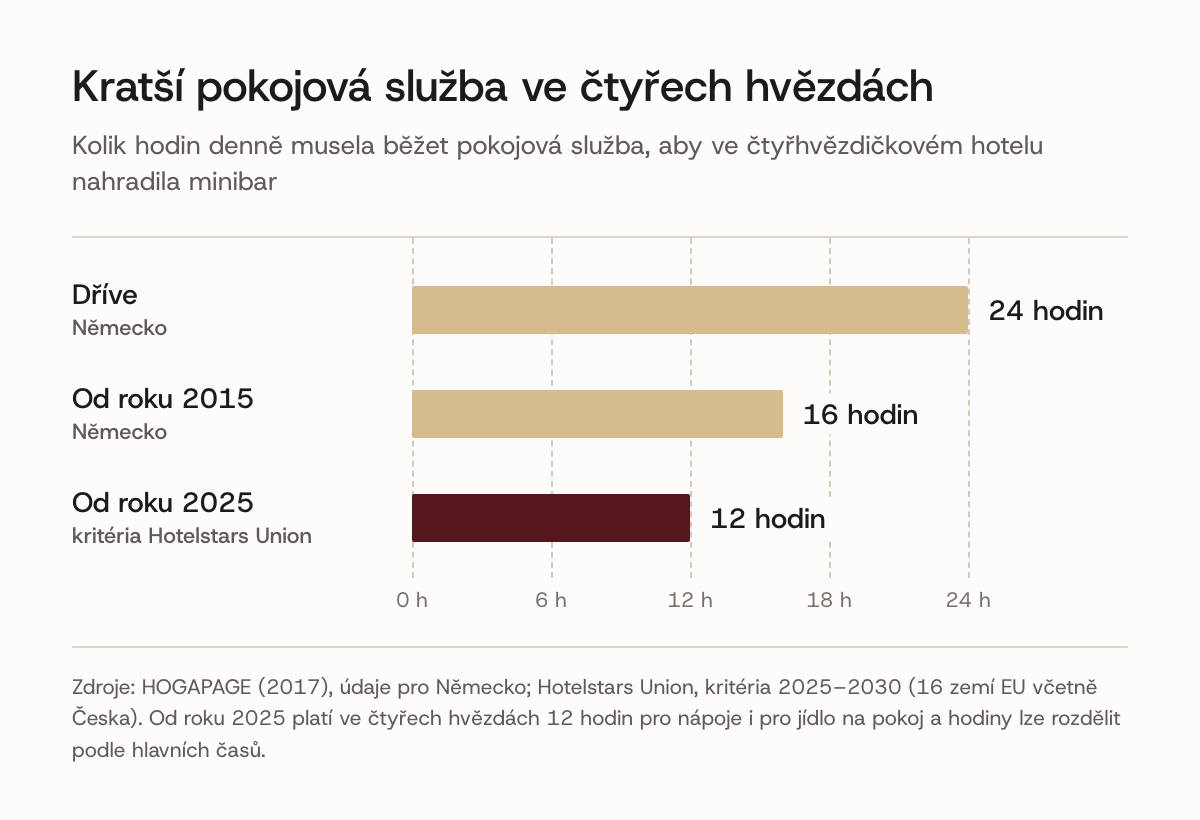
The shift is also visible over the longer term. According to the trade magazine HOGAPAGE, in Germany, room service that a four-star hotel offered in place of a minibar used to have to run around the clock. From 1 January 2015, at least 16 hours a day was enough5. Today’s criteria require 12 hours a day at four stars, and these hours can be split3.
Outside the EU, the trend is similar. In the USA, room service accounted for about 1.2% of hotels’ total revenue in 2012, compared with about 1.5% in 2007. About a fifth of the hotels in the sample studied were losing money on it6. There are no independent European data on room service revenue.
Yet the appetite for eating in the room has not disappeared; it is simply moving elsewhere. In the United Kingdom, according to a 2019 HGEM survey, 66% of hotel guests had already had food delivered to their room by a delivery service7. A more recent British survey (Zonal and CGA, 5,000 people, 2024) reports that half of hotel guests are likely to order a food delivery or eat elsewhere during their stay. Of those surveyed, 35% consider room service too expensive8.
What the Hotelstars criteria require at four and five stars
The Hotelstars Union criteria 2025–2030 distinguish between drinks and food in the room. These requirements matter for room service:
| Criterion | Four stars | Five stars |
|---|---|---|
| Minibar with drinks and snacks (184) | one of three options* | mandatory |
| Drinks via room service (186, 187) | 12 hours a day, one of three options* | 24 hours a day, mandatory |
| Food via room service (200, 201) | 12 hours a day, mandatory | 24 hours a day, mandatory |
| In-room fridge (183) | optional | optional |
* At four stars, one of three options is enough: a minibar, a maxibar or self-service shop open 24 hours, or drinks via room service 12 hours a day3. At five stars, the hotel must also offer a room service breakfast menu3.
Two details matter for day-to-day operations. Room service hours can be split across the main operating times, so the 12 hours do not have to run in a single block3. Garni hotels that serve only breakfast are exempt from the requirement for food to the room, but they cannot obtain five stars3. We describe how the criteria deal with the minibar and its alternatives in our article on what star ratings require for the minibar.
In Czechia, Hotelstars certification is voluntary2. According to data from the Czech Statistical Office (ČSÚ) processed by Horwath HTL, 934 hotels with 57,255 rooms claimed four or five stars in 2025. That is 51% of the rooms in Czech hotels and garni hotels (our calculation)9. However, the star ratings in the statistics are reported by the establishments themselves, so not every such hotel is certified and required to meet the criteria.
Why hotel room service is expensive: the night shift in figures
A hotel’s biggest cost is its staff. In European full-service hotels, payroll costs were the largest cost item in 2025: €60.5 per available room, 5.7% more than the year before (HotStats, more than 2,000 hotels)10.
For room service, this applies doubly. Running around the clock means paying someone even during hours when no orders come in. As early as 2013, an American analysis pointed out that 24-hour room service leads to a particularly inefficient use of labour6.
We calculated the cost of one person on the night shift from Eurostat data on labour costs in accommodation and food services for 20251. We assume a shift from 10 pm to 7 am, i.e. 9 hours a day and 3,285 hours a year. This covers one person, excluding night-shift premiums, the kitchen and food costs. The result is therefore a lower bound.
Compared with the EU average (about €68,700 a year), countries vary considerably. In France, one person on the night shift costs about €97,900, in Germany €90,000, in Austria €87,700 (provisional figure), in Italy €68,300, in Spain €57,800 and in Poland €41,7001.
Czechia: what one night shift costs
In Czechia, an hour of labour in accommodation and food services cost employers an average of €14.5 in 2025, compared with €20.9 in the EU1. By our calculation, one night shift from 10 pm to 7 am therefore comes to about €47,600 a year1.
Czechia is among the cheaper countries, but costs are rising fast. Between 2022 and 2025, the hourly cost of labour in Czech accommodation and food services rose from €11.7 to €14.5, an increase of 24%, compared with an EU average of 17% (our calculation)1.
| Country | Hourly cost | Night shift per year |
|---|---|---|
| EU-27 | €20.9 | €68,700 |
| Czechia | €14.5 | €47,600 |
| Germany | €27.4 | €90,000 |
| Austria | €26.7 | €87,700 |
| Italy | €20.8 | €68,300 |
| Spain | €17.6 | €57,800 |
| France | €29.8 | €97,900 |
| Poland | €12.7 | €41,700 |
For a comparison with revenue, we have only one European figure, and it comes from a vendor. According to the tablet vendor SuitePad, European hotels earn a median of €99 per room per year from room service, and the top quartile €25711. At the median, a 100-room hotel would therefore take in about €9,900 a year from room service (our calculation)11. This is revenue, not profit, and the sample consists of hotels that already sell room service digitally.
In Czechia, one person on the night shift would cost almost five times as much (our calculation). The figures are not directly comparable. But they show why a smaller hotel will struggle to pay for round-the-clock room service out of room service’s own revenue, and why hotels are cutting it back.
What happens when guests order for themselves (vendor data)
There are no independent European measurements of how room service changes after the switch to digital ordering. Vendor data are available. They should be read bearing in mind that they are published by companies that sell such systems and that they come from hotels where digital ordering is already up and running.
- Higher order value. According to the tablet vendor SuitePad, digital orders are worth 15 to 25% more than phone orders12. According to the same data, photos of main courses bring in 27% more orders11.
- A case study from Germany. At the Steigenberger Icon Frankfurter Hof (303 rooms), guests ordering via tablet spent 14% more per order than those who phoned. The vendor SuitePad puts this at €24,000 a year and states that more than 60% of room service orders now come in via the tablet13.
- A case study from Spain. At the Sheraton Mallorca Arabella, according to the vendor IRIS, the number of orders rose by 26% and guest spend by 21% year on year after digital ordering was introduced14.
- Fees put guests off. At one hotel in SuitePad’s sample, the number of orders fell from 87 to 5 a month after a service charge of €17.85 was introduced11.
None of these figures can be transferred to a specific hotel. But they do indicate a direction: according to these data, a guest who can see the menu with prices and photos and does not have to phone tends to order more rather than less.
Three options for a smaller hotel: cut back, team up with a partner, move ordering to the guest’s phone
A smaller hotel usually does not have enough staff for round-the-clock room service. It has three options, which can be combined.
Limit the hours and the menu
The Hotelstars criteria allow the 12 hours of room service at four stars to be split across the main operating times3. A hotel can therefore offer hot food to the room in the morning and evening, and at night only drinks and cold snacks that reception can handle. Data from the delivery platform Just Eat suggest that the evening matters: at the tent chain’s hotels in Spain, 55% of orders are for dinner15. A shorter menu of dishes the kitchen can prepare quickly saves both labour and stock.
Team up with a partner
The second option is a delivery service or a restaurant nearby. The platforms are keen on hotels. In Belgium, Deliveroo launched on-demand room service with about a dozen hotels as early as 2019, aimed mainly at small hotels for which running their own room service is demanding16. In Spain, Just Eat reports that orders to the tent chain’s hotels rose by 60% in a year15.
For the hotel, this option has a catch: it gets nothing from the order. The restaurant pays the platform a commission; according to Uber Eats’ official price lists, in ten EU countries this is 30% of an order delivered by the platform’s courier17. The hotel merely opens the door for the courier. We look at how much the platforms take and what is left of an order in our article on delivery platform commissions.
In France, the classification system even makes allowance for a partner: the Atout France rules state explicitly that the criterion for a tray of food or snacks in the room can also be met by external delivery18. The Hotelstars criteria say nothing of the kind, so do not count on external delivery as a substitute for room service when it comes to stars3.
Move ordering to the guest’s phone
The third option mainly addresses how orders are taken. The guest opens the menu on their own phone, makes a choice and sends the order. Staff see the order on a screen and do not have to take anything by phone or write it down. The hotel sells its own food and drink, and the revenue stays with the hotel.
This is how GuestVero works, for example. The guest scans the room QR code and orders in the browser, with no app and no account. Staff see orders on a simple order board with the columns New, Preparing and Delivered.
The hotel remains the seller and handles payments itself. The price is CZK 1.60 per active room per day, and no commission is charged on guest orders19.
There is one thing, however, that digital ordering does not solve: someone still has to prepare the food and deliver it. The Hotelstars 2025–2030 criteria set out what room service must offer and for how long (at four stars, food 12 hours a day; at five stars, 24 hours), but they do not say how the guest should order; there is no mention of a phone, tablet, app or QR code in connection with room service320. The supplementary methodology of the Association of Hotels and Restaurants of the Czech Republic (AHR ČR) defines room service as follows: ‘Room Service – floor service – a service delivering à la carte food and drinks to the room’21. Ordering via QR code with delivery to the room by hotel staff does not contradict this wording. However, no classification body has explicitly confirmed that ordering via QR code with delivery by hotel staff meets the requirement, and the decision to award stars rests with the classification committee. Before a hotel bases its classification on this, it should check in writing with the national body, which in Czechia is AHR ČR (Hotelstars.cz).
A QR code does not replace other requirements, either. Equipment for internal and external communication, such as a phone or tablet, must be available to the guest on request at three and four stars (criterion 127)20 and directly in the room at five stars (criterion 128)3. According to the interpretation by the Austrian WKO, it must have a telephone function; the interpretation refers to the hotel’s devices and does not mention the guest’s own phone22. The criteria explicitly allow a digital format for the guest information directory (criterion 132), but do not mention one for the room service breakfast menu at five stars (criterion 197)3. Room service must also be listed in the information directory: according to the WKO’s interpretation, services missing from it cannot be assessed22.
See how to take in-room orders via QR code without phone calls or note-taking. If you would like to try it in your own hotel, the GuestVero trial is free and has no time limit19.
We checked the data in this article on 15 October 2026.
Sources
- Labour cost levels by NACE Rev. 2 activity (lc_lci_lev)
- Criteria and member countries
- Classification criteria 2025–2030 (nos. 127–132 on p. 12, nos. 182–187 and 197 on pp. 15–16, nos. 200–201 on p. 17)
- Neue Kriterien für die Hotelklassifizierung
- Mini oder Maxi?
- Room Service: More than a Revenue Generator
- Food deliveries replace hotel room service
- Half of hotel guests prefer to order takeaway or eat elsewhere, research shows
- Czechia Hotel & Chains Report 2026
- Europe Hotel Market Spotlight, YE December 2025
- Room Service Benchmark Report 2026
- Club Sandwich bleibt der Bestseller beim Hotel-Room-Service
- Success story: Steigenberger Icon Frankfurter Hof
- Unlock your hotel's F&B potential with the IRIS revenue calculator
- Just Eat and Mallorca hotels
- Deliveroo collaborates with hotels to offer on-demand room service
- Uber Eats: price list for merchants (Germany, similarly in nine other EU countries)
- Guide 2022 du tableau de classement en hôtels de tourisme
- GuestVero: how it works, pricing and FAQ
- Kritéria 2025–2030 (no. 127 on p. 12, nos. 186–187 on p. 16, nos. 200–201 on p. 17)
- Doplňující metodika 2025–2030, p. 5 (the term Room Service)
- Explanations on how to apply the Criteria of the Austrian Classification System 2025–2030, nos. 88, 89 and 91 (p. 11)
Frequently asked questions
Does a four-star hotel have to offer room service?
Under the Hotelstars Union criteria 2025–2030, yes: food via room service 12 hours a day, and 24 hours at five stars. The hours can be split across the main operating times. Garni hotels that serve only breakfast are exempt from this requirement.
What does a night shift in a hotel cost?
One person from 10 pm to 7 am costs the employer about €47,600 a year in Czechia and about €68,700 on average across the EU. This is our calculation from Eurostat data for 2025, excluding night-shift premiums and the kitchen.
Does room service pay off?
There are no independent European data. In the USA, room service accounted for about 1.2% of hotel revenue in 2012, and about a fifth of the hotels in the sample studied were losing money on it.
Do guests order more by phone or digitally?
According to the tablet vendor SuitePad, digital orders are worth 15 to 25% more than phone orders. This is a vendor figure, not an independent measurement.