Model calculation: a 40-room hotel in Czechia and what it misses out on in a year
Step by step: a 40-room hotel in Czechia, 50.4% occupancy, three scenarios. How much in-room revenue slips away, how much the hotel keeps and when GuestVero pays for itself.
The typical European hotel is small: the median in the sample of the HOTREC study on hotel distribution channels is 34 rooms1. General market figures are useful, but a hotelier asks a specific question: what does this mean for my property? That is why we show a hotel revenue calculation for a model example, step by step from occupied nights to the GuestVero price: first for a European hotel with 34 rooms, then for a Czech hotel with 40 rooms.
This is not a real customer. It is a model built on average data from Eurostat and the Czech Statistical Office (ČSÚ) and on assumptions about guest behaviour that we state at each step. The full methodology and the sources for the assumptions are set out in our main article on how much revenue slips away from a hotel room.
The starting point in Europe: a typical hotel has 34 rooms
The sample of the study by the European hotel association HOTREC consists mainly of smaller properties: 44% of the hotels in it have fewer than 30 rooms, and almost three quarters are independent small and medium-sized enterprises1.
We first ran the model for a hotel with 34 rooms. With an average occupancy rate of 60.3% for hotels and similar accommodation in the EU (Eurostat, 2025)2 and average European prices, missed revenue excl. VAT in the central scenario comes to about €7,834 a year. In the low scenario it is €2,861, in the high scenario €22,139. After deducting costs, the hotel would keep €858, €3,134 or €11,069 of this3.
For 34 rooms active every day, GuestVero would cost about €815 a year45. The profit contribution would therefore be 1.05, 3.8 or 13.6 times the price3. This is the upper limit of the price. The hotel switches rooms on and off itself as needed. A room it knows will not be occupied does not have to be switched on, and the hotel does not pay for it. If it had only occupied rooms switched on, GuestVero would cost it about €492 a year at an occupancy rate of 60.3%, and the contribution would be 1.75, 6.4 or 22.5 times the price (our calculation)345. A Czech hotel faces a tougher calculation: its prices are lower, and if it pays for all rooms every day, it is also hit by lower occupancy. That is why we recalculated the model for a Czech property.
Our model hotel: 40 rooms in Czechia
The model hotel has 40 rooms. That is roughly the average for a Czech hotel or garni hotel: 2,833 such properties have a combined total of 112,130 rooms6 (our calculation). The national average including guesthouses would be lower, because guesthouses are smaller. We explain why hotel size matters in our article on software for small hotels.
| Input | Value | Source of the figure |
|---|---|---|
| Number of rooms | 40 | average for Czech hotels and garni hotels, ČSÚ data6 |
| Room occupancy | 50.4% | Czech establishments with 25–99 rooms, Eurostat2 |
| Average length of stay | 2.33 nights | hotels and similar accommodation in Czechia, Eurostat7 |
| Price level for restaurants and hotels | 74.1 (EU = 100) | Eurostat, 20248 |
| Euro exchange rate | CZK 24.357 | ECB, 14 October 20265 |
| GuestVero price | CZK 1.60 per active room per day | GuestVero pricing4 |
We chose an occupancy rate of 50.4% because that is the figure Eurostat gives for Czech establishments with 25 to 99 rooms. The national average including guesthouses was only 45.9% in 20252.
We assume a hotel that currently offers no convenient way to order from the room: there is at most a fridge in the room, and room service works only by phone. A hotel with a stocked minibar or functioning room service already captures part of the demand and is closer to the low scenario.
Step 1: occupied nights and stays
The calculation starts with occupied nights. An average month has 30.4 days (365 ÷ 12). A hotel with 40 rooms, an occupancy rate of 50.4%2 and an average length of stay of 2.33 nights7 has the following each month:
- 40 rooms × 30.4 days × 50.4% = 613 occupied nights,
- 613 nights ÷ 2.33 nights per stay = 263 stays.
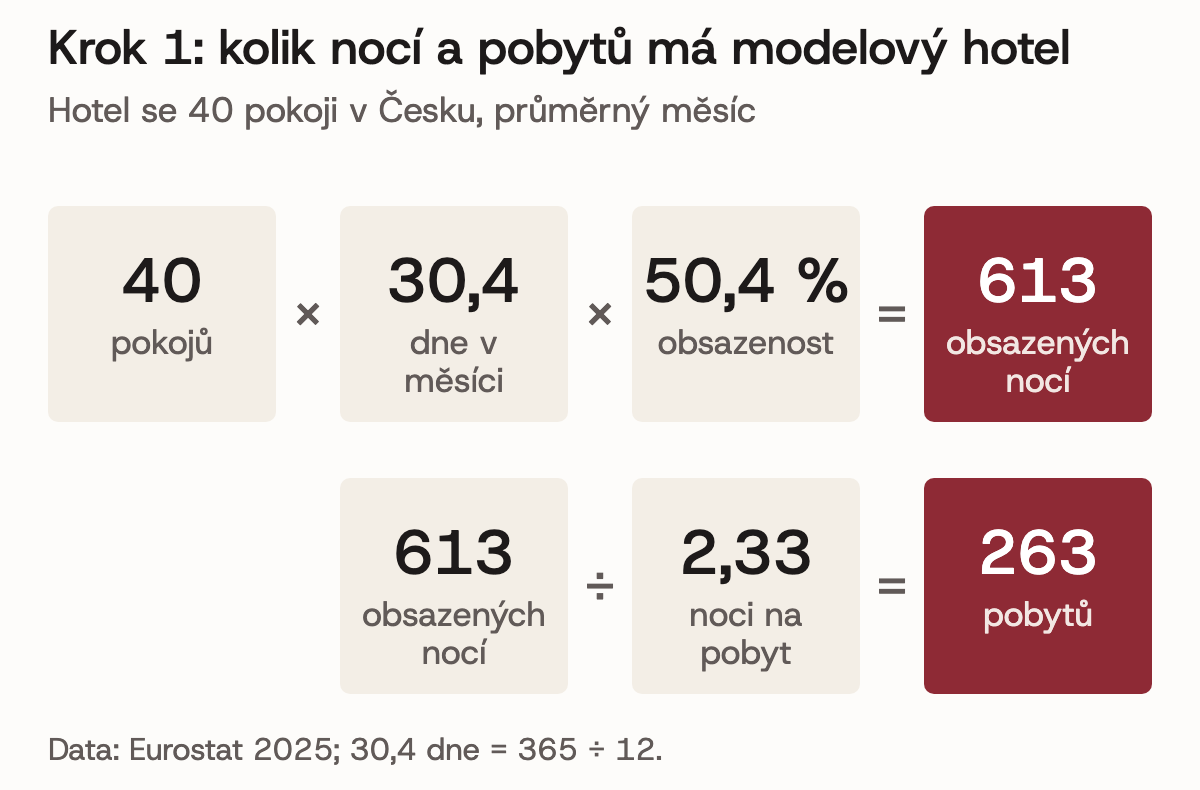
We need nights for drinks and food, because a guest can order them every evening. We need stays for extra services such as late checkout or parking, which a guest buys at most once per stay.
Step 2: drinks, food, extra services
In the second step, we estimate how often a guest orders something and how much they spend. Here we are no longer dealing with measured data but with our own assumptions. There are no independent European data on how much guests order to their rooms. We therefore draw on surveys and vendor data, which we discuss in the methodology of the main article3.
We set the spend amounts in euros at the average EU price level and converted them using the Czech price level for restaurants and hotels and the ECB exchange rate85.
| Assumption | Low | Central | High |
|---|---|---|---|
| Drink or snack: share of occupied nights with an order | 3% | 6% | 12% |
| Spend on drinks and snacks | CZK 108 | CZK 144 | CZK 180 |
| In-room dining: share of occupied nights with an order | 1% | 2% | 5% |
| Spend on food | CZK 217 | CZK 289 | CZK 397 |
| Extra service: share of stays with a purchase | 2% | 4% | 8% |
| Value of the service | CZK 180 | CZK 271 | CZK 361 |
| Margin, i.e. the share of revenue the hotel keeps | 30% | 40% | 50% |
In euros at European prices, this corresponds to a spend of €6, €8 and €10 on drinks, €12, €16 and €22 on food and €10, €15 and €20 on an extra service. In the central scenario, a guest orders a drink during roughly every seventh stay, food about once every 21 stays and an extra service during every twenty-fifth stay3.
In the central scenario, the monthly figures are:
- drinks: 613 nights × 6% = 36.8 orders at CZK 144, i.e. CZK 5,312,
- food: 613 nights × 2% = 12.3 orders at CZK 289, i.e. CZK 3,542,
- extra services: 263 stays × 4% = 10.5 purchases at CZK 271, i.e. CZK 2,850.
Together, this comes to CZK 11,704 in revenue excl. VAT a month, about CZK 293 per room3. We calculate with unrounded values, so the products shown in the text may differ by a few crowns.
Step 3: three scenarios – revenue and profit contribution
We repeated the same procedure for the low and high scenarios.
| Item | Low | Central | High |
|---|---|---|---|
| Drinks and snacks per month | 1,992 | 5,312 | 13,281 |
| In-room dining per month | 1,328 | 3,542 | 12,174 |
| Extra services per month | 950 | 2,850 | 7,600 |
| Missed revenue per month | 4,270 | 11,704 | 33,055 |
| Missed revenue per year | 51,242 | 140,446 | 396,658 |
| Margin | 30% | 40% | 50% |
| Profit contribution per year | 15,373 | 56,179 | 198,329 |
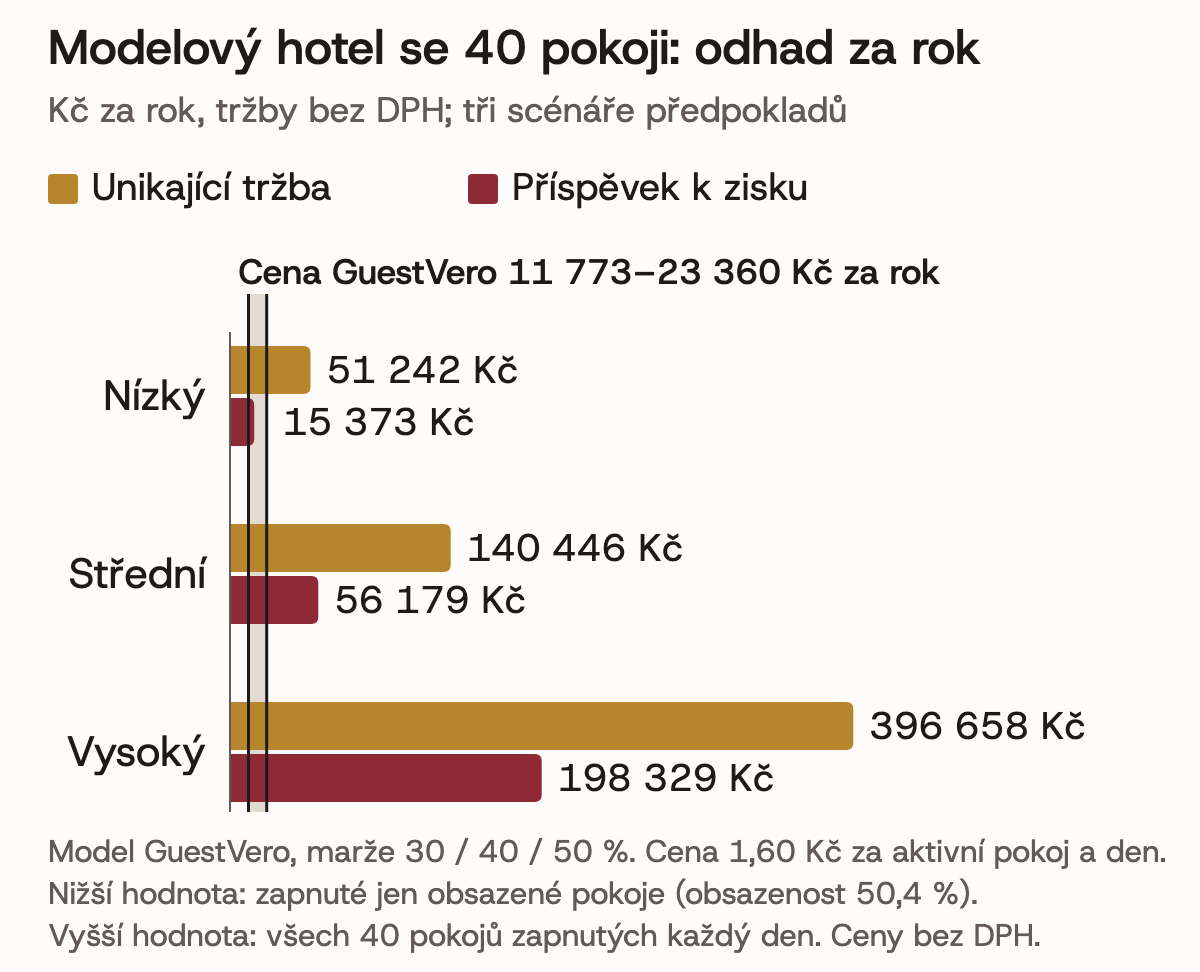
Profit contribution is the part of revenue that the hotel keeps after paying for goods and labour. In the central scenario we assume 40%: goods costing roughly 40% of the selling price and about five minutes of work for the delivery. If every order meant 15 minutes of additional paid work, which costs about €3.6 in Czechia (our calculation from Eurostat data for 2025)9, small orders would not pay off. That is why the low scenario assumes a margin of only 30%.
The model is on the cautious side. It does not include room upgrades, revenue in the restaurant and bar, reception time saved on phone orders or higher spend on orders the hotel already takes today. Nor, however, does it include the one-off work of getting started: preparing the menu, printing the QR codes and training staff.
Are these figures realistic?
There is no independent European comparison, so we can only compare the model with vendor data. According to a report by the tablet vendor SuitePad, which analysed orders in more than 500 hotels, European hotels that already take in-room orders digitally have median room service revenue of €99 per room per year. For the top quarter of hotels, the figure is €25710.
In the central scenario, our model hotel assumes drinks and food worth about CZK 2,656 per room per year, or about €109 (our calculation)5. This places it between the median and the top quarter of the vendor’s sample. However, the sample consists only of hotels that already sell room service digitally, so it tends to be on the optimistic side.
What if the hotel has a different occupancy rate
Missed revenue rises and falls in direct proportion to occupancy. The GuestVero price depends on the number of active rooms, and the hotel switches rooms on and off itself4. If it has all rooms switched on every day, the price does not change with occupancy, so the ratio of contribution to price falls when occupancy is lower. If it switches on only the rooms that will be occupied, the price falls with occupancy too, and in the central scenario the ratio stays at 4.8× at any occupancy rate (our calculation)34. The columns for occupied rooms only show the lower limit of the price: they assume that the hotel switches off every room that stays empty.
| Occupancy | Source of the figure | Missed revenue per year | Profit contribution | Contribution ÷ price, all rooms every day | Price, occupied rooms only | Contribution ÷ price, occupied rooms only |
|---|---|---|---|---|---|---|
| 29.2% | Czech establishments with fewer than 25 rooms | 81,370 | 32,548 | 1.4× | 6,821 | 4.8× |
| 45.9% | Czechia overall | 127,906 | 51,163 | 2.2× | 10,722 | 4.8× |
| 50.4% | Czech establishments with 25–99 rooms | 140,446 | 56,179 | 2.4× | 11,773 | 4.8× |
| 60.2% | Czech establishments with 100–249 rooms | 167,755 | 67,102 | 2.9× | 14,063 | 4.8× |
| 70% | for illustration | 195,064 | 78,026 | 3.3× | 16,352 | 4.8× |
The occupancy rates in the first four rows are Eurostat data for 20252; missed revenue, contribution, the price with only occupied rooms switched on and the ratios are our calculation from the model and the price list34.
Step 4: the GuestVero price and payback
GuestVero costs CZK 1.60 per active room per day. A room is active when the hotel has guest ordering switched on for it; billing is based on active room-days. The hotel switches rooms on and off itself as needed. A room it knows will not be occupied does not have to be switched on, and the hotel does not pay for it. No VAT is charged; the operator is not VAT-registered. GuestVero takes no commission on guest orders. The hotel remains the seller and receives guest payments itself4.
For 40 rooms active every day, this comes to CZK 1,947 in an average month and CZK 23,360 a year (40 × CZK 1.60 × 365 days)4. That is the upper limit. If, at an occupancy rate of 50.4%, the hotel had only occupied rooms switched on, it would pay CZK 981 a month and CZK 11,773 a year, i.e. CZK 1.60 for each occupied night (our calculation)24. That is the lower limit: it assumes that the hotel switches off every room it knows will stay empty. The actual price will most likely lie somewhere between the two figures. You will find a detailed breakdown of the price in our article on the cost of in-room ordering.
| Item | Low | Central | High |
|---|---|---|---|
| Profit contribution | 15,373 | 56,179 | 198,329 |
| GuestVero price, all 40 rooms every day | 23,360 | 23,360 | 23,360 |
| Difference, all rooms every day | −7,987 | 32,819 | 174,969 |
| Contribution ÷ price, all rooms every day | 0.66× | 2.4× | 8.5× |
| GuestVero price, occupied rooms only | 11,773 | 11,773 | 11,773 |
| Difference, occupied rooms only | 3,600 | 44,406 | 186,556 |
| Contribution ÷ price, occupied rooms only | 1.3× | 4.8× | 16.8× |
In the central scenario, after paying for GuestVero the hotel would keep about CZK 33,000 a year if it has all rooms switched on every day, and about CZK 44,000 if it has only occupied rooms switched on (our calculation)34. In the high scenario, the profit contribution is more than eight times the price, even with all rooms switched on every day.
In other words: with all rooms switched on every day, about 34 drinks orders a month cover the price – roughly one a day for the whole hotel. Two drinks for about CZK 144 excl. VAT bring in about CZK 58 at a 40% margin, and the price for the whole hotel is CZK 1,947 a month (our calculation)34. With only occupied rooms switched on, the hotel pays CZK 1.60 per occupied night, and one such order covers the price of about 36 occupied nights (our calculation)34.
We are not hiding the low scenario. Suppose guests ordered a drink on only about one stay in fourteen, the hotel kept only 30% of the revenue and all rooms were switched on every day: the hotel would then make a loss of about CZK 8,000 a year3. If it switched on only occupied rooms, it would keep about CZK 3,600 a year (our calculation)34. That is why the trial with no time limit matters: the hotel sees its own figures, not our assumptions.
Hotel revenue calculation for your property: a table to fill in
A model is only as good as its inputs. You will get the most accurate result by entering your own figures in the table: the number of rooms, occupancy over the last twelve months, the average length of stay and spend based on your own price list. You can adjust the order shares and the margin to reflect your own experience.
| Row | How to calculate | Model hotel | Your hotel |
|---|---|---|---|
| 1 Number of rooms | from your system | 40 | … |
| 2 Occupancy | over the last 12 months | 50.4% | … |
| 3 Occupied nights per month | row 1 × 30.4 × row 2 | 613 | … |
| 4 Average length of stay | from your system | 2.33 nights | … |
| 5 Stays per month | row 3 ÷ row 4 | 263 | … |
| 6 Drinks | row 3 × 6% × spend | CZK 5,312 (spend CZK 144) | … |
| 7 In-room dining | row 3 × 2% × spend | CZK 3,542 (spend CZK 289) | … |
| 8 Extra services | row 5 × 4% × value | CZK 2,850 (value CZK 271) | … |
| 9 Missed revenue per month | row 6 + row 7 + row 8 | CZK 11,704 | … |
| 10 Profit contribution | row 9 × margin | CZK 4,682 (margin 40%) | … |
| 11 GuestVero price, all rooms every day | row 1 × CZK 1.60 × 30.4 | CZK 1,947 | … |
| 12 GuestVero price, occupied rooms only | row 3 × CZK 1.60 | CZK 981 | … |
If you send us your number of rooms and occupancy rate, we will run the model for your hotel. Contact us, or go straight ahead and try GuestVero for free: the trial has no time limit.
And if concerns that guests won’t want to use in-room ordering are holding you back, take a look at the most common objections to hotel digitalisation.
Sources
- European Hotel Distribution Study 2024 (R. Schegg, HES-SO Valais-Wallis)
- Net occupancy rate of bedrooms in hotels and similar accommodation, including by establishment size (tour_occ_anor)
- How much revenue slips away from the average hotel room: the GuestVero model and its assumptions
- GuestVero: pricing and FAQ
- Euro foreign exchange reference rates: Czech koruna (CZK)
- Czechia Hotel & Chains Report 2026 (capacity data from ČSÚ, the Czech Statistical Office)
- Nights spent and arrivals in hotels and similar accommodation (tour_occ_ninat, tour_occ_arnat)
- Price levels: restaurants and hotels (prc_ppp_ind)
- Hourly labour costs in accommodation and food services (lc_lci_lev)
- Room Service Benchmark Report 2026 (vendor data)
Frequently asked questions
Is this a real hotel?
No. It is a model hotel built from average data from Eurostat and the Czech Statistical Office (ČSÚ) and from assumptions about guest behaviour that we state at each step in the article.
How much revenue does a 40-room hotel miss out on?
According to our model, about CZK 140,000 a year in the central scenario (revenue excl. VAT), about CZK 51,000 in the low scenario and about CZK 397,000 in the high scenario. This is an estimate, not a measured figure.
How much of that does the hotel keep?
With an assumed margin of 40%, about CZK 56,000 a year. In the low scenario with a margin of 30%, about CZK 15,000; in the high scenario with a margin of 50%, about CZK 198,000.
How much does GuestVero cost for 40 rooms?
At most just under CZK 2,000 a month (CZK 1,947 in an average month), i.e. CZK 23,360 a year, if the hotel has ordering switched on in all 40 rooms every day. However, the hotel switches rooms on and off itself as needed. A room it knows will not be occupied does not have to be switched on, and the hotel does not pay for it. With only occupied rooms switched on, at an occupancy rate of 50.4% it would pay CZK 981 a month, i.e. CZK 11,773 a year (our calculation). No VAT is charged; the operator is not VAT-registered. GuestVero takes no commission on guest orders.
What if my hotel has lower occupancy?
Missed revenue falls in proportion to occupancy. If the hotel has all rooms switched on every day, the price stays the same, and at an occupancy rate of 29.2% the profit contribution in the central scenario is 1.4 times the price. If it switches on only the rooms that will be occupied, the price falls with occupancy too, and in the central scenario the contribution is 4.8 times the price at any occupancy rate (our calculation). The sensitivity table is in the article.