How much revenue slips away from the average hotel room
A model for the EU and Czechia: how much revenue from drinks, food and services the average hotel room fails to capture. Three scenarios, with all assumptions and sources.
Hotels and similar accommodation in the European Union have 6,225,128 rooms (Eurostat, 2025)1. Every evening, these rooms hold guests who might like something to drink or a light meal, or who would gladly pay for a late checkout. They don’t feel like calling reception, and they don’t want to go to the bar either. The hotel’s ancillary revenue then never materialises, or it ends up with a delivery service or the shop round the corner.
How much could that be? There is no precise measurement: we found no independent European data on revenue from room service or minibars. So we built an open model. It is based on Eurostat data on occupancy, length of stay and prices, and on assumptions about guest behaviour, which we set out in full. The result is an estimate of the ancillary revenue the average room misses out on, in three scenarios: for the EU, for Czechia and for six other countries.
Europe in numbers: 6.2 million rooms and over a billion occupied nights
In 2025, those 6,225,128 rooms belonged to a total of 163,767 hotels, motels, guesthouses and similar establishments1. The average net room occupancy rate was 60.3%, compared with 59.9% a year earlier2. That works out at over a billion occupied room-nights a year (our rough estimate: rooms × 365 days × occupancy)12. The average guest stay lasted 2.43 nights (our calculation from Eurostat data on nights spent and arrivals)3.
European accommodation is also small-scale. In the 18 EU countries that report establishment size, 57.1% of hotels and similar establishments have fewer than 25 rooms and 91.6% fewer than 100 rooms4. Small establishments also have lower occupancy. In 2025, establishments in the EU with fewer than 25 rooms had an occupancy rate of 32.81%, and those with 25 to 99 rooms 56.65%2.
In Czechia, Eurostat counted 7,043 hotels and similar establishments with 154,567 rooms1. They include 4,210 guesthouses5, and 78.8% of establishments have fewer than 25 rooms4. Average room occupancy was therefore only 45.9%, and 50.4% in establishments with 25 to 99 rooms2. Prague hotels in CoStar’s sample, mostly larger ones, reached an occupancy rate of 77.7% in the 12 months to March 20265.
What we mean by ‘missed revenue’ and what we leave out
By missed revenue we mean revenue excluding VAT that the hotel would earn if guests could easily order a drink, food or a small service from their room on their own phone, and that it does not earn today because no such route exists or it is inconvenient: phoning reception, going to the bar. We calculate it per available room, i.e. including nights when the room is empty, per month (30.4 days) and per year. This makes it directly comparable with revenue per available room, a figure hotels track.
The model applies to a room with no working way to order: at most there is a fridge in the room, and room service is available only by phone. A hotel with a stocked minibar or well-run room service already captures part of the demand. For such a hotel, the low scenario is the closer fit.
What we deliberately leave out of missed revenue, which is why the estimate is on the cautious side:
- room upgrades and restaurant and bar revenue;
- staff time saved on phone orders: if each such order took 15 minutes of work, it would cost about €5.2 in the EU and €3.6 in Czechia at average labour costs in accommodation and food services (our calculation from Eurostat data for 2025)6;
- electricity saved by switching off fridges: in an Australian measurement, one fridge used about 197 kWh a year (our conversion)7;
- higher spend on orders the hotel already sells today: the tablet vendor SuitePad reports a 15 to 25% larger basket for digital orders than for phone orders89;
- one-off set-up costs, i.e. preparing the menu, printing QR codes and training staff.
How the model works: occupancy, guest behaviour, prices
The model has three parts, each corresponding to one type of spend:
- A – drinks and snacks: occupied nights × share of nights on which the guest buys something × average spend;
- B – in-room dining: occupied nights × share of nights with a food order × average spend;
- C – extra services, such as an add-on breakfast, late checkout, parking, a transfer or a bottle of wine: number of stays × share of stays with a purchase × average value.
We take three inputs from Eurostat data: room occupancy in 2025, average length of stay and the price level for restaurants and hotels in 20242310. The price level converts spend from the European average to local prices. With the EU average at 100, Czechia stands at 74.1 and Germany at 112.110. The average room in the EU is therefore occupied 18.34 nights a month and hosts 7.55 stays; in Czechia, the figures are 13.96 nights and 5.99 stays (our calculation).
Nobody has independently measured guest behaviour and spend levels in Europe. These values are therefore our assumptions, and for each one we give a low, central and high scenario. In the central scenario, we assume that a guest:
- orders a drink or a snack on roughly every seventh stay (6% of occupied nights) and spends €8 excl. VAT, i.e. about two drinks and a snack;
- has food brought to the room on roughly every twentieth stay (2% of occupied nights) for €16 excl. VAT, i.e. a simple meal with a drink;
- buys an extra service on every twenty-fifth stay (4% of stays) for €15 excl. VAT.
Why these values? The minibar manufacturer Bartech estimates that 33% of guests who have a minibar use it, with an average daily spend of $12 (USA)11. According to a 2007 TripAdvisor survey, a third of travellers never use the minibar12. A cola (0.33 l) in a restaurant costs from €1.64 in Czechia to €3.42 in Austria (user-submitted data on Numbeo, October 2026)13.
For food, European data are thin. In the United Kingdom, according to a survey of 5,000 consumers, half of hotel guests are likely to order a food delivery or eat elsewhere during their stay14, and according to an earlier survey, 66% of British guests have already had food delivered to their room15. The platform Just Eat reports that orders to nine hotels in Spain belonging to the tent chain rose by 60% in a year16. For extra services, the vendor Runnr.ai draws on guest conversations from more than 1,000 European properties: 18% of conversations contain a request for an extra service that the guest raised on their own initiative17.
Even the high scenario stays below Bartech’s estimate: it corresponds to a drinks purchase on roughly 27% of stays. You will find a full overview of the assumptions in the methodology at the end of the article.
Results for the EU: hotel ancillary revenue in three scenarios
According to our model, in the central scenario the average room in the EU may fail to capture €19.20 of revenue excl. VAT a month, or about €230 a year. The low scenario gives €84 a year, the high scenario €651. Per occupied night, the central scenario comes to €1.05.
| € per available room | Low | Central | High |
|---|---|---|---|
| A – drinks and snacks per month | 3.30 | 8.80 | 22.01 |
| B – in-room dining per month | 2.20 | 5.87 | 20.18 |
| C – extra services per month | 1.51 | 4.53 | 12.08 |
| Missed revenue per month | 7.01 | 19.20 | 54.26 |
| Missed revenue per year | 84 | 230 | 651 |
| Missed revenue per occupied night | 0.38 | 1.05 | 2.96 |
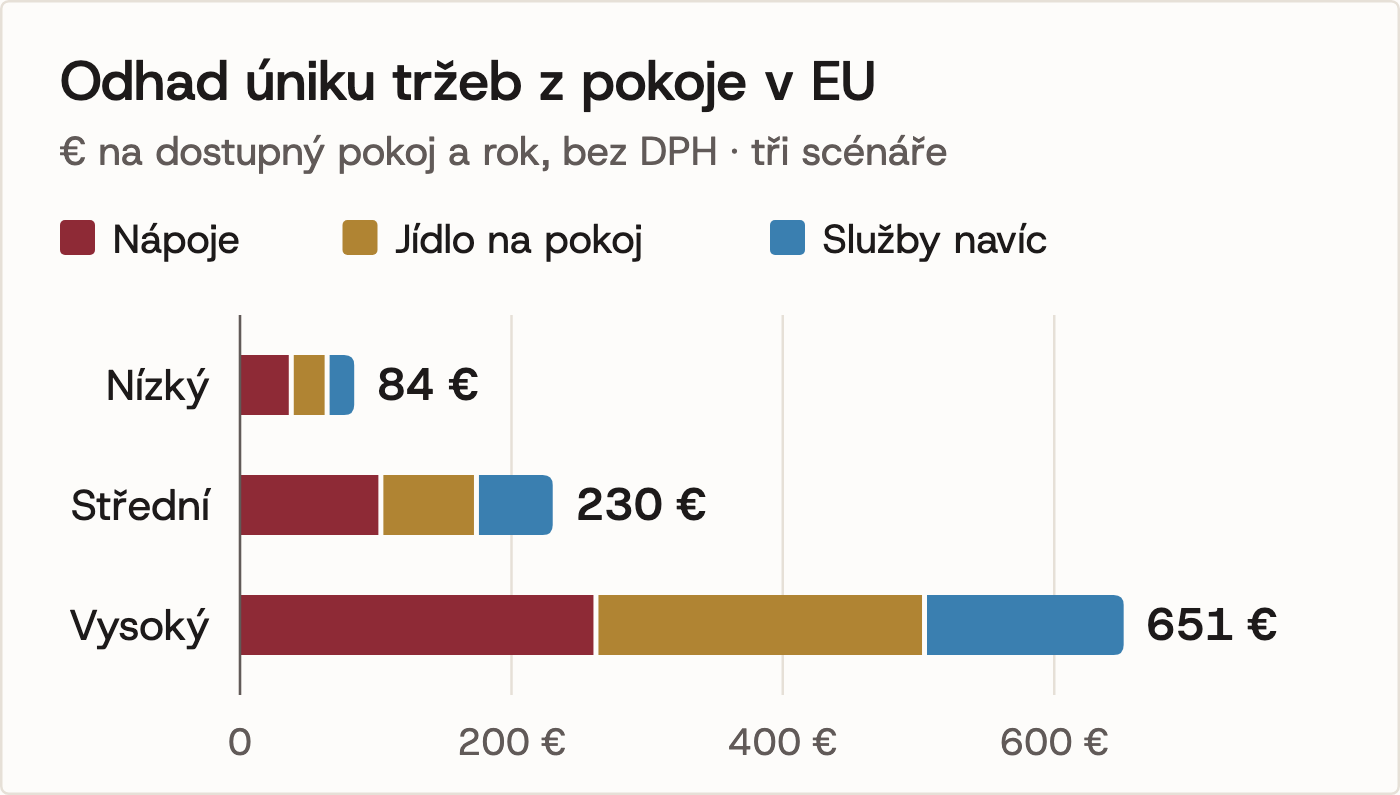
In the central scenario, drinks account for roughly 46% of missed revenue, food for 31% and extra services for 23%.
Is that a lot or a little? There is no independent European comparison, but three available figures point to the same order of magnitude:
- Room service. The tablet vendor SuitePad reports that European hotels already selling room service digitally earn a median of €99 per room per year from it, and the top quartile €2578. Our central scenario for drinks and food combined (€176 a year) lies between these values. SuitePad’s sample, however, consists of its own customers.
- Minibar. According to PKF data for 2010, the minibar earned US hotels $152 per available room per year and $0.60 per occupied room18. For drinks, our model works with €106 a year and €0.48 per occupied night.
- Higher spend. According to a SuitePad case study, the 303-room Steigenberger Icon Frankfurter Hof gained €24,000 a year thanks to 14% higher spend on tablet orders, or about €79 per room (our calculation)19. The model does not include this effect at all.
Czechia and six other countries
The same calculation with local occupancy and price levels gives the following results for seven countries. We know the length of stay from Eurostat data for the EU (2.43 nights) and for Czechia (2.33 nights); for the other countries, we assume the EU average3.
| Country | Occupancy | Price level (EU = 100) | Central scenario, € per year | Scenario range, € per year |
|---|---|---|---|---|
| EU-27 | 60.3% | 100 | 230 | 84–651 |
| Czechia | 45.9% | 74.1 | 131 | 48–371 |
| Germany | 60.38% | 112.1 | 259 | 94–731 |
| Austria | 56% | 110.0 | 235 | 86–665 |
| Italy | 57% | 106.9 | 233 | 85–658 |
| Spain | 69.95% | 83.9 | 224 | 82–634 |
| France | 62.3% | 110.0 | 262 | 96–740 |
| Poland | 51.9% | 91.7 | 182 | 66–514 |
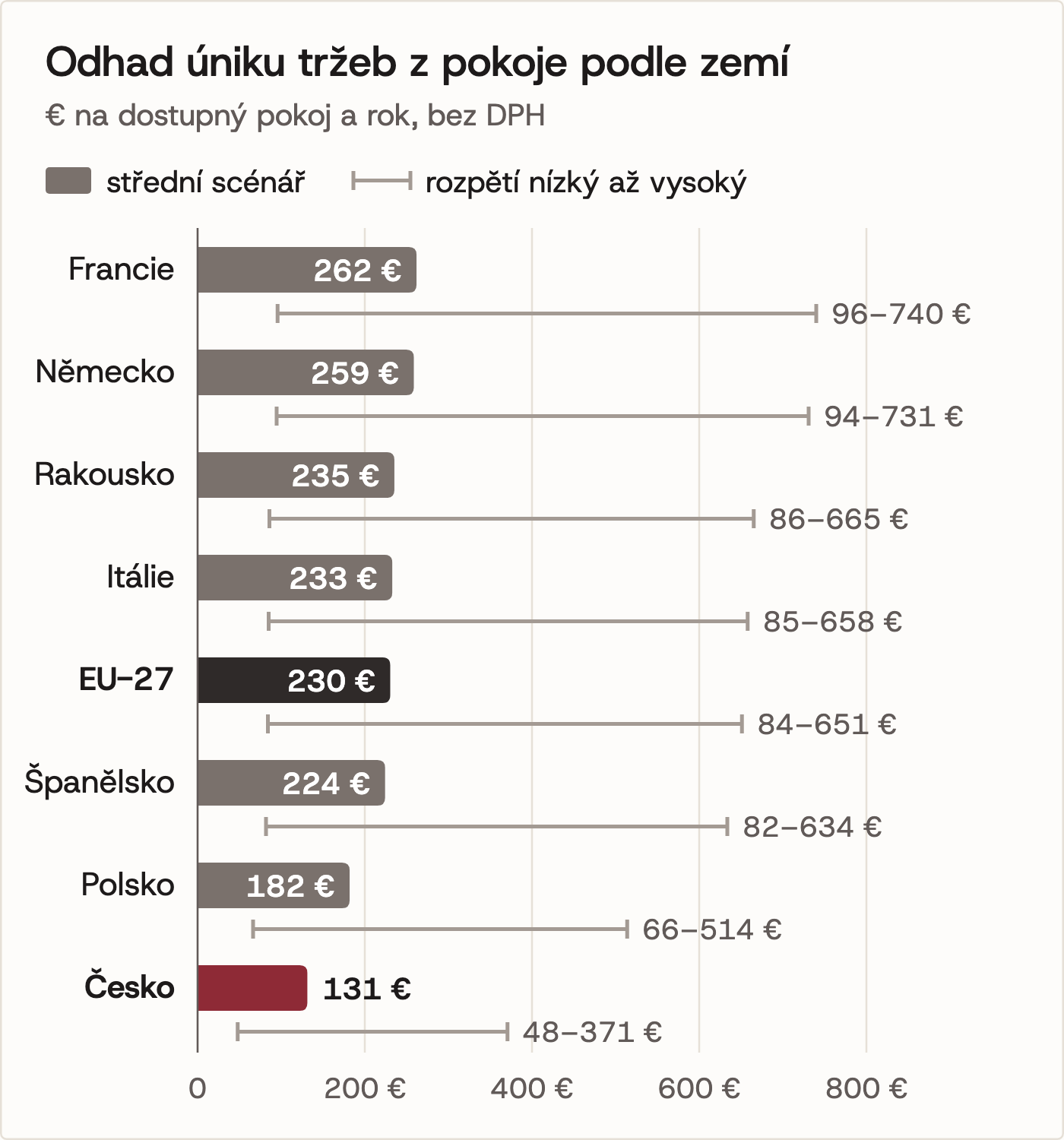
Czechia in koruna: in the central scenario, CZK 266 a month and CZK 3,198 a year per available room; in the low scenario, CZK 97 and CZK 1,167; in the high scenario, CZK 753 and CZK 9,031. We convert at the ECB rate of 14 October 2026 (CZK 24.357 per euro)20.
Why does Czechia come out lowest? Eurostat’s figures for Czech hotels and similar accommodation include 4,210 guesthouses5, and 78.8% of establishments have fewer than 25 rooms4, so average occupancy is only 45.9%2. At the same time, the Czech price level for restaurants and hotels is 74.1% of the EU average10.
Occupancy matters most, because missed revenue rises in direct proportion to it. So a hotel can easily find the row that matches its situation:
| Occupancy | Example | CZK per month | CZK per year |
|---|---|---|---|
| 30% | close to small establishments with under 25 rooms (Czechia 29.2%) | 174 | 2,090 |
| 45.9% | Czechia overall | 266 | 3,198 |
| 50.4% | Czech hotel with 25 to 99 rooms | 293 | 3,511 |
| 60.3% | EU average | 350 | 4,201 |
| 70% | for illustration | 406 | 4,877 |
| 77.7% | Prague, sample of mostly larger hotels | 451 | 5,413 |
For Prague, we use the national price level because we have no regional figure. The result is therefore more likely to be an underestimate.
How much the hotel keeps and what it costs to capture
Revenue is not profit. The hotel keeps only part of what an ordered drink brings in; the rest goes on goods and labour. In the model, we assume the hotel keeps 40% of revenue: 30% in the low scenario and 50% in the high one. We base this on three data points:
- The profit margin of food and beverage departments in US hotels was 29.1% in the first half of 202521. In Spanish hotels, according to HotStats, food and beverage departments had a margin of 21.0% from January to November 202522. Both figures, however, cover the entire restaurant operation, not just a drink brought to the room.
- In 2007, 45% of TripAdvisor respondents said they had paid two to three times the normal price in the minibar1223. With a mark-up like that, the normal price of the goods makes up roughly a third to a half of the minibar price (our estimate).
- If every order meant an extra 15 minutes of paid work, small orders would not pay off. That is why the low scenario uses only 30%.
For the EU average, the hotel therefore keeps €2.10 / €7.68 / €27.13 per room per month (€25 / €92 / €326 a year) in the low, central and high scenarios. In Czechia, it is CZK 29 / 107 / 376 a month, or CZK 350 / 1,279 / 4,516 a year.
What does it cost to capture this missed revenue? GuestVero charges CZK 1.60 per active room per day and takes no commission on guest orders. No VAT is charged; the operator is not VAT-registered. The hotel switches rooms on and off itself as needed. A room it knows will not be occupied does not have to be switched on, and the hotel does not pay for it. We therefore give the price as two limits:
- upper limit, all rooms switched on every day: CZK 48.7 per room per month and CZK 584 a year, or about €2.00 a month and €23.98 a year20;
- lower limit, only occupied rooms switched on: the hotel pays CZK 1.60 per occupied night, which at the Czech occupancy rate of 45.9% means CZK 22.3 per room per month and CZK 268 a year, and at the average EU occupancy rate of 60.3% about €1.20 a month (our calculation)220.
The lower limit assumes that the hotel switches off every room it knows will stay empty. The actual price will therefore usually lie somewhere between the two limits.
| Country | Contribution, central scenario, € per month | Low | Central | High |
|---|---|---|---|---|
| EU-27 | 7.68 | 1.05× | 3.8× | 13.6× |
| Czechia | 4.38 | 0.60× | 2.2× | 7.7× |
| Germany | 8.62 | 1.18× | 4.3× | 15.2× |
| Austria | 7.85 | 1.08× | 3.9× | 13.9× |
| Italy | 7.76 | 1.06× | 3.9× | 13.7× |
| Spain | 7.48 | 1.02× | 3.7× | 13.2× |
| France | 8.73 | 1.20× | 4.4× | 15.4× |
| Poland | 6.06 | 0.83× | 3.0× | 10.7× |
| Country | Low | Central | High |
|---|---|---|---|
| EU-27 | 1.75× | 6.4× | 22.5× |
| Czechia | 1.31× | 4.8× | 16.8× |
| Germany | 1.96× | 7.1× | 25.2× |
| Austria | 1.92× | 7.0× | 24.8× |
| Italy | 1.87× | 6.8× | 24.1× |
| Spain | 1.46× | 5.3× | 18.9× |
| France | 1.92× | 7.0× | 24.8× |
| Poland | 1.60× | 5.8× | 20.6× |
How to read this honestly: with all rooms switched on every day, the profit contribution in the central scenario covers the price 3.8 times for the EU average and 2.2 times in Czechia. In the low scenario, the margin only just covers the price for the EU average (1.05×), and in Czechia and Poland it does not (0.60× and 0.83×). If the hotel switches on only the rooms that will be occupied, it pays only for occupied nights, and the ratio of contribution to price no longer depends on occupancy; the differences between countries then come only from the price level and the length of stay. In the central scenario, the ratio is 6.4× for the EU average and 4.8× in Czechia. Even in the low scenario, the contribution then covers the price for the EU average and in all seven countries, including Czechia and Poland (1.31× and 1.60×, our calculation)220. This lower limit, however, assumes that the hotel switches off every room that stays empty. That is exactly why a trial without a time limit matters: the hotel sees its own figures.
Another way to look at it: how many orders cover the price? With all rooms switched on every day, less than one drinks order per room per month is enough in all seven countries. In Czechia, it is 0.84 orders. Two drinks for about CZK 144 excl. VAT bring in about CZK 58 at a 40% margin, while the price is CZK 48.7 per room per month. If the hotel switches on only occupied rooms and pays CZK 1.60 per occupied night, one such order covers the price of about 36 occupied nights (58 ÷ 1.60, our calculation)1020.
For a typical European hotel from the HOTREC sample, which has a median of 34 rooms24, missed revenue at the average EU occupancy rate comes to €2,861 / €7,834 / €22,139 a year and the profit contribution to €858 / €3,134 / €11,069. GuestVero would cost such a hotel €815 a year with all rooms switched on every day, or €492 a year if it switched on only occupied rooms (our calculation)220. For Czechia, we have a detailed model calculation for a 40-room hotel, and a comparison with other ways of ordering in our article on what in-room ordering costs.
Would you like figures for your hotel? Send your number of rooms and average occupancy to [email protected] and we will run the model with your values.
Where revenue slips away: drinks, food, extra services
Missed revenue has more than one cause. We look at each part of it in detail in a separate article.
Drinks and the minibar
- What star ratings require of the minibar. Under the Hotelstars 2025–2030 criteria, a minibar is mandatory only at five stars; at four stars it is one of three options25. The article shows how much a minibar earns and what a fridge costs.
In-room dining
- Hotel room service. Why hotels are cutting it back: one person on a night shift from 10 pm to 7 am costs the employer about €47,600 a year in Czechia and about €68,700 for the EU average, excluding night-work supplements (our calculation from Eurostat labour costs for 2025)6.
- Delivery platform commissions. When a platform courier delivers the food, Uber Eats takes 30% of every order in ten EU countries, according to its price lists26.
Extra services
- Upselling without pressure. Research by the University of Hamburg found that fast-food customers spent 14% and 16% more at self-service kiosks than at the counter (two studies); the authors attribute this to less social pressure27.
Why guests don’t order
- Why guests don’t call reception. According to a representative Bitkom survey, 36% of Germans have already put off a necessary phone call out of phone anxiety28.
- The language barrier in hotels. In 2025, foreign guests accounted for 53.0% of nights spent in Czech hotels and similar accommodation3, and according to a 2022 survey, 25.3% of adults in the EU aged 25 to 64 speak no foreign language29.
- Ordering with no app and no sign-up. In North America, only 19% of guests downloaded the hotel’s app (J.D. Power, 2017)30.
- Objections to hotel digitalisation. In Czechia, 57.9% of people aged 65 to 74 use the internet on a mobile phone; in the EU, 70.3%31. Older guests, paper menus and concerns about extra work for staff are legitimate questions.
How to capture missed revenue
- In-room ordering via QR code. What an order looks like in the browser on the guest’s phone, with no app and no account, and what staff do when it comes in.
- What in-room ordering costs. What the different ways of ordering cost and why 0% commission changes the calculation.
- Software for small hotels. Who in-room ordering suits, given that in the 18 EU countries that report size, 57.1% of establishments have fewer than 25 rooms4.
- Model calculation for a 40-room hotel. The whole model applied to one Czech hotel, step by step.
- GuestVero FAQ. Active rooms, payments, guest data and the trial.
Methodology, assumptions and sources
The model calculates revenue excl. VAT per available room. The steps are as follows:
- Occupied nights per room per month (N) = 30.4 days × room occupancy rate.
- Stays per room per month (S) = N ÷ average length of stay.
- Country price coefficient (k) = price level for restaurants and hotels ÷ 100.
- Drinks A = N × pA × spend A × k; food B = N × pB × spend B × k; services C = S × pC × value C × k.
- Missed revenue per month = A + B + C; per year = 12 × (A + B + C). Profit contribution = missed revenue × m.
- GuestVero price = CZK 1.60 ÷ 24.357 = €0.0657 per active room per day. Upper limit (all rooms switched on every day) = €0.0657 × 30.4 days per room per month; lower limit (only occupied rooms switched on) = €0.0657 × N. At the lower limit, N cancels out in the ratio of contribution to price, so the ratio does not depend on occupancy.
Data inputs: room occupancy in hotels and similar accommodation in 20252, average length of stay of 2.43 nights in the EU and 2.33 nights in Czechia (the EU average is assumed for the other countries)3, the price level for restaurants and hotels in 202410 and the ECB exchange rate20.
| Parameter | Low | Central | High |
|---|---|---|---|
| pA – share of occupied nights with a drink or snack purchase | 3% | 6% | 12% |
| Spend A | €6 | €8 | €10 |
| pB – share of occupied nights with an in-room dining order | 1% | 2% | 5% |
| Spend B | €12 | €16 | €22 |
| pC – share of stays with an extra service purchase | 2% | 4% | 8% |
| Value C | €10 | €15 | €20 |
| m – share of revenue the hotel keeps | 30% | 40% | 50% |
The evidence for each assumption is set out above, block by block. For extra services, we add two comparisons. In September 2023, the Mews platform reported that room upgrades during online check-in brought in an average of €30 per upgraded booking32; an upgrade, however, costs more than a small service, which is why we leave it out of the model. In the United Kingdom, the Mercure chain charges £10 for each hour of early check-in33.
Points to bear in mind:
- Occupancy. Eurostat’s category of hotels and similar accommodation also includes small establishments and guesthouses, so its occupancy rate is lower than that of hotel panels, which mainly track larger hotels. For small and medium-sized hotels, this is the right basis.
- A model is not a measurement. Occupancy, length of stay and prices are data; guest behaviour and spend are assumptions. That is why we give three scenarios rather than a single figure.
- Figures on different bases cannot be combined. We calculate missed revenue per available room; figures per occupied room or per booking are always labelled as such in the text.
- Timeliness. We checked the data on 15 October 2026. Eurostat may revise its figures for 2025, and the koruna exchange rate changes; we recalculate the article before each update.
Sources
- Number of establishments, bedrooms and bed-places (tour_cap_nat), hotels and similar accommodation, 2025
- Net occupancy rate of bed-places and bedrooms (tour_occ_anor), 2025
- Nights spent and arrivals at tourist accommodation (tour_occ_ninat, tour_occ_arnat), 2025
- Establishments by size class (tour_cap_nats), 2025
- Czechia Hotel & Chains Report 2026
- Labour cost levels by NACE Rev. 2 activity (lc_lci_lev), accommodation and food services, 2025
- Does every hotel room need a minifridge? (Dolnicar et al.), Annals of Tourism Research Empirical Insights 5(2); measured values from Pandey et al., arXiv 2608.17467
- Room Service Benchmark Report 2026
- Club Sandwich bleibt der Bestseller beim Hotel-Room-Service
- Purchasing power parities and price level indices (prc_ppp_ind), restaurants and hotels, 2024
- Why Americans fell out of love with the hotel minibar (D. Geeter, CNBC)
- Travelers Steer Clear of Hotel Mini Bar
- Price of a 0.33 l cola in a restaurant by country (user data for the last 12 months)
- Half of hotel guests prefer to order takeaway or eat elsewhere, research shows
- Food deliveries replace hotel room service
- Just Eat and hotels in Mallorca (Europa Press)
- 2026 Guest Trends and Preferences in European Hospitality
- Mini-Bar, Maxi-Profits (L. Mogelonsky, with PKF Trends data)
- Steigenberger Icon Frankfurter Hof case study
- Euro reference exchange rate against the koruna (EUR/CZK), 14 October 2026
- Hotel Food and Beverage: A Bright Spot in 2025 (R. Mandelbaum, A. Grigg)
- Revenue steady as costs shape margins across Europe: Spain (HotStats)
- Mini Bars, Big Prices, Say Travellers
- European Hotel Distribution Study 2024 (R. Schegg, HES-SO Valais-Wallis)
- Classification criteria 2025–2030, criteria 184 to 186 and note 36, p. 16
- Price list for merchant partners (Germany, Austria, the Netherlands, Belgium, Spain, Portugal, Poland, Ireland, Sweden, Denmark)
- Self-service kiosks: customers spend more (Gedenk, Widdecke, Otten)
- Angst vorm Telefonieren: Anrufe werden aufgeschoben
- Adult Education Survey 2022: number of foreign languages people know (edat_aes_l21)
- 2017 North America Hotel Guest Satisfaction Index Study
- Internet use on a mobile phone (isoc_ci_dev_i), 2025
- Hoteliers bring in an additional 25k over the summer by upselling
- Cashing inn: major hotel chains cash in by minimising guest time in rooms
Frequently asked questions
How much revenue slips away from a single hotel room?
According to our model, it is €19.20 a month for the EU average and CZK 266 in Czechia in the central scenario, in each case as revenue excl. VAT per available room. The low scenario gives just over a third of this amount, the high scenario almost three times as much.
Why does Czechia come out lower than Germany?
Because of lower room occupancy (45.9% against 60.38% in 2025) and a lower price level for restaurants and hotels (74.1 against 112.1, EU = 100). Both are Eurostat data.
Is this a measurement or an estimate?
An estimate. Occupancy, length of stay and the price level are Eurostat data. Guest behaviour and spend levels are our assumptions, which we set out in the methodology, including the low and high scenarios.
What do you leave out of missed revenue?
Room upgrades, restaurant and bar revenue, savings in staff time and electricity, and higher spend on orders the hotel already sells today. The estimate is therefore on the cautious side.
How many orders cover GuestVero’s price?
The hotel switches rooms on and off itself as needed. A room it knows will not be occupied does not have to be switched on, and the hotel does not pay for it. If the hotel has all rooms switched on every day, less than one drinks order per room per month is enough in all seven countries in the model; in Czechia, 0.84 orders at an assumed margin of 40%. If it switches on only occupied rooms, it pays CZK 1.60 per occupied night, and by our calculation one order of two drinks with a margin of about CZK 58 covers the price of about 36 occupied nights.