The hotel minibar: required by star rating, or an unnecessary cost?
When the Hotelstars 2025–2030 criteria make a minibar mandatory, how much it earns, what a fridge costs and what can replace it. An overview for hotels in the EU.
The minibar is such a natural part of a hotel room that it is rarely thought about in operational terms. The European Union has 163,767 hotels and similar accommodation establishments with 6,225,128 rooms (Eurostat, 2025)1. How many of them have a minibar or a fridge, however, is not tracked by Eurostat, the Czech Statistical Office (ČSÚ) or hotel associations; we found no such figure. The classification rules give an indirect indication: it is mainly the star rating that requires a minibar or a substitute for it.
This overview summarises what exactly the Hotelstars 2025–2030 criteria say, which Czech hotels the requirement applies to, what we know about minibar revenue and the electricity consumption of fridges, and what can replace the minibar under the new rules. The minibar is, however, only one of the places where a hotel loses drinks revenue. For the full picture, including food and extra services, see our calculation of how much revenue slips away from a hotel room.
The minibar in Europe: a star-rating requirement in 16 EU countries
The common Hotelstars Union classification rules are used by 16 EU member states: Austria, Belgium, Czechia, Denmark, Estonia, Germany, Greece, Hungary, Latvia, Lithuania, Luxembourg, Malta, the Netherlands, Poland, Slovenia and Sweden. Outside the EU, they are joined by Switzerland, Liechtenstein, Georgia and Azerbaijan2. In Czechia, certification is voluntary.
New criteria for the 2025–2030 period have applied since 1 January 20253. According to the Austrian Federal Economic Chamber (WKO), the number of criteria fell from 247 to 239, and the requirements for reception opening hours, for room service and for restaurant opening hours were eased4.
Other EU countries have their own national or regional systems, among them France, Italy, Spain, Portugal, Croatia and Slovakia2. The French Atout France classification table lists the minibar as a separate criterion (no. 87): it must be clean and in working order and offer at least three kinds of drinks and three kinds of food, with the payment method stated5. In the Italian region of Lazio, which includes Rome, a fridge with drinks (frigobar) is mandatory only for four- and five-star hotels6.
In Germany, according to the trade magazine HOGAPAGE, a minibar was mandatory at both four and five stars until 2015. From 1 January 2015, at four stars it could be replaced by a drinks vending machine or by room service available at least 16 hours a day; previously, this required a round-the-clock service. At five stars, the minibar remained mandatory7.
What exactly the Hotelstars criteria require for three, four and five stars
The Hotelstars catalogue covers drinks in the room in six items, numbered 182 to 187. Each has a points value and is mandatory for some categories3.
| Catalogue item | Points | 3★ | 4★ | 5★ |
|---|---|---|---|---|
| 182 Drinks offer in the room | 3 | mandatory | mandatory | mandatory |
| 183 In-room fridge | 3 | – | – | – |
| 184 Minibar with drinks and snacks | 5 | – | one of three | mandatory |
| 185 Maxibar or 24-hour self-service shop | 3 | – | one of three | – |
| 186 Drinks via room service 12 hours a day | 10 | – | one of three | – |
| 187 Drinks via room service 24 hours a day | 15 | – | – | mandatory |
In other words, a three-star hotel must offer guests some drinks in the room, but it does not need a fridge or a minibar. A four-star hotel can choose between three routes. It can have a minibar, a maxibar or a self-service shop open 24 hours, or bring drinks via room service at least 12 hours a day. A five-star hotel needs a minibar and also drinks via room service 24 hours a day3.
The requirements for food are graded in a similar way. Food via room service is mandatory 12 hours a day at four stars (criterion 200) and 24 hours a day at five stars (criterion 201). Five stars also require a room service breakfast menu (criterion 197). According to a note in the catalogue, the hours can be split across the main operating times. Garni hotels, which serve only breakfast, are exempt from criterion 200 and cannot obtain five stars3.
Czechia: which hotels the requirement applies to
Eurostat counts 7,043 hotels and similar accommodation establishments in Czechia. According to Czech Statistical Office data processed by the consultancy Horwath HTL, 2,833 of them are hotels and garni hotels and 4,210 are guesthouses8. In the ČSÚ data, the category is reported by the establishments themselves.
| Category | Hotels | Rooms | Drinks in the room under Hotelstars |
|---|---|---|---|
| 5★ | 77 | 9,092 | minibar and drinks via room service 24 hours a day |
| 4★ | 857 | 48,163 | minibar, maxibar or drinks via room service 12 hours a day |
| 3★ | 1,475 | 44,940 | drinks offer in the room |
| 2★ | 179 | 4,382 | not required |
| 1★ | 89 | 1,757 | not required |
| Garni hotel | 156 | 3,796 | depending on the category awarded, four stars at most |
In total, 934 hotels with 57,255 rooms have four or five stars. That is 51% of rooms in hotels and garni hotels and 37% of all rooms in hotels and guesthouses (our calculation from ČSÚ data)8. It is precisely in these hotels that the Hotelstars criteria require a minibar or a substitute for it, and room service 12 or 24 hours a day.
In Prague, the share is higher. In 2023, four- and five-star hotels had 25,938 rooms, or 58.7% of all rooms in collective accommodation establishments in the capital (our calculation from ČSÚ data)9.
One caveat: the category is reported by the establishment itself, and Hotelstars certification is voluntary in Czechia. So not every hotel that reports four stars in the statistics is certified and inspected. For the 1,475 three-star hotels with 44,940 rooms, a less strict rule applies: a drinks offer in the room is enough83.
How much a hotel minibar earns and what a fridge costs
We found no independent European figure for minibar revenue. The most reliable numbers come from the US. According to a 2025 CBRE study covering 2,669 full-service hotels, resorts and convention hotels in the US, minibars accounted for just 0.2% of food and beverage department revenue. This was despite the fact that between 2024 and 2025 they grew faster, in percentage terms, than any other item10.
Older data from the consultancy PKF for 2010 shows the same order of magnitude. The minibar brought US hotels an average of $152 per available room per year, 60 cents per occupied room and 0.24% of total hotel revenue11. In the same article, a supplier of minibar systems advised hotels with revenue at that level that they would be better off without minibars11.
On the other side are the costs. According to supplier estimates, manual checking and restocking keeps one employee busy for roughly every 100 to 130 rooms1112. The minibar manufacturer Dometic states that, in German conditions, a minibar pays off from roughly three drinks sold per room per month, depending on the hotel’s cost structure; hoteliers’ biggest concern is stock losses7. According to CBRE, US hotels have often removed minibars from their rooms and replaced them with small fridges that guests use themselves13.
A fridge has a cost too. An Australian study measured 19 fridges in four hotels over four months. They used an average of 539.83 Wh a day, or about 197 kWh a year (our conversion), and consumption did not depend on how often guests opened them1415. Most of the time, a fridge was opened only once a day, which corresponds to the check during housekeeping15. What this costs you depends on the electricity price at your hotel: simply multiply 197 kWh by the price per kilowatt hour and by the number of rooms with a fridge.
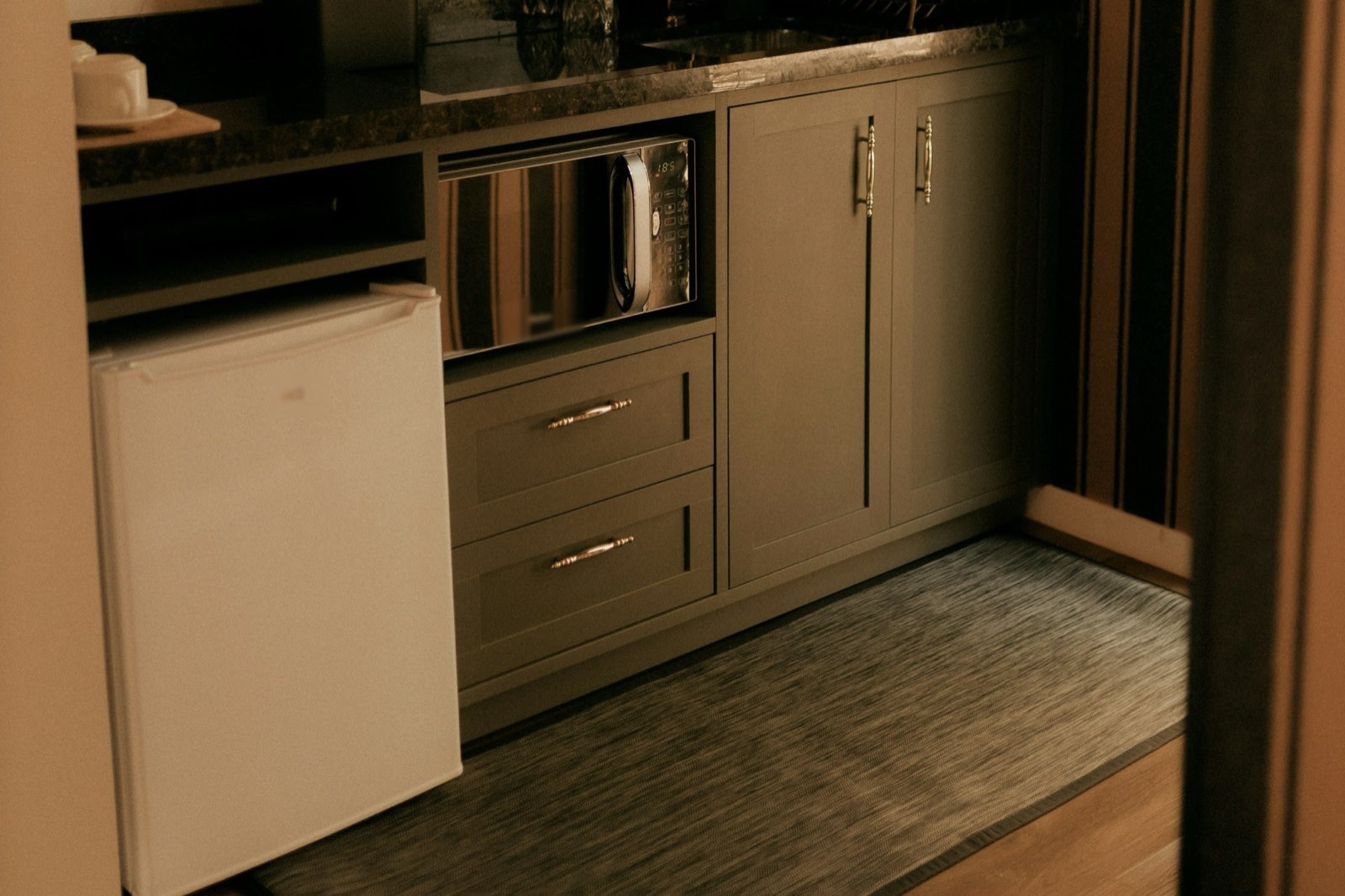
What guests actually do with the minibar and the fridge
Guest surveys mainly reveal distrust of prices. In a 2007 TripAdvisor survey of more than 1,600 travellers from around the world, 86% of respondents said minibar prices were too high. Another 45% said they had paid two to three times the normal price. A third never use the minibar; when guests do buy something, it is most often bottled water (52%) and nuts (17%)1617. A quarter of respondents had already argued with a hotel over a minibar bill16.
More recent surveys say the same. In a 2015 poll by GO Group, more than 70% of travellers said they never use the minibar, and just under 4% said they always do18.
In 2025, the minibar manufacturer Dometic surveyed 1,018 Americans and 1,021 Germans. For 40% of them, an empty fridge in the room matters when choosing a hotel (in 2019 the figure was 26%), and 73% would prefer minibar drinks to be included in the room rate. Germans would rather report what they have consumed to staff themselves (61%) than have it billed by a sensor, and 65% of them want a price list1920. This is a survey by a company that makes minibars.
A figure from the Netherlands dates from June 2026. More than three quarters of Dutch hotel guests would rather pay a lower room rate than pay for amenities they hardly use, and two thirds of men consider the minibar completely unimportant. The survey of 1,000 adults was commissioned by the budget chain easyHotel21.
And the fridge? In an Australian survey of 400 respondents, only 60% of guests who had one in their room used it15. Using the fridge does not mean buying anything, though; it may simply hold the guest’s own shopping.
The surveys suggest that guests reject the minibar less because of the drinks and more because of the prices and uncertainty over billing. In the TripAdvisor survey, 94% of respondents said they would use the minibar more often if prices were reasonable1617. This is, however, a stated intention, not measured behaviour.
What can replace the minibar under the 2025 rules
The new criteria give four-star hotels three equivalent routes: a minibar, a maxibar or a self-service shop open 24 hours, or drinks via room service at least 12 hours a day3. According to WKO, since 2025 a self-service kiosk can also replace the minibar, maxibar or room service at four stars4. According to the catalogue, this concerns only the drinks requirement (items 184 to 186): a kiosk can stand in for the minibar, but it does not replace food via room service (criterion 200)3.
The minimum room service hours that can stand in for a minibar at four stars have thus been gradually shortened: from 24 hours before 2015 to 16 hours, and to 12 hours since 2025 (our summary based on HOGAPAGE and the Hotelstars catalogue)73. How to run room service with shorter hours and what it costs is covered in our article on hotel room service.
France takes a different approach. For criterion 198, a tray of food or snacks to the room, it explicitly accepts external delivery services as well5.
The Hotelstars criteria also allow for digital formats. The bilingual guest information directory can be printed or digital and is mandatory from three stars upwards (criterion 132); the bar’s drinks menu can be digital too3. The Hotelstars 2025–2030 criteria set out what room service must offer and for how long (at four stars, food 12 hours a day; at five, 24 hours), but they do not say how the guest should order; there is no mention of a phone, tablet, app or QR code in connection with room service323. The supplementary methodology of the Association of Hotels and Restaurants of the Czech Republic (AHR ČR) defines room service as follows: ‘Room Service – floor service – a service delivering à la carte food and drinks to the room’24. Ordering via QR code with delivery to the room by hotel staff does not contradict this wording. However, no classification body has explicitly confirmed that ordering via QR code with delivery by hotel staff meets the requirement, and the decision to award stars rests with the classification committee. Before a hotel bases its classification on this, it should check it in writing with the national body, which in Czechia is AHR ČR (Hotelstars.cz).
A QR code does not, however, replace other requirements. According to the interpretation of the Austrian WKO, the mandatory drinks offer in the room (criterion 182) can be met even by an unchilled bottle of water25; neither the criteria nor the interpretation suggest that a drinks menu on the guest’s phone would replace it. At five stars, a minibar remains mandatory (criterion 184)3. Equipment for internal and external communication, such as a telephone or tablet, must be available on request at three and four stars (criterion 127)23 and directly in the room at five stars (criterion 128)3. According to the WKO interpretation, it must have a telephone function; the interpretation refers to the hotel’s devices and does not mention the guest’s own phone25.
The move away from minibars is not new. As early as January 2014, the US broadcaster ABC News reported that Marriott was gradually phasing out minibars and that Hilton and Hyatt were doing something similar. In the TripAdvisor survey cited in the article, only 21% of participants said it mattered to them whether there was a minibar in the room22.
What this means for your hotel
In Europe, the minibar is mainly a question of star rating. It contributes little to revenue, and running it costs both labour and electricity. Four questions are enough to make the decision:
- What does your category require? At three stars, a drinks offer in the room is enough; at four, you choose between a minibar, a maxibar and drinks via room service; at five, a minibar is mandatory3.
- What does the minibar cost you? Factor in the labour for checking and restocking, stock losses, disputes at checkout and the electricity for fridges that keep running even when they are empty.
- What do your guests want? Surveys repeatedly show resistance to high prices, and interest in an empty fridge for guests’ own things and in prices known in advance161920.
- Where will guests actually buy a drink? At the bar, in the lobby, or from their room on their own phone.
For the last option, there is a simple route: the guest scans the QR code in the room and orders in their phone’s browser, with no app and no sign-up. We describe how this works in day-to-day operation in our article on in-room ordering via QR code. GuestVero, for example, offers such a service for CZK 1.60 per active room per day, with no commission on orders; the hotel remains the seller.
Work out how much revenue slips away from your hotel’s rooms. Our model for the EU and Czechia sets out three scenarios and all the assumptions it is based on.
We checked the data in this article on 15 October 2026.
Sources
- Number of establishments, bedrooms and bed-places (tour_cap_nat), hotels and similar accommodation, 2025
- Hotelstars Union: Criteria and member countries
- Classification criteria 2025–2030 (nos. 127–132 on p. 12, nos. 182–187 and 197 on pp. 15–16, nos. 200–201 on p. 17)
- Neue Kriterien für die Hotelklassifizierung
- Guide 2022 du tableau de classement en hôtels de tourisme
- Regolamento regionale 22/2014, allegati A1–A6
- Mini oder Maxi? (M. Eichhammer)
- Czechia Hotel & Chains Report 2026 (capacity data from ČSÚ, the Czech Statistical Office, 2018–2025)
- Cestovní ruch v Praze 2023, table Kapacity HUZ
- Hotel Food and Beverage: A Bright Spot in 2025 (R. Mandelbaum, A. Grigg)
- Mini-Bar, Maxi-Profits (L. Mogelonsky, with PKF Trends data)
- B. Agrario (Bartech): comment on automated minibars
- R. Mandelbaum, E. Stacy (CBRE): US hotel food and beverage revenue and costs for 2022
- Does every hotel room need a minifridge? (Dolnicar, Greene, Layeghy, Portmann), Annals of Tourism Research Empirical Insights 5(2)
- LoRIS (Pandey et al.), arXiv 2608.17467, pp. 34–35
- Mini Bars, Big Prices, Say Travellers
- Travelers Steer Clear of Hotel Mini Bar
- 70 percent of travellers never use hotel minibars: survey
- Here’s what guests expect from hotel minibars, reveals Dometic’s 2025 study
- Hotel minibar: top features (Dometic survey, 2025)
- Research: three quarters of Dutch people trade luxury hotel amenities for a lower room price
- Minibar no more: hotels phase out the ol’ boozy guest room staple
- Kritéria 2025–2030 (no. 127 on p. 12, nos. 186–187 on p. 16, nos. 200–201 on p. 17)
- Doplňující metodika 2025–2030, p. 5 (the term Room Service)
- Explanations on how to apply the Criteria of the Austrian Classification System 2025–2030, nos. 88, 89 and 105 (pp. 11–12)
Frequently asked questions
Does a four-star hotel have to have a minibar?
Under the Hotelstars 2025–2030 criteria, not necessarily. A maxibar or a self-service shop open 24 hours, or drinks via room service 12 hours a day, is enough. According to the Austrian Federal Economic Chamber (WKO), a self-service kiosk can also replace the minibar at four stars.
Is an in-room fridge mandatory?
No. From three stars upwards, a ‘drinks offer in the room’ is mandatory; under the Hotelstars criteria, a fridge on its own is optional in all categories.
How much electricity does a fridge in a hotel room use?
When 19 fridges were measured in four Australian hotels, they used an average of almost 540 Wh a day, or about 197 kWh a year, regardless of how often the guest opened them.
Does a minibar pay off?
There is no independent European data. In US hotels, minibars account for 0.2% of food and beverage revenue (CBRE, 2025). The minibar manufacturer Dometic states that a minibar pays off from roughly three drinks sold per room per month.
Do the Hotelstars criteria apply in Czechia?
Yes. Czechia is one of the 16 EU countries that use the Hotelstars Union system. Certification is voluntary in Czechia.