In-room ordering via QR code: how it works in practice
The guest scans a QR code and orders on their own phone with no app or account; staff see the order on an order board. How it works, what to prepare and where the limits are.

In 2025, 89.9% of people aged 16 to 74 in the European Union used the internet on their mobile phone; in Czechia, the figure was 90.0%.1 So almost every guest has a phone with them and knows how to use it to search, write and shop. This is what in-room ordering via QR code is built on: the guest scans the code in the room, opens the hotel’s offer on their own phone and orders a drink, food or a service. They need no app or account and do not have to call reception.
This article describes what the process looks like in everyday operation: what the guest does, what staff see, what the hotel has to prepare and where the limits are. Why this matters, and how much revenue hotels miss out on without an easy way to order, is covered in the main article of this series: how much revenue slips away from a hotel room.
How guests in Europe order today, and why on their phones
Mobile internet is taken for granted across the EU, and the differences between countries are small. According to Eurostat, in 2025 it was used by 87.4% of people in Germany, 91.8% in Austria, 87.2% in Italy, 95.3% in Spain, 89.4% in France and 87.3% in Poland.1 So guests bring the device they can order with themselves. The hotel does not have to lend, charge or install anything.
Payment is changing with the phone too. The European Central Bank reports that in the second half of 2025, 85% of card payments in shops in the euro area were contactless.2 Czechia is not in the euro area, and we have no comparable figure for Czechia. For guests from the euro area, however, cashless and contactless payment is a normal part of the day.
A phone call to reception, by contrast, is a step that many guests put off. The guest has to find out what the hotel offers in the first place, call and make themselves understood, often late in the evening and in a foreign language. We describe why this is and what guests do instead in our article on why guests don’t call reception. A written order on the phone removes this barrier: the guest can browse the offer at leisure and order when it suits them.
Step by step: an in-room order via QR code
The whole process has four steps. All the guest needs is their own phone with a camera and an internet connection.
- The guest scans the QR code. The code is in the room, for example on the bedside table or by the kettle. Each room has its own code, so the order carries the room number and staff know where to take it.
- The hotel’s offer opens. It appears in the phone’s browser, with no download and no sign-up. The hotel includes whatever it can provide: drinks and snacks, in-room breakfast, meals, late checkout, parking or wellness.
- The guest chooses and orders. They select the items, the delivery time and a payment method from the options the hotel has enabled.
- Staff handle the order. They accept it, prepare it, deliver it to the room and update its status as they go.
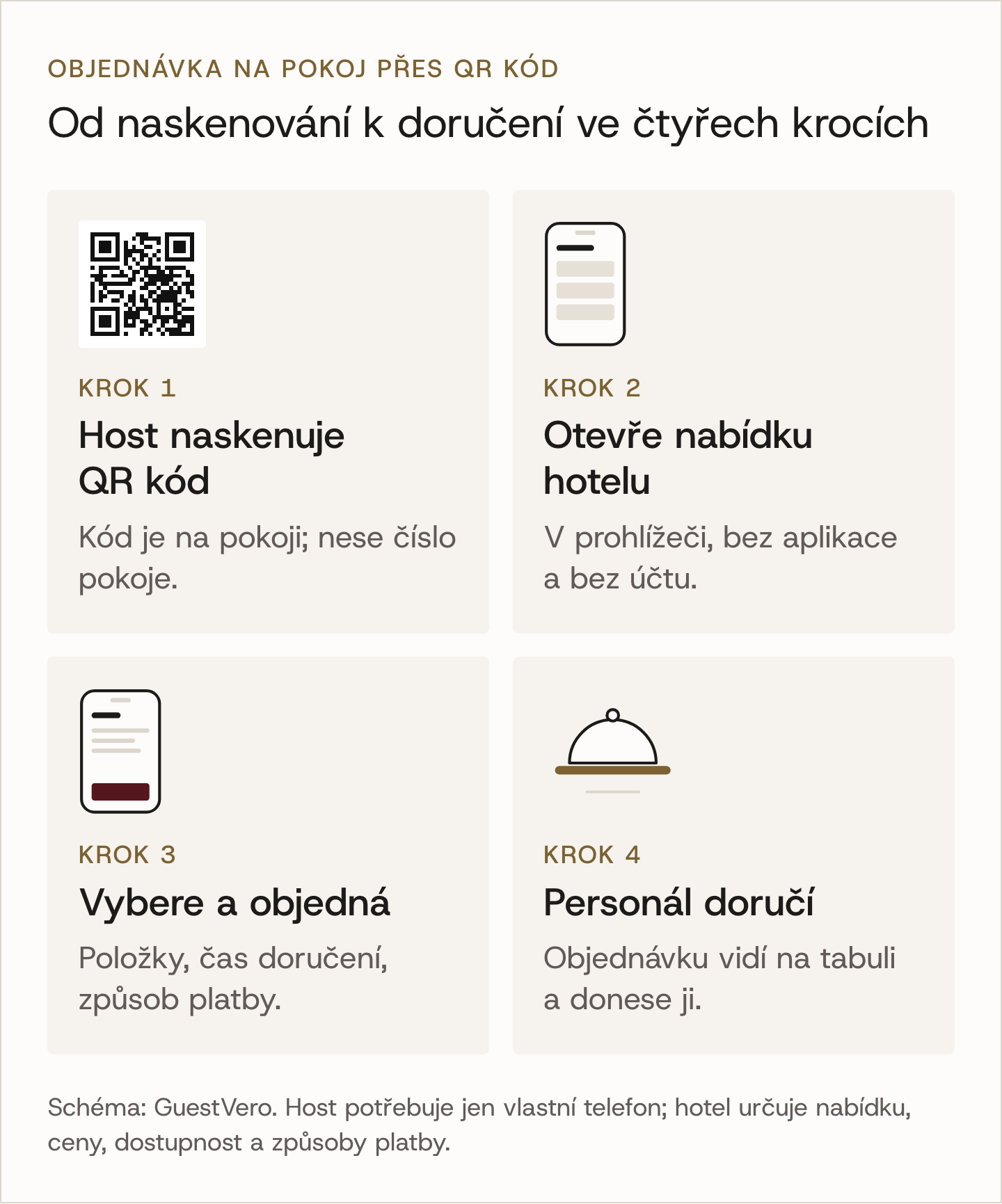
GuestVero, the ordering software behind this series of articles, works in the same way: the guest orders in the browser with no app and no account, and the hotel sets its own offer, prices, availability and payment methods.3 For the guest, it is much like shopping online. The only difference is that hotel staff carry the goods upstairs.
What staff see: the New – Preparing – Delivered board
On the hotel’s side, orders arrive on a simple order board with three columns: New, Preparing and Delivered. A new order appears in the first column. Whoever takes it moves it to Preparing and, once it has been delivered to the room, marks it as Delivered. Everyone on the shift can see what is waiting, what is being worked on and what is done.
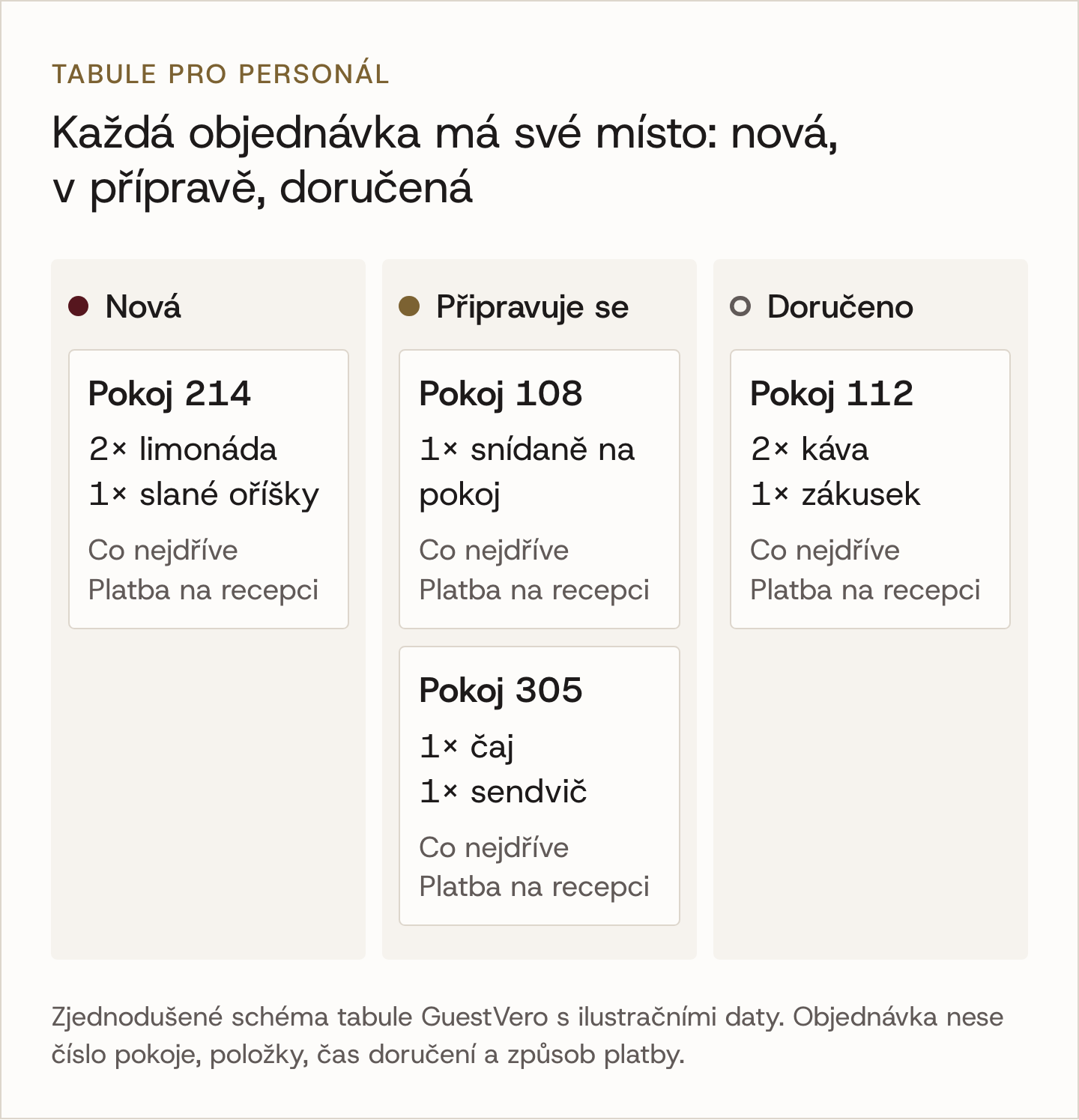
Each order includes the room number, the items ordered, the requested delivery time and the chosen payment method.3 There is no more copying orders from the phone onto paper or tracking down who promised what to whom. The order is in writing from the start, so it can be checked calmly even when there is a queue at reception.
By comparison, a phone order has to be taken by the receptionist, written down, passed on to the bar or kitchen and followed up to make sure it has gone out. If the receptionist is busy checking in an arrival, the guest waits on the line or tries again later, and perhaps not at all. A written order on the board waits until someone takes it, and in the meantime the guest does not have to repeat or spell anything.
The roles are separate. The hotel administrator sets the offer, prices and availability, and staff take care of the orders. The hotel decides which device the board will be open on, who monitors it at which times and who delivers the orders. It is worth thinking about this before you put the first QR code in a room.
Under the hotel’s brand: the hotel remains the seller
The guest orders from the hotel, not from an intermediary. The offer carries the hotel’s logo, colours and range, so it feels like a natural part of the stay rather than a third-party service inserted between the guest and the hotel.3
The commercial side matters even more. The hotel remains the seller: it sets the offer and prices itself, receives guest payments and is responsible for delivery. GuestVero only provides the ordering software; it takes no commission on guest orders and does not receive the money paid for them.3 This is the key difference from delivery platforms, which take a share of every order. The revenue from the hotel’s own offer therefore stays with the hotel in full, including the margin.
The guest does not create an account or install anything. Why this is more convenient for guests and what it means for their privacy is covered in our article on ordering with no app and no sign-up.
What the data on digital orders shows (and what it doesn’t)
Independent European data on how much digital in-room ordering brings hotels is still lacking. Most of the figures are published by technology vendors. They are worth knowing, but should be read with caution.
The hotel tablet vendor SuitePad analysed more than 200,000 digital room service orders from over 500 hotels that use its system, covering the period from early 2024 to early 2026.45 According to its data, digital orders have a 15 to 25% higher basket value than phone orders.5
From Central Europe, there is a case study of the Hungarian Danubius group, published in 2026 by the system vendor Bit-Soft. After digital ordering was introduced, room service revenue at the Danubius Hotel Aréna rose by 223%, and more than 70% of orders there now come in digitally; at the Danubius Hotel Hélia, average spend rose by 66%.7 The study does not give the starting values, so we do not know how low the base was from which the growth started.
Independent research outside the hotel sector describes a similar effect. In 2023, the University of Hamburg reported that, in two studies, customers of a fast-food chain spent 14% and 16% more at self-service terminals than at the counter. The authors attribute this to lower social pressure when ordering.8 People who order in writing and without an audience order at their own pace.
What the data does not show:
- It is not about QR codes on the guest’s own phone. The SuitePad figures come from tablets that the hotel itself provides in the rooms.
- The sample is skewed. It covers hotels that already sell room service digitally, and the customers of a single vendor.
- There is no independent European measurement of room service revenue, average order value or margin. For Czechia, we do not even have a survey of how guests order from their rooms.
So the data points to a direction, not a promise: a written order without a phone call tends to be larger. By how much will only become clear in a particular hotel’s day-to-day operation.
What to prepare: offer, prices, photos, who delivers
The QR code is only the entry point. Whether guests order depends on the offer and on reliable delivery. Before launch, it is worth going through the following points.
- The offer. Start with what the hotel can already provide today: drinks, snacks, in-room breakfast, simple meals, late checkout or parking. A short, reliable list is better than a long one in which some items are unavailable. How to offer extra services without guests perceiving it as pressure is covered in our article on upselling without pressure.
- Prices and surcharges. The hotel sets the prices. Be careful with delivery charges: according to SuitePad data, after one hotel introduced a service charge of €17.85, the number of orders fell from 87 to 5 a month.4
- Photos. They are worth it for main courses. SuitePad reports that main courses with a photo receive 27% more orders.4
- Who takes orders and who delivers. Decide who monitors the board at which times, who delivers the orders and how quickly. Set item availability according to when the kitchen or bar is open.
- Payment. Decide which payment methods you will offer guests. In the demo on the GuestVero website, the option shown is payment at reception.3
- QR codes in the rooms. Place them where guests will see them without searching: on the bedside table, on the desk or by the tea and coffee station.
Where the limits are: Hotelstars, older guests, the kitchen
Hotelstars. The Hotelstars Union classification is used by 16 EU countries, including Czechia.9 Its criteria for 2025–2030 explicitly allow a digital format for the bilingual guest information directory, which is mandatory from three stars upwards.10 For room service, they set out what it must offer and for how long: a four-star hotel must offer food to the room 12 hours a day, a five-star hotel 24 hours (criteria 200 and 201). They do not, however, say how the guest should order; there is no mention of a phone, tablet, app or QR code in connection with room service.1012 According to the supplementary methodology of the Association of Hotels and Restaurants of the Czech Republic (AHR ČR), room service is a ‘service delivering à la carte food and drinks to the room’.13 Ordering via QR code with delivery by hotel staff does not contradict this wording. However, no classification body has explicitly confirmed that this way of ordering meets the requirement, and the decision to award stars rests with the classification committee. Before a hotel bases its classification on this, it should check it in writing with the national body, which in Czechia is AHR ČR (Hotelstars.cz). And a QR code does not replace the telephone: hotels with three and four stars must provide equipment for internal and external communication to guests on request, and five-star hotels must provide it directly in the room (criteria 127 and 128).10
Older guests. In 2025, 70.3% of people aged 65 to 74 in the EU used the internet on their mobile phone, but only 57.9% in Czechia.1 So some guests will not use the QR code. Keep a printed menu and the reception phone number in the room as well. Other guests may not always want a QR code either: in the United Kingdom, 85% of guests at casual restaurants prefer a printed menu, according to a 2024 survey by the point-of-sale vendor Lightspeed.11 The QR code does not replace paper; it complements it.
The kitchen. A QR code will not create a kitchen or add a shift. If the kitchen closes in the evening, the offer must reflect that: at night, offer only what reception or the bar can handle, such as drinks and packaged snacks. A promise the hotel fails to keep does more harm than an item missing from the offer. Other common concerns, from ‘our guests won’t want it’ to staffing worries, are discussed in our article on objections to hotel digitalisation.
Summary
In-room ordering via QR code is not technology for technology’s sake. It is a simpler door to an offer the hotel usually already has. The guest orders on their own phone, staff see the order on the board, and the hotel sells under its own brand and keeps the revenue. Success depends on a well-prepared offer, a clear division of work and honestly set availability.
What such a tool costs and how its price compares with platform commissions is covered in our article on the cost of in-room ordering. You can try GuestVero for free, with no time limit.3
Sources
- Individuals used the internet on a mobile phone or smart phone (isoc_ci_dev_i)
- Payments statistics: second half of 2025
- GuestVero: how it works, pricing and FAQ
- Room Service Benchmark Report 2026
- Club Sandwich bleibt der Bestseller beim Hotel-Room-Service
- Case study: Steigenberger Icon Frankfurter Hof
- How Danubius Hotels Group increased room service revenue
- Press release on a study of spending at self-service terminals (Gedenk, Widdecke, Otten)
- Hotelstars Union: criteria and member countries
- Classification criteria 2025–2030
- 2024 State of the UK Hospitality Industry
- Kritéria 2025–2030, Czech version (criteria 186, 187, 200 and 201; pp. 16 and 17)
- Doplňující metodika 2025–2030 (terminology, definition of Room Service, p. 5)
Frequently asked questions
Does the guest have to download an app?
No. The guest scans the QR code in the room and orders in their phone’s browser. They need no app and no account.
Who receives the payment?
The hotel. It remains the seller and receives guest payments itself; the guest chooses from the payment options the hotel has enabled, such as payment at reception. GuestVero receives no money from guest orders.
Does ordering via QR code meet the Hotelstars room service requirements?
No classification body has explicitly confirmed it. The Hotelstars Union 2025–2030 criteria set out what room service must offer and for how long, but they do not say how the guest should order; there is no mention of a phone, tablet, app or QR code in connection with room service. Ordering via QR code with delivery by hotel staff does not contradict their wording, but the decision to award stars rests with the classification committee. Before a hotel bases its classification on this, it should check it in writing with AHR ČR (Hotelstars.cz).
Are digital orders larger than phone orders?
According to the tablet vendor SuitePad, digital orders have a 15 to 25% higher basket value than phone orders, and at the Steigenberger Icon Frankfurter Hof, guests ordering via tablet spent 14% more. This is vendor data, not an independent measurement.