Who in-room ordering is for: small and independent hotels
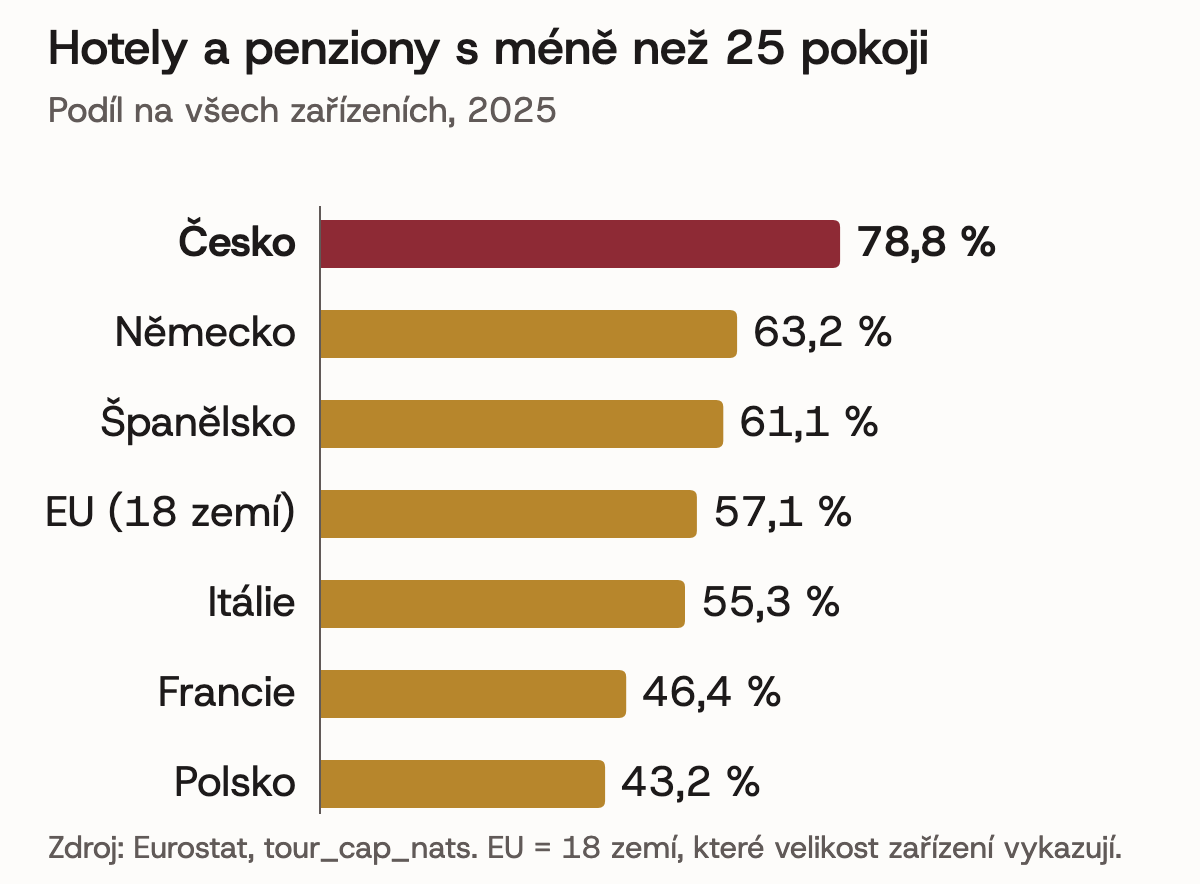
78.8% of Czech hotels and guesthouses have fewer than 25 rooms, and roughly nine in ten hotels carry no chain brand. Which hotels in-room ordering makes sense for, and which it doesn’t.
When people talk about technology for hotels, they usually mean large chain properties with their own IT department. The statistics paint a different picture: the typical European hotel is small and independent. This article summarises what data from Eurostat and the consultancy Horwath HTL says about the size and ownership of hotels, what this means for Czechia and who software for small hotels, such as in-room ordering, makes sense for.
Our main article on how much revenue slips away from a hotel room examines how much a room can lose without a convenient way to order. Here we look at which hotels this affects.
The European hotel is small: 38 rooms on average, 57% with fewer than 25 rooms
In 2025, the EU had a total of 163,767 hotels and similar establishments with 6,225,128 rooms1. That is an average of 38 rooms per establishment (our calculation)1. Eurostat includes hotels, motels, inns, guesthouses and similar accommodation in this group.
The average, however, hides how large a share of the market small properties make up. In the 18 EU countries that report establishment size, 57.1% of hotels and similar establishments have fewer than 25 rooms and 91.6% fewer than 100 rooms2. A hotel with hundreds of rooms is the exception in Europe.
The share of small establishments varies by country. It is 63.2% in Germany, 61.1% in Spain, 55.3% in Italy, 46.4% in France and 43.2% in Poland. At 78.8%, Czechia is well above all of them2.
Mostly independent: chains have about 38% of rooms in Europe
Small size goes hand in hand with independence. According to a Horwath HTL estimate cited by Hotelanalyst, chains in Europe (not just in the EU) operated 18,575 hotels with 2,289,879 rooms. This means chains hold about 38% of hotel rooms, while roughly 62% belong to independent hotels. The data dates from around 2022 and 20234.
A study of hotel sales channels by the European hotel association HOTREC gives a similar picture. The median in its sample is 34 rooms, 44% of the hotels have fewer than 30 rooms and almost 75% are independent small and medium-sized enterprises. Chains account for 17% of the hotels in the sample and hotel cooperations for 10%5.
There are, however, large differences between countries:
Even where chains have a large share of rooms, they make up a smaller share of hotels, because their properties tend to be larger. In Poland, chains account for 20.2% of hotels but 46.1% of rooms7. In Spain, they account for 38% of hotels and 58% of rooms6.
Czechia: 7,043 hotels and guesthouses, nine in ten hotels without a brand
For Czechia, Eurostat records 7,043 hotels and similar establishments with 154,567 rooms (2025)1. The average establishment has 21.9 rooms, the fewest of the seven countries we compare in this article (our calculation)1. The explanation lies in the mix: according to data from the Czech Statistical Office (ČSÚ) processed by Horwath HTL, the total comprises 2,833 hotels and garni hotels and 4,210 guesthouses10. The hotels and garni hotels alone have 112,130 rooms, or about 40 rooms per property (our calculation)10.
78.8% of Czech hotels and similar establishments have fewer than 25 rooms, or 5,548 out of 7,043. Another 1,301 establishments have 25 to 99 rooms, 159 have 100 to 249 rooms and only 35 have 250 rooms or more2.
A branded hotel in Czechia has 117.1 rooms on average10, roughly three times as many as the average Czech hotel. The typical Czech hotel is therefore a smaller property without a head office behind it.
This has practical consequences for operations. A single night shift, meaning one person from 10 pm to 7 am all year round, costs the employer in Czechia about €47,600 a year, excluding night-work supplements (our calculation from Eurostat data on labour costs in accommodation and food services for 2025)11. For a property with twenty rooms, that is a major cost. Small hotels therefore often have neither a round-the-clock reception nor an IT department of their own, and they need tools that require neither extra staff nor hardware.
Small hotels have lower occupancy, so each guest matters all the more
Size also shows in occupancy. In 2025, establishments in the EU with fewer than 25 rooms had an average of 32.8% of their rooms occupied, while properties with 250 rooms or more had 69.0%. The gap is similar in Czechia: 29.2% for the smallest and 66.2% for the largest establishments12.
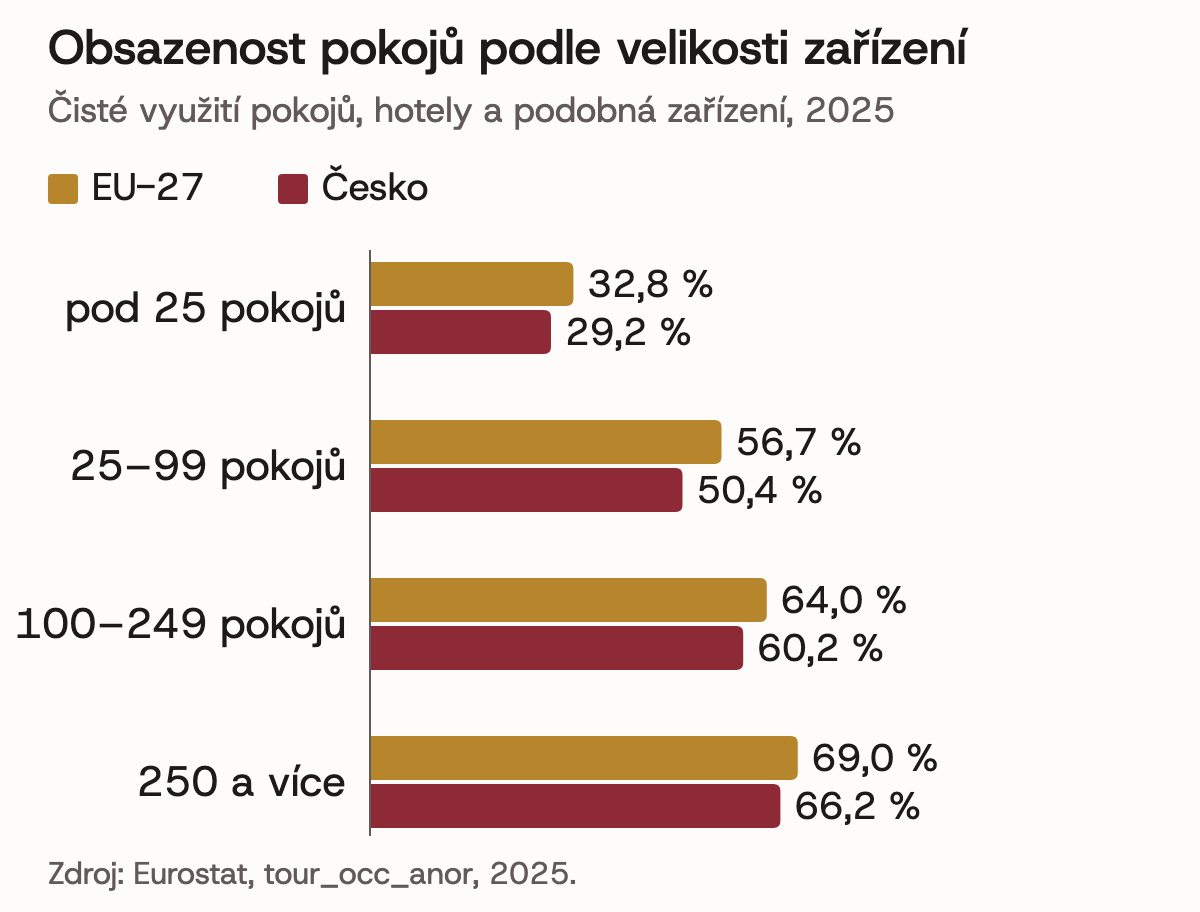
| Establishment size | EU-27 | Czechia |
|---|---|---|
| Fewer than 25 rooms | 32.8% | 29.2% |
| 25–99 rooms | 56.7% | 50.4% |
| 100–249 rooms | 64.0% | 60.2% |
| 250 rooms or more | 69.0% | 66.2% |
Eurostat calculates occupancy across all establishments, including guesthouses. That is why it comes out lower than the figures from hotel benchmarking panels, which mainly track larger hotels.
For a small hotel, the conclusion is simple: there are fewer guests, so what each of them buys during their stay matters more. A drink in the evening after arrival, an in-room breakfast or a late checkout: this is revenue for which the hotel needs no extra rooms. Our model calculation for a 40-room hotel shows what this looks like in figures.
Who software for small hotels is for: owner, general manager, F&B manager
GuestVero is an ordering system for hotels. The guest scans the QR code in the room and orders food, drinks or hotel services in their phone’s browser, with no app and no sign-up. The hotel remains the seller: it sets its own offer, prices and availability and receives guest payments itself13.
Almost every guest has their own phone. In 2025, 89.9% of EU residents aged 16 to 74 used the internet on their mobile phone, compared with 90.0% in Czechia14.
Who this kind of solution makes sense for:
- The owner of a smaller hotel who does not want to buy tablets for the rooms or pay a percentage of revenue. GuestVero costs CZK 1.60 per active room per day and takes no commission on guest orders13. A 20-room hotel with ordering switched on in all rooms every day pays about CZK 973 in an average month (our calculation)13. That is the upper limit. The hotel switches rooms on and off itself as needed. A room it knows will not be occupied does not need to be switched on, and the hotel does not pay for it13. If it has only occupied rooms switched on, it pays CZK 1.60 for each occupied night; at an occupancy rate of 29.2%, as in Czech establishments with fewer than 25 rooms, this comes to about CZK 284 in an average month, by our calculation1213.
- The general manager who does not want orders tying up the reception phone. The order arrives in writing and includes the room, the items, the delivery time and the chosen payment method13.
- The F&B manager who wants to change the offer and prices themselves, for example by season or depending on what the kitchen is preparing at the time.
The precondition is that the hotel has something to offer and someone to deliver the order. It does not have to be room service with a kitchen. Drinks from the bar, breakfast, a bottle of wine or services such as parking or late checkout are enough. You will find a detailed breakdown of the price in our article on what in-room ordering costs.
Who it is not for, and when it is better to wait
In-room ordering is not for every property. It is worth waiting in the following cases:
- The hotel has nothing to deliver. If there is nobody to bring anything to the room, for example in a guesthouse without permanent staff on site, a QR code will not help the guest.
- Ordering already works well. A hotel with a stocked minibar or with room service that guests use regularly already captures part of the demand. The benefit will be smaller.
- Occupancy is low and the offer is small. In our model, missed revenue rises and falls in direct proportion to occupancy. At an occupancy rate of 30%, roughly what small establishments achieve (29.2% in Czechia, 32.8% in the EU), the central scenario comes to about CZK 174 in revenue excl. VAT per room per month. After costs, about CZK 70 remains. If the hotel has ordering switched on in all rooms every day, GuestVero costs CZK 48.7 per room per month, and in the low scenario the margin does not cover the price15. The hotel, however, switches rooms on and off itself as needed. A room it knows will not be occupied does not need to be switched on, and the hotel does not pay for it13. With only occupied rooms switched on, it pays CZK 1.60 per occupied night, and the price falls along with occupancy. In our model, the profit contribution then equals 1.31 times the price in the low scenario and 4.8 times in the central scenario, at any occupancy rate (our calculation)15. This does, however, assume that the hotel switches off every room that stays empty.
- Head office makes the technology decisions. In chain hotels, choosing guest-facing tools is usually a matter for the whole group, not for an individual property.
It is precisely because of the uncertainty in point 3 that we offer a trial without a time limit: the hotel sees its own figures, not our assumptions. We discuss common doubts, such as whether older guests will order too, in our article on objections to hotel digitalisation.
The most reliable way to find out whether GuestVero is right for your hotel is in your own rooms: try it for free.
Sources
- Capacity of accommodation establishments: hotels and similar accommodation (tour_cap_nat)
- Capacity of hotels and similar accommodation by number of rooms (tour_cap_nats)
- Enterprises by size class, hotel accommodation (sbs_sc_ovw)
- European Hotel Report 2024 (sample), citing a Horwath HTL estimate
- European Hotel Distribution Study 2024 (R. Schegg)
- Spain Hotel & Chains Report 2024
- Poland Hotel & Chains Report 2026
- DACH Hotel & Chains Report 2026
- Italy Hotels & Chains Report 2023 (presentation at Bocconi University)
- Czechia Hotel & Chains Report 2026
- Hourly labour costs by sector (lc_lci_lev)
- Net room occupancy rate in hotels and similar accommodation (tour_occ_anor)
- GuestVero: how it works, pricing and FAQ
- Internet use on a mobile phone (isoc_ci_dev_i)
- How much revenue slips away from the average hotel room: model and methodology
Frequently asked questions
Is GuestVero suitable for a small hotel or guesthouse too?
Yes, if you offer guests something to order, such as drinks, breakfast or services, and you have someone to deliver the order. The principle is the same as in a large hotel, and the price depends on the number of active rooms: CZK 1.60 per active room per day, with no commission on orders.
How many hotels in Czechia are small?
According to Eurostat, 78.8% of Czech hotels and similar establishments have fewer than 25 rooms, or 5,548 out of 7,043 establishments (2025). These include guesthouses.
How many Czech hotels belong to chains?
According to the Horwath HTL report, 261 hotels with 30,551 rooms carry a chain brand, out of about 2,833 hotels and garni hotels. So roughly nine in ten Czech hotels are independent.
Do I need in-house IT?
No. GuestVero runs in the browser. Guests order on their own phone with no app and no sign-up, so the hotel needs neither tablets for the rooms nor an app of its own.