‘Our guests won’t want it’ and six other objections to in-room ordering
Older guests, paper menus, too few staff, Hotelstars, no kitchen. Honest answers to hoteliers’ objections, with data from the EU and Czechia.

In 2025, Booking.com asked 4,110 accommodation managers in the EU and Switzerland about their approach to technology and digitalisation. For 78% of them, technology is becoming ever more important for efficient operations and guest service. Yet only 29% name it as their main training topic.1 So the will to digitalise hotels is there. What is missing is the time and the people to introduce new things.
We hear much the same when we show hoteliers in-room ordering via QR code. Our guests are older. Guests want a paper menu. We don’t have the staff for it. We don’t have a kitchen. We take these objections seriously, because some data bears them out, and we present that data in this article as well. Why we talk about in-room ordering at all is explained in the main article of the series, on how much revenue slips away from a hotel room.
Hotel digitalisation in Europe: keen on technology, behind on training
The Booking.com survey reveals a contradiction that many operators will recognise. Of the managers surveyed, 82% say staff digital literacy will be essential, yet only 16% make it a priority. And according to the European Accommodation Barometer 2025, which the research refers to, 42% of respondents say that staff turnover holds back training.1 If you are training a new receptionist every few months, you don’t want to add another system on top.
The other side of the same coin is cost. In 2025, an hour of labour in accommodation and food services cost employers in the EU €20.9 on average, 17% more than in 2022.2 In Czechia an hour is cheaper, at €14.5, but the cost has risen faster: by 24% compared with 2022 (our calculation from Eurostat data).2 At the same time, hotels in Europe are mostly run by small businesses. About 73% of hotel businesses in the EU employ fewer than ten people (Eurostat estimate for 2023).3
To hold its own in an operation like this, technology must not add work. For each objection, we therefore set out what the data says and what it means for a smaller hotel.
‘Our guests are older’
In Czechia, this objection is backed by data. In 2025, 57.9% of Czechs aged 65–74 used the internet on their mobile phone. The EU average was 70.3%, with 71.3% in Germany and 56.2% in Poland.4 So roughly four in ten Czechs in this age group do not use mobile internet (our calculation). Across the whole population aged 16–74, the picture is different: 90.0% of Czechs and 89.9% of EU residents use the internet on their mobile phone.4
For a hotel, though, what matters is the age and origin of its own guests, not of the population as a whole. In 2025, foreign guests accounted for 53.0% of nights spent in Czech hotels and similar accommodation.5 The largest group among them in 2024 were guests from Germany, with 25.1% of foreign guests’ nights (our calculation from Eurostat data).6 And in Germany, as many as 71.3% of people aged 65–74 use mobile internet.4
What to do: ordering via QR code is not meant to replace phoning reception or the printed menu. It is an additional option for guests who prefer it. A guest who would rather call can go on calling.
‘Guests want a paper menu’
Here, too, the data supports the objection. According to a survey by the point-of-sale vendor Lightspeed, 85% of guests at casual restaurants in the United Kingdom prefer a paper menu, and 93% expect one in fine dining. When guests were offered a QR code, 35% asked for a paper menu.7 It is similar with the minibar: according to a 2025 survey by the minibar manufacturer Dometic, 65% of Germans prefer a menu card with prices.8
That said, for the guest information directory, the classification rules prescribe neither paper nor a screen. The Hotelstars Union criteria 2025–2030 require a bilingual guest information directory from three stars upwards, ‘printed or digital’ (criterion 132). There is no such note, however, for the room service breakfast menu, which is mandatory at five stars (criterion 197).9
What to do: keep the printed menu in the room and print the QR code directly on it, or place the code next to it. The guest chooses how to order. The hotel also gains a menu it can update straight away: it changes items, prices and availability in the digital menu itself, with no reprinting.10
‘We don’t have the staff for it’
This is the most serious objection, because labour in accommodation and food services has become significantly more expensive in recent years, and in Czechia faster than the EU average.2
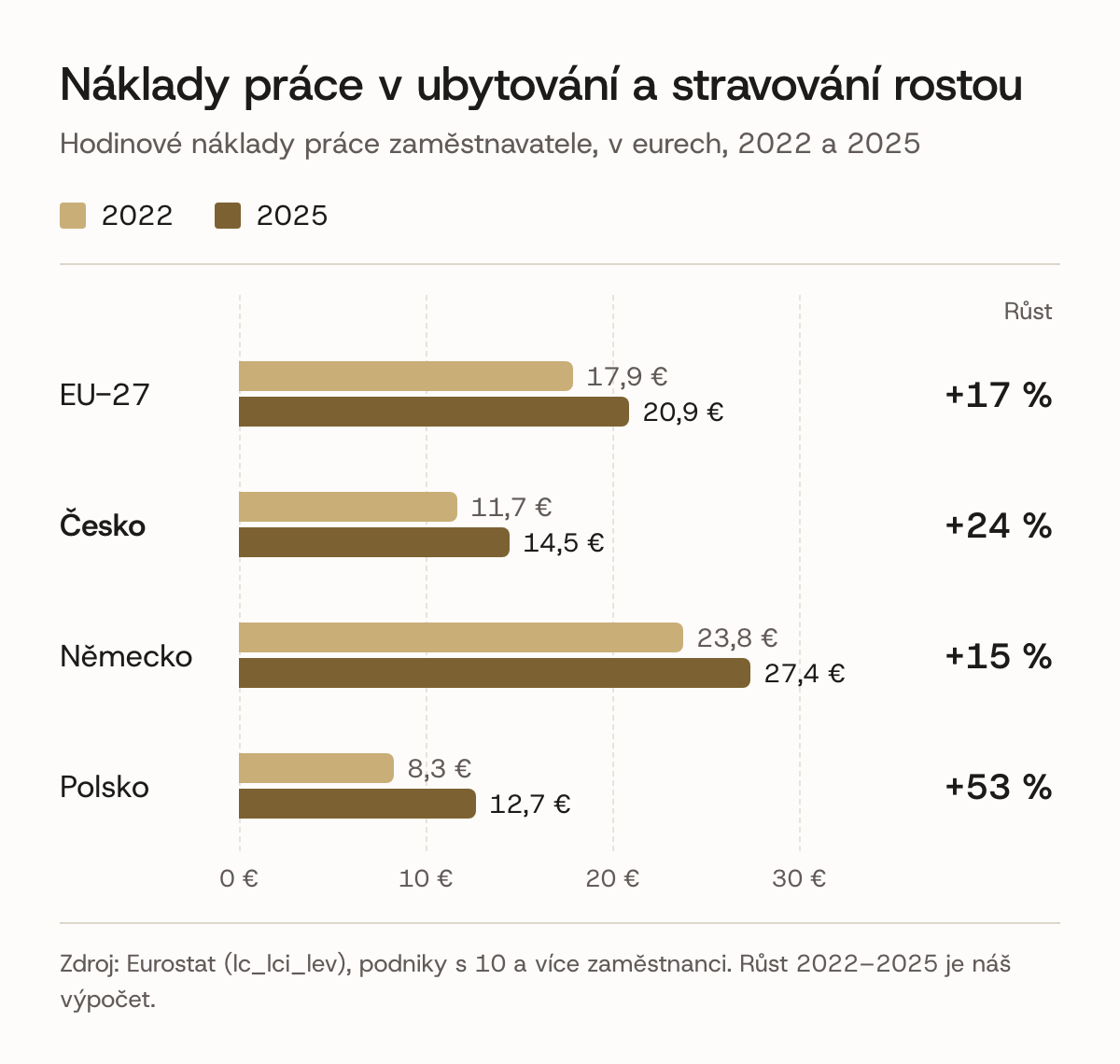
| Area | 2022 | 2025 | Change |
|---|---|---|---|
| EU-27 | €17.9 | €20.9 | +17% |
| Czechia | €11.7 | €14.5 | +24% |
| Germany | €23.8 | €27.4 | +15% |
| Poland | €8.3 | €12.7 | +53% |
A phone order takes time: someone takes the call, writes down the order, passes it on and then delivers it. If the whole process took 15 minutes, by our calculation from Eurostat data it would cost about €3.6 in labour in Czechia and €5.2 at the EU average.2 The fifteen minutes is only an example, not a measured figure.
A digital order does not save you the delivery: someone still has to carry the tray of lemonade up. But it does away with the phone call, the note-taking and misunderstandings. The order arrives on the staff order board complete with the room number, items, delivery time and payment method.10
What to do: offer only what you can deliver, and only during the hours when you have the staff for it. The hotel sets the availability of each item itself.10 In the evening, when there is only one person on reception, the menu can be limited to drinks and snacks, with no hot meals.
‘We don’t have a kitchen’
A kitchen is not a requirement, not even for classification. The Hotelstars Union criteria require food to the room 12 hours a day at four stars and 24 hours a day at five. Garni hotels, which serve only breakfast, are exempt from this criterion.9 In 2025 there were 156 garni hotels and 4,210 guesthouses in Czechia.11
Guests can order even without a kitchen: drinks, snacks, in-room breakfast, late checkout, parking or a transfer. What is more, guests ask for breakfast of their own accord. According to data from the chat tool vendor Runnr.ai, which analysed guest conversations with more than 1,000 European accommodation providers, 12% of conversations concern adding or confirming breakfast.12
Food can be provided by a partner. In Belgium in 2019, the delivery platform Deliveroo offered small hotels ‘on-demand room service’, arguing that running in-house room service requires substantial resources.13 You can just as well come to an arrangement with a restaurant nearby. For Hotelstars classification, however, do not count on a delivery platform: the criteria do not mention delivery by an external service, and under criterion 5 services are ‘provided by competent and identifiable staff’.19
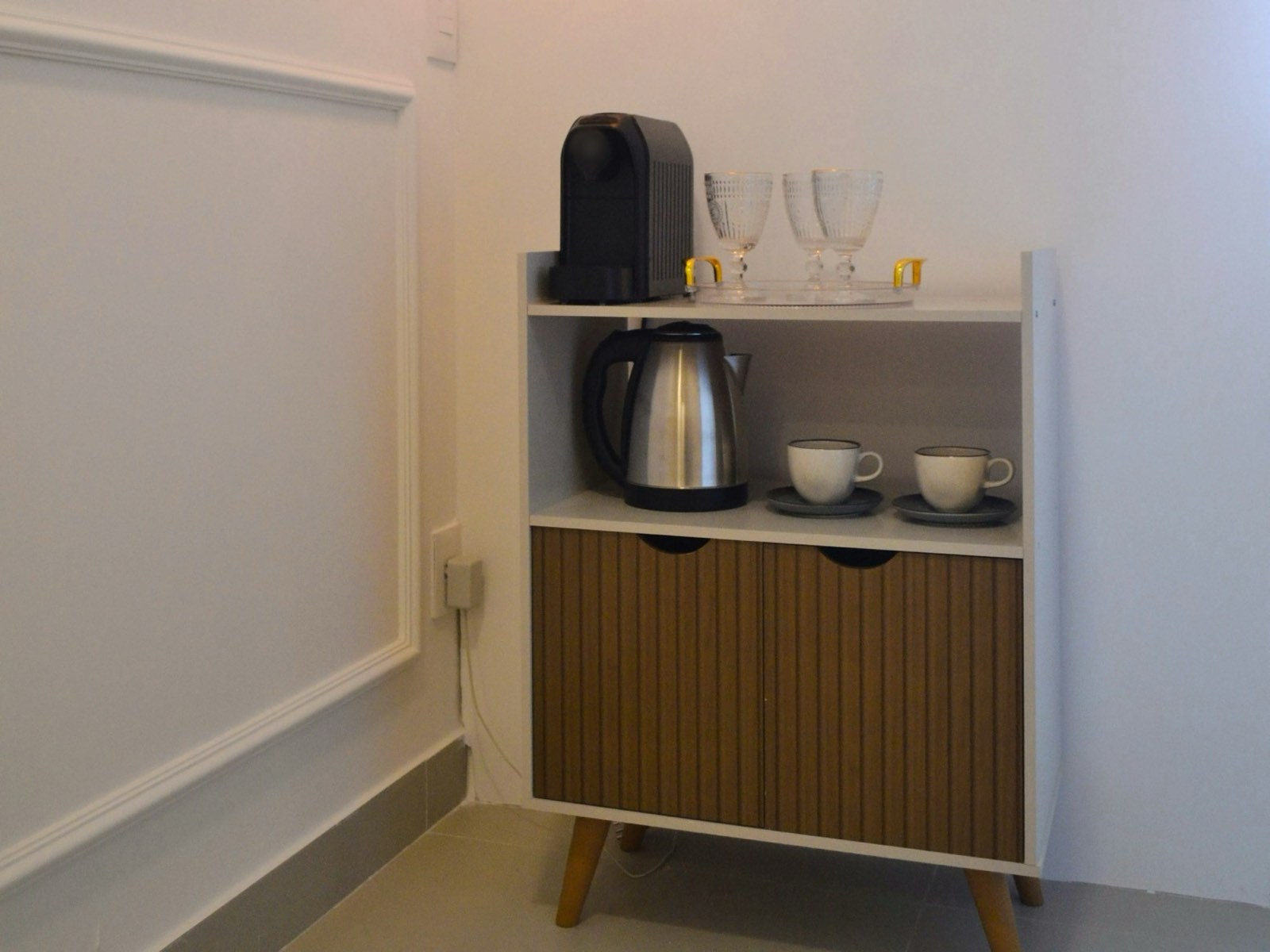
‘We have a minibar, and Hotelstars won’t recognise this anyway’
There are two objections in this one sentence. The Hotelstars Union classification is used by 16 EU member states, including Czechia, Germany, Austria and Poland.14 Under the 2025–2030 criteria, a minibar is mandatory at five stars. At four stars it can be replaced by a maxibar, a self-service shop open 24 hours, or drinks via room service 12 hours a day. At three stars, a ‘drinks offer in the room’ is enough, and a fridge on its own is optional at every level.9 We look at this in detail in our article on what star ratings require for the minibar.
The rules are also being relaxed. According to the Austrian Federal Economic Chamber (WKO), since 2025 a self-service kiosk can replace the minibar, maxibar or room service at four stars, and the requirements for the opening hours of reception, room service and the restaurant have also been eased.15 According to the text of the criteria, however, this applies only to drinks: at four stars, a kiosk can stand in for both the minibar and drinks via room service (criteria 184 to 186), but it does not replace food to the room 12 hours a day (criterion 200).9 In Czechia, 934 hotels with 57,255 rooms have four or five stars (2025; our calculation from data from ČSÚ, the Czech Statistical Office; the category is reported by the establishments themselves, and Hotelstars certification is voluntary).11
Now, an honest look at the second part of the objection. The Hotelstars 2025–2030 criteria set out what room service must offer and for how long (at four stars, food 12 hours a day; at five, 24 hours; criteria 200 and 201), but they do not say how the guest should order: there is no mention of a phone, tablet, app or QR code in connection with room service.919 According to the supplementary methodology of the Association of Hotels and Restaurants of the Czech Republic (AHR ČR), room service is a ‘service delivering à la carte food and drinks to the room’.20 Ordering via QR code with delivery by hotel staff does not contradict this wording. However, no classification body has issued an explicit confirmation that this way of ordering meets the requirement, and the decision to award stars rests with the classification committee. Before a hotel bases its classification on it, it should check this in writing with the national body, which in Czechia is AHR ČR (Hotelstars.cz). And a QR code does not replace the telephone: hotels with three and four stars must provide equipment for internal and external communication to guests on request, and five-star hotels must provide it directly in the room (criteria 127 and 128).9
What to do: a QR code does not replace the minibar where the criteria require one. But it can show what is in the minibar and at what price, and offer what won’t fit into it.
‘Nobody uses QR codes’
The data suggests rather the opposite, though not without caveats. In 2025, 89.9% of EU residents aged 16–74 used the internet on their mobile phone.4 According to a 2021 survey by the IT security vendor Ivanti, 17% of Germans had scanned a QR code during the previous day, up from 6% six months earlier. But the same survey also revealed mistrust: 36% of Germans had already scanned a code that did something unexpected or suspicious.16
According to a 2025 survey by the hotel software vendor eviivo, only 4% of travellers want to communicate with their accommodation via its app or a QR code, while 58% prefer a link by SMS, WhatsApp or email.17 However, the question was about communicating with the hotel, not about ordering, and the sample was small: 430 people.
The main lesson lies elsewhere: guests will not discover self-service on their own. According to 2025 data from the Mews platform, guests check in online via a web portal for only 8.6% of bookings worldwide. In hotels that have a self-service terminal, 20% of guests check in at it.18
What to do: put the QR code somewhere visible, by the bed or on the desk, not in a drawer. Have reception point it out in one sentence at check-in. And make sure the code leads to a menu with your hotel’s name and look, so that guests can tell where they have landed. We describe what such an order looks like, step by step, in our article on in-room ordering via QR code.
‘It’s yet another system we have to learn’
This objection applies to every new tool, especially given the staff turnover that 42% of respondents in the European Accommodation Barometer identify as a brake on training.1 So the sensible question to ask is how much each person needs to know.
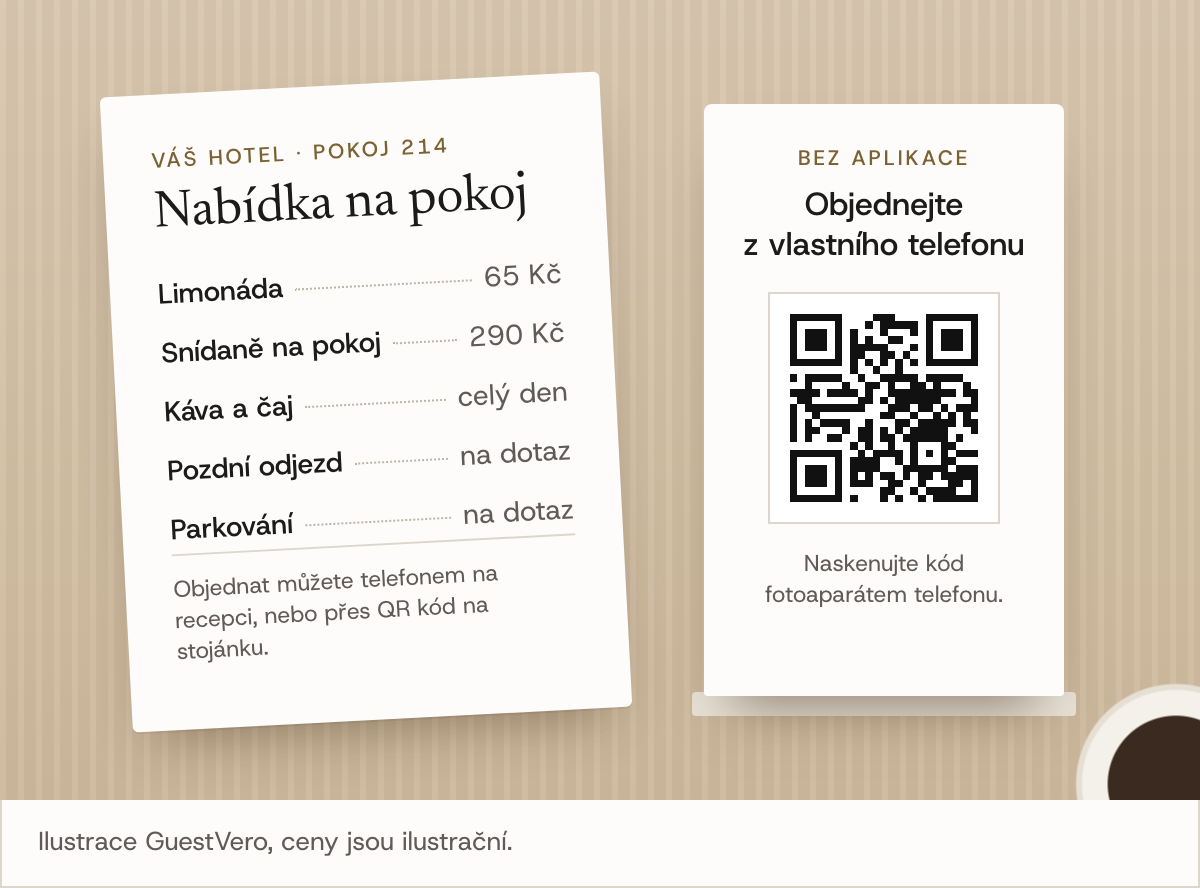
With GuestVero, the guest installs nothing and creates no account: they scan the QR code and order in their phone’s browser. Staff see orders on an order board with three statuses: New, Preparing, Delivered. The hotel administrator sets the offer and prices. The hotel remains the seller and receives guest payments itself. The price is CZK 1.60 per active room per day, with no commission on orders, and the trial has no time limit.10
The best test is a practical one. Ask a new colleague to place an order on their own phone and then handle that order themselves. If they manage it without instructions, the system has passed.
Summary: seven objections in one table
| Objection | What the data says | What to do |
|---|---|---|
| Our guests are older | In Czechia, 57.9% of people aged 65–74 use the internet on their mobile phone; in the EU, 70.3% | Keep both the phone and the printed menu |
| Guests want a paper menu | In the UK, 85% of guests at casual restaurants prefer one (Lightspeed) | Print the QR code on the printed menu |
| We don’t have the staff for it | Labour costs in Czech accommodation and food services rose by 24% between 2022 and 2025 | Offer only what you can deliver |
| We don’t have a kitchen | Garni hotels are exempt from the in-room food criterion | Drinks, breakfast, services, food via a partner |
| We have a minibar; Hotelstars won’t recognise this | The criteria set the room service offer and hours, not how guests order; there is no explicit confirmation for QR codes | Check this in writing with AHR ČR before classification |
| Nobody uses QR codes | According to Mews, 8.6% of bookings worldwide use online check-in via a portal | Code in a visible place, a mention from reception |
| Another system to learn | 42% of respondents say staff turnover holds back training | Test whether a new colleague can manage it |
Do you have an objection we haven’t covered here? Email us at [email protected] and we will reply. You will find answers to practical questions about pricing, payments and day-to-day operation in our GuestVero FAQ. And if you want to test these objections on your own guests, try GuestVero for free, with no time limit.
Sources
- Booking.com research reveals widening gap between future skills ambitions and current training priorities in Europe’s hospitality sector
- Hourly labour costs in accommodation and food services (lc_lci_lev)
- Enterprises by number of employees: hotel accommodation (sbs_sc_ovw)
- Individuals used the internet on a mobile phone or smart phone (isoc_ci_dev_i)
- Nights spent in hotels and similar accommodation by guest origin (tour_occ_ninat)
- Nights spent in hotels and similar accommodation by guests’ country of residence (tour_occ_ninraw)
- 2024 State of the UK Hospitality Industry
- Hotel minibar: top features guests expect
- Classification criteria 2025–2030
- GuestVero: how it works, pricing and FAQ
- Czechia Hotel & Chains Report 2026 (capacity data from ČSÚ, the Czech Statistical Office)
- 2026 Guest Trends and Preferences in European Hospitality
- Deliveroo collaborates with hotels to offer on-demand room service
- Hotelstars Union: criteria and member countries
- Neue Kriterien für die Hotelklassifizierung
- QR Code Sentiment: Key Data Points
- eviivo survey: how travellers want to communicate with their accommodation
- 70% of travelers would skip the front desk: Mews survey reveals the rise of self check-in hotels
- Kritéria 2025–2030, Czech version (criteria 5, 186, 187, 200 and 201; pp. 3, 16 and 17)
- Doplňující metodika 2025–2030 (terminology, definition of Room Service, p. 5)
Frequently asked questions
Can older guests manage digital ordering?
Many can, but not all. In 2025, 70.3% of people in the EU aged 65–74 used the internet on their mobile phone; in Czechia, 57.9%. So keep the printed menu and the option of phoning reception as well: the QR code is an additional option, not the only one.
Do I have to get rid of the paper menu?
No. In the United Kingdom, according to a survey by the point-of-sale vendor Lightspeed, 85% of guests at casual restaurants prefer one. The QR code is an addition, not a replacement; ideally, print it directly on the printed menu.
What if I don’t have a kitchen?
Offer drinks, snacks, breakfast or services such as late checkout or parking. Food can be arranged through a partner, for example a nearby restaurant.
Will guests use it of their own accord?
Probably not: self-service needs a reminder. According to data from the Mews platform, only 8.6% of bookings worldwide use online check-in via a web portal (2025). A QR code in a visible place and a mention from reception at check-in will help.
Does Hotelstars recognise ordering via QR code?
No classification body has explicitly confirmed it. The Hotelstars 2025–2030 criteria set out what room service must offer and for how long, but they do not say how the guest should order; there is no mention of a phone, tablet, app or QR code in connection with room service. Ordering via QR code with delivery by hotel staff does not contradict their wording, but the decision to award stars rests with the classification committee. Before you base your classification on it, check this in writing with AHR ČR (Hotelstars.cz). A QR code does not replace the phone or any other communication equipment that the criteria require.