No app, no sign-up: guest privacy when ordering
Almost two thirds of Czechs refuse to share their data for advertising, and few people download a hotel app. Why ordering without an account, under the hotel’s own brand, makes sense.
Europeans are more careful with their personal data than they were five years ago. In 2025, 55.2% of EU residents aged 16–74 refused to allow their personal data to be used for advertising, compared with 48.5% in 20201. For a hotel, this is not just a marketing statistic: guest privacy in a hotel starts with how much data the hotel asks guests for. Every app a guest has to download and every account they have to create is a request for a piece of their privacy. The guest can refuse it, and the order along with it.
This article shows how Europeans and Czechs handle their personal data, why guests don’t download hotel apps and why mandatory sign-up holds back purchases. It is part of a series in which we calculate how much revenue slips away from a hotel room when guests have no easy way to order.
Europeans and personal data: more refusals than five years ago
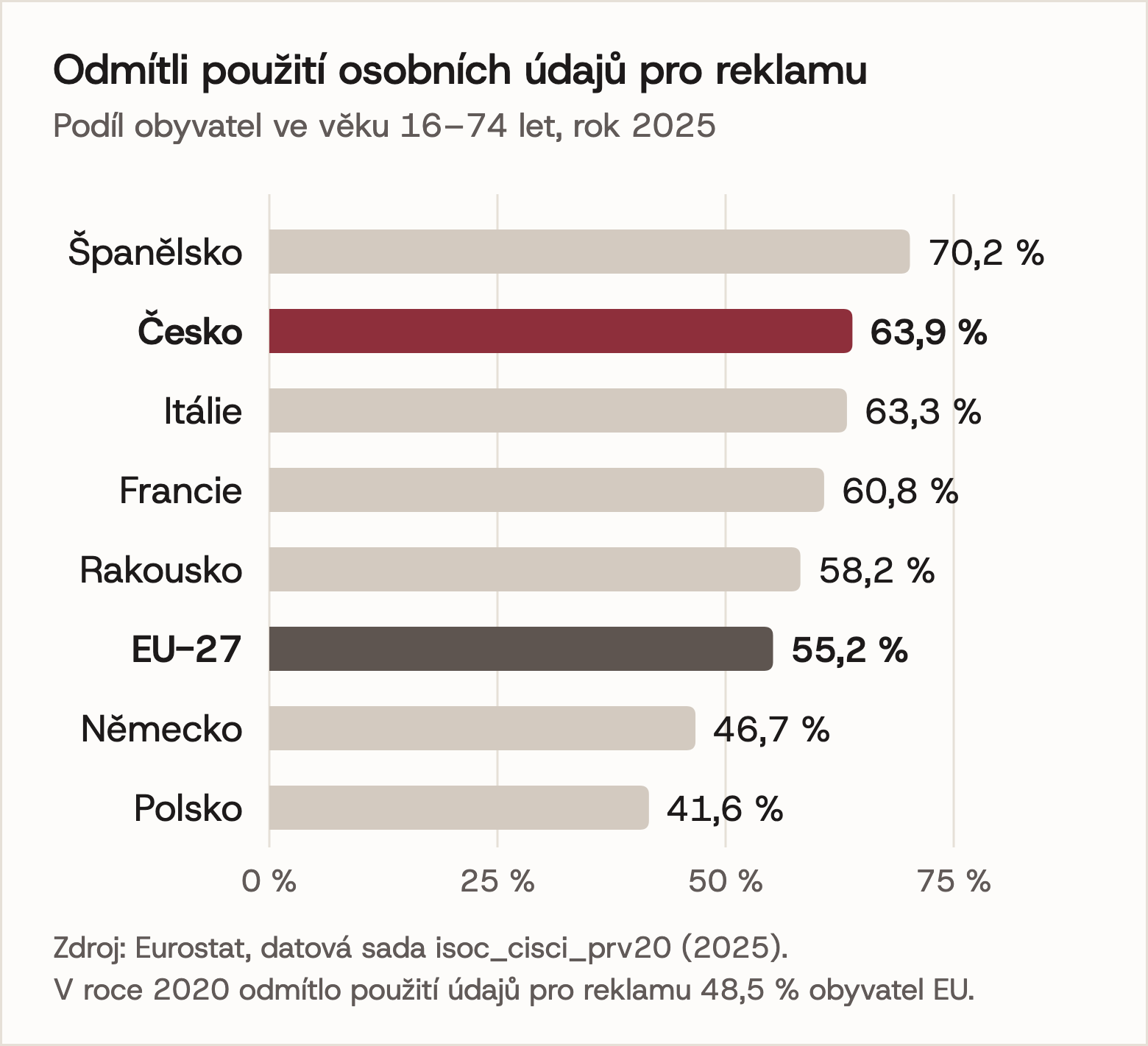
In its survey on internet use, Eurostat tracks how many people have refused to let their personal data be used for advertising. In 2025, the figure in the EU was 55.2% of residents aged 16–741. There are large differences between countries, though. Of the countries compared, people refused most often in Spain (70.2%), followed by Italy (63.3%), France (60.8%) and Austria (58.2%). Germany (46.7%) and Poland (41.6%) stayed below the EU average1. Caution with personal data is therefore not the exception; in many countries it is the majority view.
For a hotel, this leads to a simple rule. Every piece of data it asks the guest for must have an obvious purpose. The guest will understand why the hotel needs to know where to bring the order. They will not understand why a coffee to the room should require an email address, a phone number or consent to receive offers.
Czechia: 63.9% of people do not want to share their data for advertising
In Czechia, 63.9% of residents aged 16–74 refused to allow their personal data to be used for advertising, considerably more than the EU average1. Of the eight values compared in the chart, only Spain’s is higher.
| Country | Refused (2025) |
|---|---|
| Spain | 70.2% |
| Czechia | 63.9% |
| Italy | 63.3% |
| France | 60.8% |
| Austria | 58.2% |
| EU-27 | 55.2% |
| Germany | 46.7% |
| Poland | 41.6% |
Caution does not mean that Czechs do not use their phones. In 2025, 90.0% of residents of Czechia aged 16–74 used the internet on their mobile phone, practically the same as the EU average (89.9%)2. So guests have a phone and know how to use it. They just don’t want to fill in more than they have to for a small order.
What is more, a Czech hotel does not serve only Czechs. In 2025, foreign guests accounted for 53.0% of nights spent in Czech hotels and similar accommodation3. The largest source market is Germany, with 25.1% of foreign guests’ nights in 2024 (our calculation from Eurostat data)4. So a guest from Spain, where 70.2% of people refused to let their data be used for advertising, may be staying on the same floor as a guest from Germany, where the figure was 46.7%1. The simplest approach is to offer ordering that asks neither of them for personal data.
Why guests don’t download hotel apps
The best available data on hotel apps comes from North America. According to a J.D. Power study from 2016–2017, based on responses from more than 63,000 guests in the USA and Canada, only 19% of guests had downloaded the hotel’s app. Of these, 38% did not use the app at all during their stay. Only 4% of check-ins and 1% of checkouts were completed via apps5. J.D. Power data for 2018 shows a similar picture: 15% of guests had the hotel’s app on their device, and 46% of them did not use it during their stay6. We found no comparable European study.
The gap between what people say in surveys and what they actually do is telling. In a 2017 survey by Oracle and Phocuswright, 73% of travellers from the USA and Europe said they would like to download hotel apps7. In a 2020 survey by the British hotel app vendor Criton, the figure was 80%8. In reality, however, only 15–19% of guests had the hotel’s app on their phone (North American data)56. Willingness expressed in a questionnaire therefore says nothing about what a guest will do in the room.
One of the reasons is simple: the phone is full. According to a survey by the Bitkom association, the average German had 42 apps installed in 2025, compared with 25 in 2022. Of those surveyed, 11% regularly delete apps they don’t use, and another 39% do so occasionally9. This is a relevant figure for Czech hotels, because guests from Germany are their largest foreign market4. An app that a guest opens once a year for two nights will struggle to hold its own against such competition.
Guests avoid phoning reception in a similar way. We explain why, and what they do instead, in our article on why guests don’t call reception.
Mandatory sign-up as a barrier to purchase
The second barrier is the account. Baymard Institute, which has studied the buying process in online shops for many years, reports that 18% of US shoppers who abandoned an online purchase did so because the shop wanted them to create an account. According to a summary of 50 studies, the average cart abandonment rate is 70.22%10. This is data from US online shops, not from hotels. But the mechanism is the same: every extra form is a point at which the customer can leave.
In a hotel, the situation is even more sensitive. The guest has already filled in their details once when booking and a second time on arrival. Asking them to register a third time for a cup of tea and a sandwich is an unnecessary barrier. To deliver an order, all you need to know is what the guest wants and where to bring it.
Collecting less data also benefits the hotel. What a hotel does not collect, it does not have to protect, store or delete. Nor does it have to explain to a guest who asks why the hotel wants their email address for a coffee.
QR codes and trust: why the hotel’s brand matters
A QR code removes both barriers at once. The guest installs nothing and creates no account; the phone’s camera is all they need. There is a catch, though: the guest cannot see in advance where the code will take them. In a 2021 survey by the IT security vendor Ivanti, 36% of Germans said they had scanned a QR code that did something unexpected or suspicious. The same survey, across six countries, also showed the other side: 61% of respondents said that QR codes make their lives easier11. Both figures date from the pandemic period.
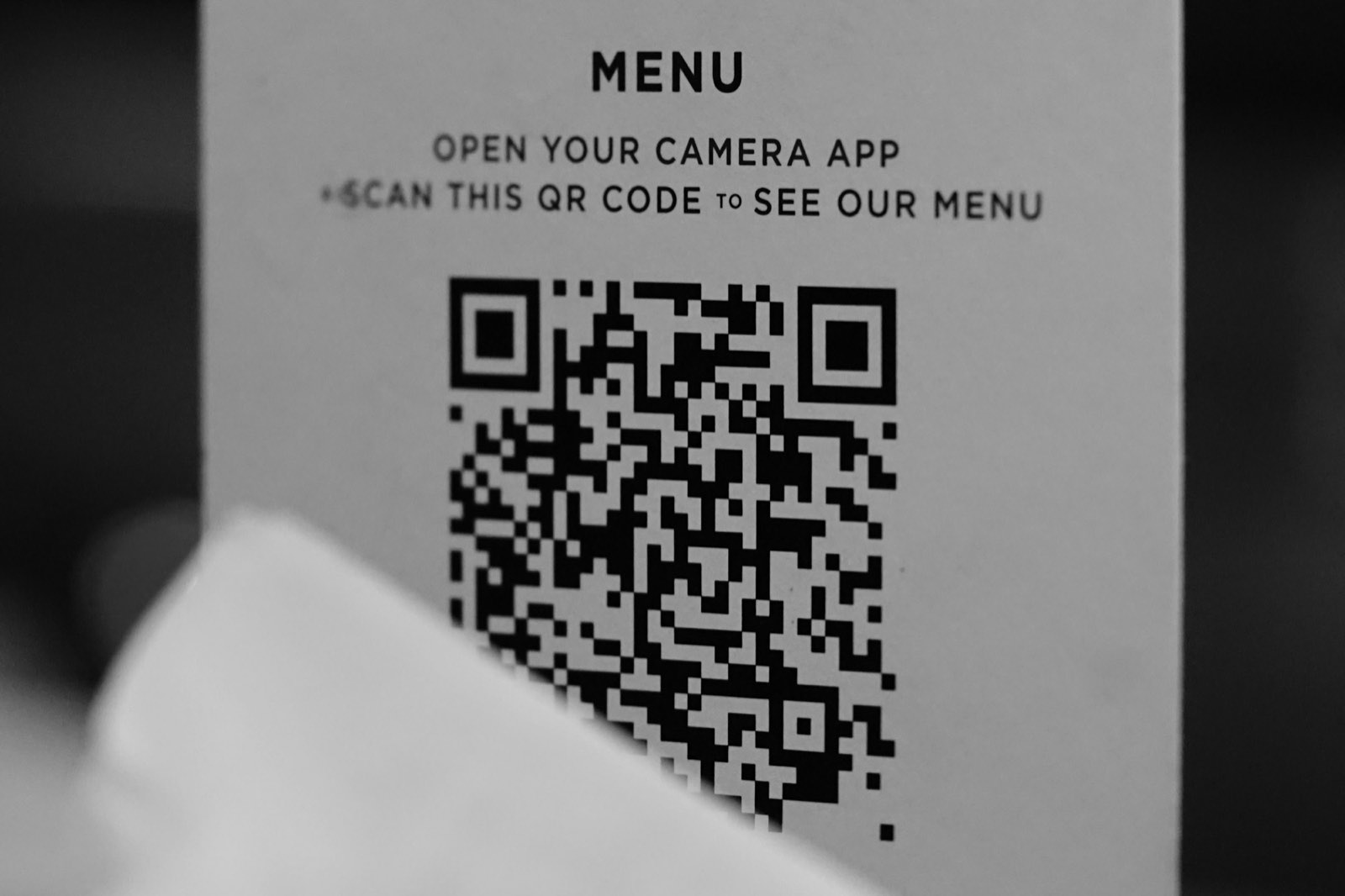
That is why what the guest sees after scanning matters. The page should carry the hotel’s name and look, not someone else’s brand. It should ask the guest only for what the order really needs. And the code itself belongs on a hotel stand or card with the hotel’s name, not on an anonymous sticker.
Not every guest welcomes QR codes. In 2025, the hotel software vendor eviivo asked 430 travellers how they want to communicate with their accommodation. Only 4% wanted to download the accommodation’s app or scan a QR code, 58% prefer SMS, WhatsApp or a link in an email, and 25% want to speak to a person12. The question, however, was about communication, not ordering. Ordering in the browser has the advantage that both the QR code in the room and a link in a message from the hotel can lead to the same page. And anyone who wants to speak to a person can still call reception.
This is also how GuestVero works. The guest scans the QR code in the room and orders in their phone’s browser, with no app and no account. The offer runs under the hotel’s brand, and the hotel remains the seller13. We describe what this looks like step by step in our article on how in-room ordering via QR code works.
Checklist: guest privacy in hotels and what to check with your vendor
Whether a hotel is choosing an ordering system, online check-in or a guest chat, it pays to ask every vendor the same questions. Get the answers in writing.
- What data does the guest enter? Which items are mandatory, and why. Is the delivery location enough for an order, or does the system want a name, email address or phone number?
- Does the guest have to install anything or create an account? If so, how many guests actually do it, based on the vendor’s experience.
- Under whose brand does the guest order? Do they see the hotel’s name and look, or the vendor’s brand? What web address does the page run on?
- Where is the data stored, and for how long? In the EU or outside it? When and how is it deleted?
- Who is the controller and who is the processor? Does the vendor offer a data processing agreement under the GDPR?
- Does the vendor use guest data for its own purposes? For example, for advertising, selling other services or comparisons across hotels.
- Who owns the relationship with the guest? Who is the seller, who receives the payment and who the guest contacts if something is wrong.
- What happens to the data when the contract ends? How the hotel gets it back and when the vendor deletes its copy.
In Czechia, data protection is supervised by the Office for Personal Data Protection. If anything is unclear, its website is a good starting point, but a binding interpretation for a specific hotel is a matter for a lawyer.
These questions apply to every vendor, GuestVero included. We discuss other concerns that hoteliers associate with digital services in our article on the objections to hotel digitalisation we hear most often and what the data says about them.
Try it for free and see what ordering without sign-up looks like from the guest’s point of view. The GuestVero trial has no time limit. Just scan the code with your own phone and go through an order as a guest.
We checked the data in this article on 15 October 2026.
Sources
- Refusal to allow the use of personal data for advertising (dataset isoc_cisci_prv20)
- Internet use on a mobile phone (dataset isoc_ci_dev_i)
- Nights spent in hotels and similar accommodation (dataset tour_occ_ninat)
- Nights spent by guests’ country of residence (dataset tour_occ_ninraw)
- 2017 North America Hotel Guest Satisfaction Index Study
- In the Quest to Improve All Things Digital (J.D. Power data)
- Welche Technik wollen die Hotelgäste? (Oracle and Phocuswright survey)
- Research: 80% of hotel guests would download an app to check in and out (Criton survey)
- Durchschnittlich 42 Apps auf Smartphones
- Cart Abandonment Rate Statistics
- QR Code Sentiment – Key Data Points
- Survey: how travellers want to communicate with their accommodation
- GuestVero: in-room ordering via QR code, pricing
Frequently asked questions
Does the guest have to create an account to order?
Not with GuestVero. The guest scans the QR code in the room and orders in their phone’s browser, with no app and no account.
How many people refuse to share their personal data for advertising?
According to Eurostat, 55.2% of EU residents aged 16–74 and 63.9% of residents of Czechia refused to allow their personal data to be used for advertising in 2025.
Do guests download hotel apps?
Rarely. According to a 2017 J.D. Power study, only 19% of guests in North America had downloaded the hotel’s app, and 38% of them did not use it during their stay. Comparable European data is not available.
Are QR codes safe?
A QR code is just a link; what matters is where it leads. In a 2021 survey by the IT security vendor Ivanti, 36% of Germans said they had scanned a QR code that did something unexpected or suspicious. The page that opens after scanning should therefore carry the hotel’s brand and ask only for the data needed for the order.