Why guests don’t call reception and what they do instead
Almost nine in ten people in the EU use the internet on their mobile phone, and a third of Germans have already put off a phone call out of phone anxiety. What does this mean for in-room ordering?
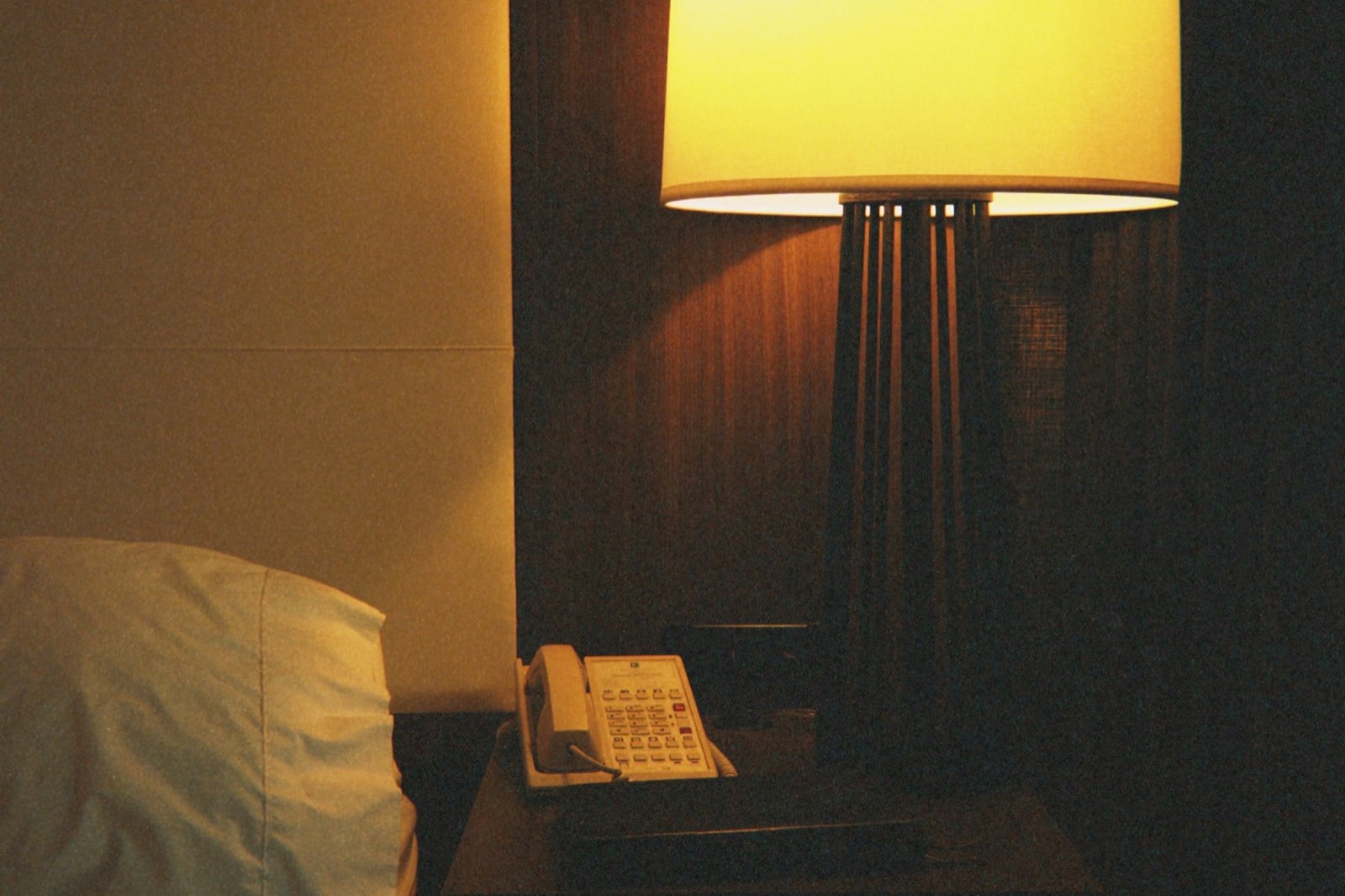
A hotel room has a telephone with a button for reception, and the hotel has a kitchen, a bar and helpful staff. But a guest who doesn’t feel like phoning may order nothing at all in the evening. It need not be a matter of appetite or price. Hotel guest behaviour is changing: almost 90% of people in the EU use the internet on their mobile phone1, many would rather text than call, and they handle most things on their own phone. A hotel cannot find out how many orders never happen as a result. An order that was never placed does not show up in any revenue figure.
This article summarises what data from the EU and Czechia say about guest behaviour and what follows from them for in-room ordering. It builds on our calculation of how much revenue slips away from a hotel room when guests have no easy way to order.
Europe has a phone in hand: almost 90% of people use the mobile internet
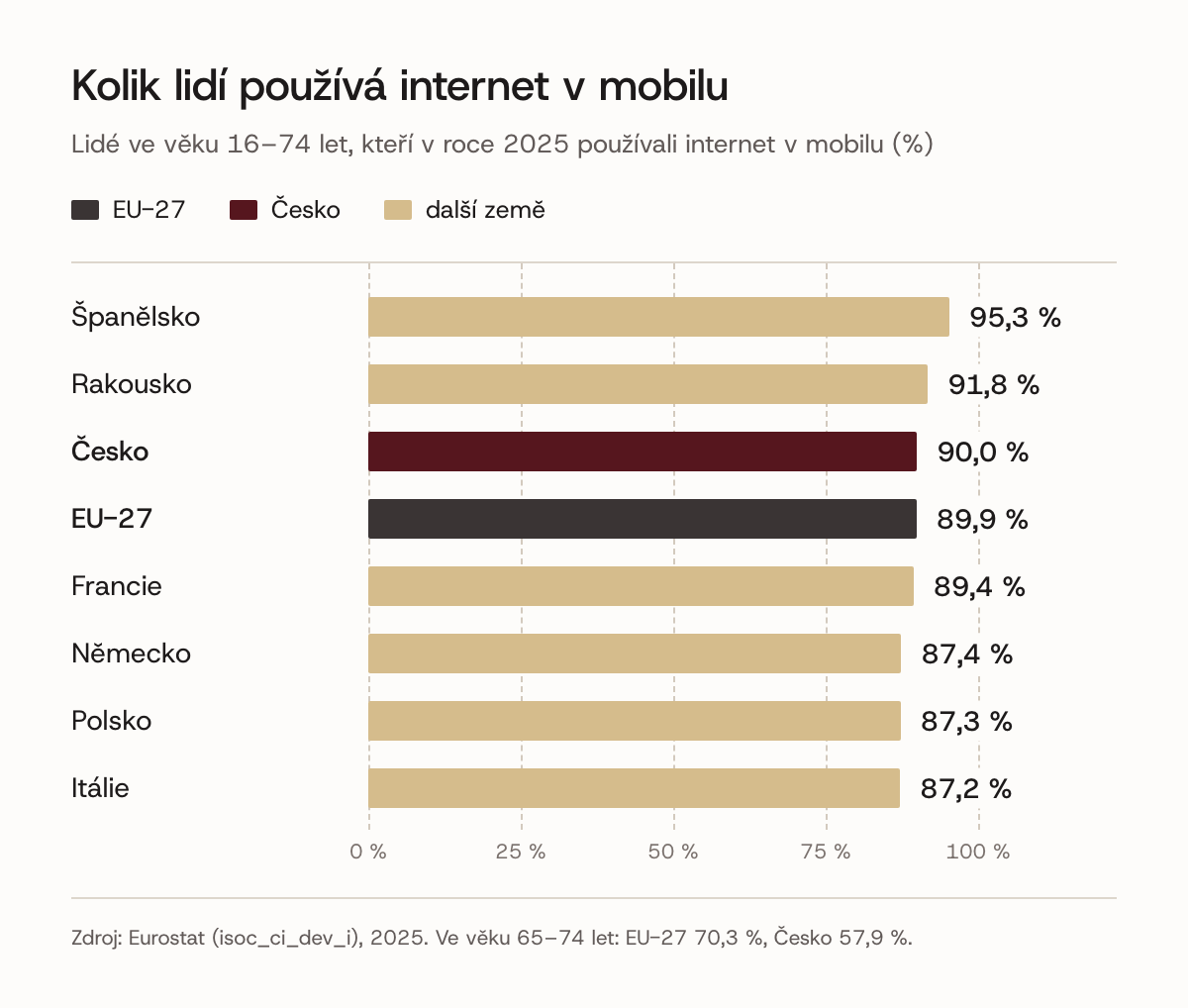
In 2025, 89.9% of EU residents aged 16 to 74 used the internet on a mobile phone1. In the countries we follow in our articles, the differences are small: from 87.2% in Italy to 95.3% in Spain. At 90.0%, Czechia is in line with the EU average1.
For a hotel, the implication is simple. Almost every guest who arrives carries a device on which they can search, choose and pay. They know it, always have it with them and have it set to their own language. The room telephone, by contrast, is a device the guest comes across only in hotels.
| Country | Mobile internet | Instant messaging |
|---|---|---|
| EU-27 | 89.9% | 82.3% |
| Czechia | 90.0% | 87.9% |
| Germany | 87.4% | 82.8% |
| Austria | 91.8% | 88.2% |
| Italy | 87.2% | 84.3% |
| Spain | 95.3% | 94.8% |
| France | 89.4% | 75.4% |
| Poland | 87.3% | 74.9% |
Text, don’t call: messaging and phone anxiety
A phone in someone’s pocket does not mean they want to make calls with it. Instant messaging – WhatsApp, Messenger, Viber and similar services – was used by 82.3% of EU residents in 2025, up from 79.2% a year earlier2. For most people, writing is the normal way to arrange things.
The most detailed European data on why people put off calls come from Germany. According to a representative survey by the Bitkom association (1,004 people aged 16 and over, spring 2025), 36% of Germans have already put off a necessary phone call out of phone anxiety. Among 16- to 29-year-olds, the figure was 44%3. Calling strangers is often unpleasant for 33% of respondents, and 40% would rather write than call, even with family and friends3.
For a guest, reception is exactly that kind of stranger. The call may also have to be made late in the evening, in a foreign language and about something the guest does not really need: a second beer, a bowl of soup, a late checkout. For some guests it is therefore easier to order nothing at all. The hotel never learns about such an order, because it never happened.
A smaller survey by the hotel software vendor eviivo (430 travellers from various countries, 2025) points the same way. When communicating with their accommodation, 58% of travellers prefer SMS, WhatsApp or a link in an email; 25% want to speak to a person4.
Czechia: guests who text, and older guests
We have no survey on phone calls for Czechia. Eurostat data do show, however, that people in Czechia use messaging more than the European average: 87.9% of people aged 16 to 74 used instant messaging in 2025, compared with 82.3% in the EU2. In Czechia, 90.0% of people use the internet on a mobile phone1.
Older guests present a different picture. Among people aged 65 to 74, 57.9% used the internet on a mobile phone in Czechia, compared with an EU average of 70.3%. Here Czechia is well below Germany (71.3%) and at a similar level to Poland (56.2%)1.
For a hotel, this means two things:
- Most guests have a phone in their hand on which they can open the hotel’s offer without any difficulty.
- A hotel with many older guests must also keep the other route open: a printed menu in the room and a phone line to reception.
Prague hotels, moreover, mainly accommodate foreigners: in 2025, foreign guests accounted for 86.4% of nights spent in hotels in Prague5. For them, calling reception is even harder; we look at this in more detail in our article on the language barrier in hotels.
Less social pressure, higher spend: what the research shows
A phone call is not just inconvenient. It can also affect how much people order. The University of Hamburg compared transaction data from 20 restaurants of a single fast-food chain. In two studies, customers who ordered at a self-service kiosk spent 14% and 16% more than at the counter6. Among other things, the authors attribute this to lower social pressure when ordering at a kiosk6.
Economists described a similar effect at a US pizza chain they followed for four years. When the same customers switched to ordering online, their orders were 15% more complex, 4% more expensive and contained 6% more calories7. The authors put this down to the fact that so-called social transaction costs disappear when ordering online7. In other words, when you don’t have to say your order out loud to anyone, you are more likely to order exactly what you feel like.
Both studies concern restaurants, not hotels. For a hotel, they are therefore an indirect pointer, not a measurement. But they make sense in a hotel room too: a guest who browses the offer at leisure and orders on their own does not have to explain to anyone that they still want a dessert at 10 pm. Only your own figures will show whether this holds true in your hotel.
Why not an app: few guests download a hotel app
When guests want to order from their phone, a dedicated hotel app seems the obvious answer. The data show why it usually does not work. In the J.D. Power study (more than 63,000 guests in the USA and Canada, 2017), only 19% of guests had downloaded their hotel’s app, and 38% of them did not use it at all during their stay8. Only 4% of check-ins and 1% of checkouts were done via apps8.
The gap between what people say and what they do is telling. In a 2017 survey by Oracle and Phocuswright, 73% of travellers from the USA and Europe said they would like to download hotel apps9. But that is a stated interest. According to J.D. Power, fewer than one in five guests actually had their hotel’s app8.
There are no European data on hotel apps. But a practical conclusion follows for hotels: every extra step, be it downloading, signing up or signing in, gives the guest a reason to put off ordering. We discuss why this also matters for guest privacy in our article on ordering without an app or sign-up.
Caution is also called for with QR codes. In the eviivo survey mentioned above, only 4% of travellers wanted to download an app or scan a QR code to communicate with their accommodation4. However, the question was about communicating with the accommodation, not ordering, and it combined the QR code and the app into a single option. For in-room ordering, the lesson is therefore: the QR code should lead straight to the offer, with no further steps.
Where the limits are: paper menus and guests who want to talk
A guest’s phone is not the answer for everyone or for every situation. According to a survey by the point-of-sale vendor Lightspeed, 85% of guests at casual restaurants in the United Kingdom prefer a paper menu. In upscale restaurants, 93% of guests expect one10. When guests were first given a QR code instead of a menu, 35% asked for a paper menu10.
The same applies in hotels. Some guests want to speak to a person; in the eviivo survey, the figure is 25%4. Older guests in Czechia use the mobile internet considerably less than average. And some requests are better dealt with in person or by phone: allergies, complaints, an unexpected problem in the room.
So the sensible line is not drawn between the old way and the new. The printed menu in the room stays, and so does reception. Ordering from the guest’s own phone is a third route for guests who would rather not call.
In practice, this can be simple. In the room there is a printed card with a short menu, prices and the reception number, and on it a QR code that opens the same menu on the guest’s phone. The guest chooses the route that suits them: they call, go to reception or order from bed. Staff then need just one rule: who takes orders from any of the routes and who delivers them. The printed card only needs updating when the range or prices change.
We address other common concerns hoteliers have in our article on objections to hotel digitalisation.
What hotel guest behaviour means for in-room ordering
Five practical conclusions follow from the data:
- Put the offer on the guest’s phone. Mobile internet is used by 89.9% of people in the EU and 90.0% in Czechia1. The phone is a device the guest already has in hand and knows how to use.
- Don’t make guests call. For many people, writing is more comfortable than talking on the phone; in Germany, 36% of people have already put off a necessary call out of phone anxiety3.
- Don’t require an app or sign-up. Only 19% of guests in North America had downloaded their hotel’s app8. Ordering in the browser after scanning a QR code gets round this obstacle.
- Let guests browse the offer and prices at leisure. Without social pressure, people spend more in restaurants6. This has not been independently measured in hotels, so track your own figures.
- Keep the other routes open too. The printed menu and reception remain for guests who want to talk or who do not use the mobile internet.
We describe what such an order looks like step by step in our article on in-room ordering via QR code. GuestVero works this way too: the guest scans the QR code in the room and orders in their phone’s browser, with no app and no account. The hotel remains the seller and receives guest payments itself11. See how ordering from the guest’s phone works in your hotel, for free and with no time limit11.
We checked the data in this article on 15 October 2026.
Sources
- Individuals used the internet on a mobile phone or smart phone (isoc_ci_dev_i)
- Individuals – internet activities: instant messaging (isoc_ci_ac_i)
- Angst vorm Telefonieren: Anrufe werden aufgeschoben (press release, representative survey of 1,004 people)
- eviivo survey: guest communication preferences
- Nights spent at tourist accommodation establishments by NUTS 2 regions (tour_occ_nin2)
- Self-service kiosks: customers spend more when there is less social pressure
- Ordering food online? That'll be more calories, cost and complexity
- 2017 North America Hotel Guest Satisfaction Index Study
- Welche Technik wollen die Hotelgäste?
- 2024 State of the UK hospitality industry
- GuestVero: how it works, pricing and FAQ
Frequently asked questions
Do hotel guests use smartphones?
In 2025, 89.9% of EU residents aged 16–74 used the internet on a mobile phone, and 90.0% in Czechia (Eurostat). Among people aged 65–74, the figure is 57.9% in Czechia and 70.3% on average in the EU.
Why don’t guests want to call reception?
We have no data for Czechia. In Germany, according to a 2025 survey by the Bitkom association, 36% of people have already put off a necessary phone call out of phone anxiety, and 40% would rather write than call, even with family and friends.
Do guests spend more when they order on their own?
In research by the University of Hamburg, customers at self-service kiosks spent 14% and 16% more than at the counter in two studies. These were fast-food restaurants, not hotels; in hotels, this has not been independently measured.
Will guests download a hotel app?
Few will. In the J.D. Power study (USA and Canada, 2017), only 19% of guests had downloaded their hotel’s app, and 38% of them did not use it during their stay. European data are lacking.
Do guests prefer paper menus?
In British restaurants, 85% of guests prefer a paper menu (Lightspeed, 2024). So keep the printed menu in the room alongside the QR code.