Upselling in hotels: what guests buy when nobody pushes them
Breakfast, late checkout, parking: what guests in Europe buy as extras, why offers at reception put them off and how to offer extra services without pressure.
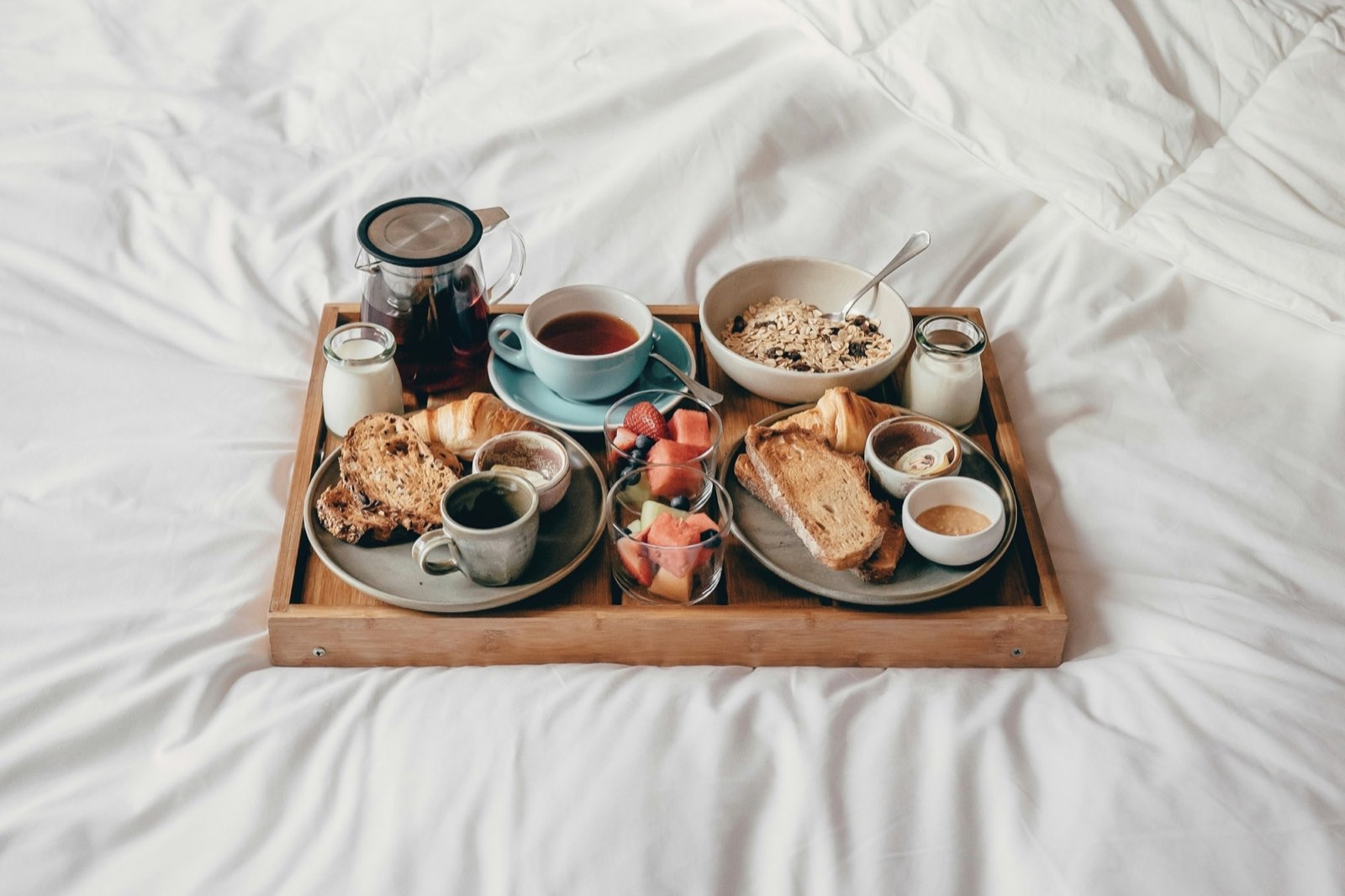
Mention upselling in a hotel and most people picture a question at reception: ‘Would you like a larger room for an extra charge?’ Yet European guests are less receptive to such offers than guests elsewhere in the world. They do buy extra services, though: breakfast, parking, late checkout. They simply want to decide for themselves, in their own time and at the moment they actually need them.
This article sums up what European surveys say about upselling, what we know about Czechia and how to offer extra services without bothering guests. Most of the figures in this field come from hotel software vendors, so for each one we state who published it and what sample it is based on. For the overall picture of how much revenue slips away from a hotel room when guests have no easy way to order, see our separate article.
European guests and add-on offers: less enthusiasm than elsewhere
In 2021, the hotel systems vendor Oracle Hospitality and the travel news site Skift asked guests what offers on arrival meant to them. Only 41% of European guests said that being offered a room upgrade or another perk at check-in definitely mattered to them. That is nine percentage points lower than for guests in the survey as a whole.1
The survey was carried out during the pandemic and commissioned by a technology vendor, so it cannot be taken as a precise measure. The direction is clear, though. An offer made at the desk comes at a moment when the guest is tired from travelling, is holding a suitcase and has other guests waiting behind them. That is a poor moment for decisions about money.
This does not mean that Europeans are unwilling to pay for extras. When the research agency Kantar surveyed travellers in Spain in August 2024 for the booking software vendor SiteMinder, 86% said they would pay extra for something on top of their room.2 So the difference lies not in the willingness to pay, but in how and when the offer is made.
What guests buy most often: breakfast comes first
The SiteMinder survey of more than 12,000 travellers in 14 countries provides a breakdown for two European markets. In Spain, 44% of guests would pay extra for breakfast, 24% for parking, 22% for a room with a view and 17% for wellness.2 In Italy, breakfast leads with 42%, followed by parking and airport transfers (26% each) and a room with a view (21%).3
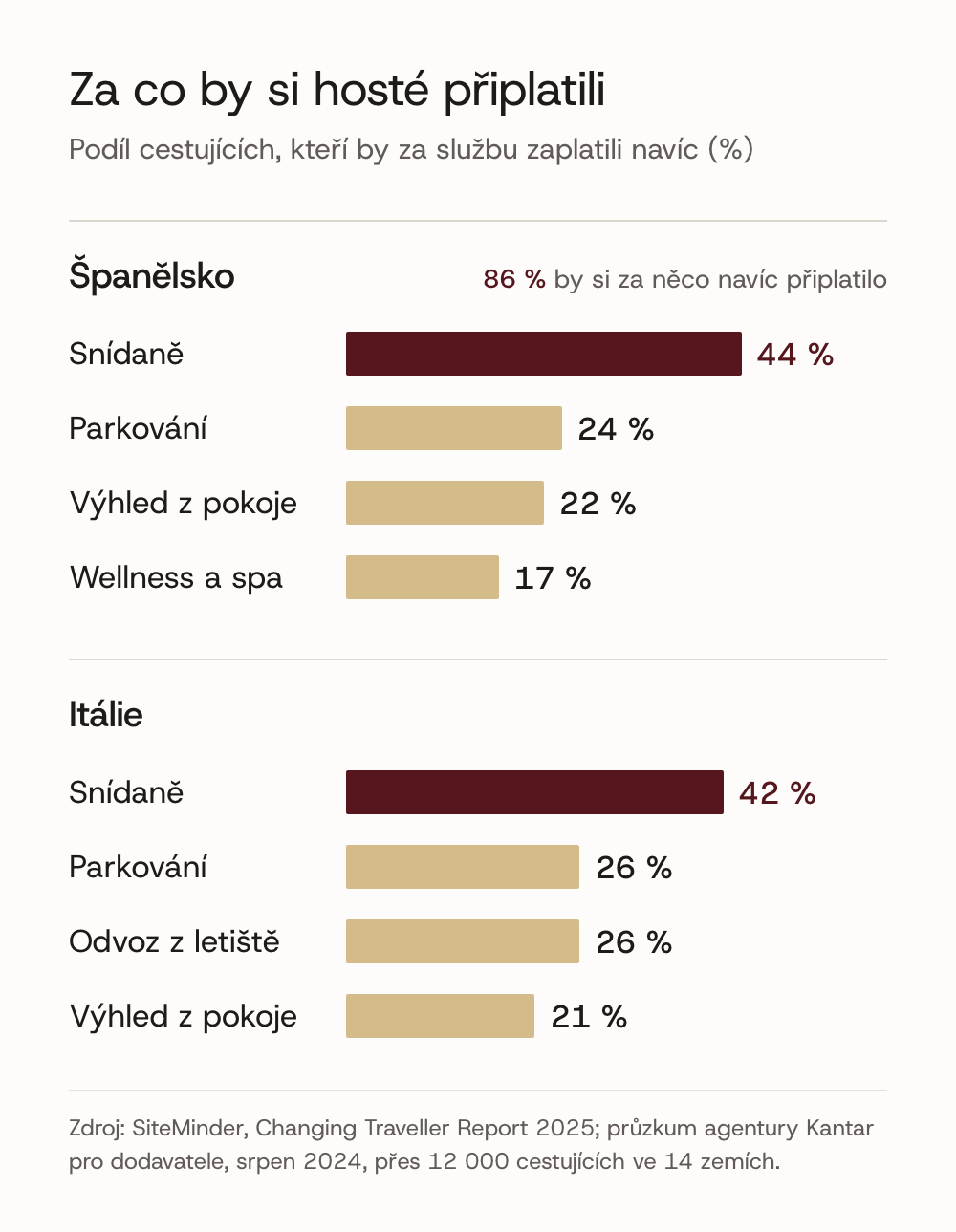
| Service | Spain | Italy |
|---|---|---|
| Breakfast | 44% | 42% |
| Parking | 24% | 26% |
| Room with a view | 22% | 21% |
| Wellness and spa | 17% | – |
| Airport transfer | – | 26% |
SiteMinder has not published such a breakdown for Germany, France or Czechia. A broader picture comes from an earlier Oracle and Skift study from spring 2022, which surveyed 5,266 people in nine countries, including Germany and France from the European Union. Of those surveyed, 54% would pay extra to choose their view, 38% to choose a specific room, 37% for early check-in or late checkout and 33% for wellness or a gym.4
Breakfast also emerges as the most common extra in data from Mews, a platform that supplies hotels with an operations and booking system. In its 2023 press release, breakfast is the largest upselling item.5 For a hotel, the conclusion is simple: the services that sell best are those the hotel provides anyway. Selling breakfast, a parking space or late checkout requires no new investment, only that guests know about these services in time.
When guests ask of their own accord
Runnr.ai handles guest conversations for more than 1,000 European accommodation providers. In its report covering March 2025 to February 2026, it analysed 10,000 conversation summaries, including some written in Czech. A request for an extra service that the hotel had not offered appeared in 18% of conversations. Of their own accord, 12% of guests clicked on an offer of extra services, and 12% of conversations were about adding or confirming breakfast.6
This is vendor data, and the sample is heavily weighted towards the Benelux countries. It does show, however, that demand for extra services exists even without persuasion. Almost one in five conversations contains a request the hotel did not prompt, and breakfast is a frequent topic. Guests speak up when they have a place and a way to do so.
A case study by the vendor Duve shows what this can look like in a single hotel. The 208-room Hotel Am Konzerthaus MGallery in Vienna generated almost €6,500 from upselling in one December, or roughly €31 per room (our calculation). Before that, the hotel had moved away from a platform which, according to the study, charged high commissions.7
For a hotel, this means a shift in thinking. Rather than asking how to persuade the guest, it is more useful to ask how to make it easy for them to ask for a service themselves.
Czechia: data from Prague and from conversations in Czech
We did not find a dedicated Czech survey on upselling. The closest to Czechia are two vendor sources. In September 2023, the Mews platform issued a press release datelined Prague. According to the release, one guest in six used online check-in before arrival, room upgrades during online check-in brought in an average of €30 per upgraded booking, and breakfast was the largest upselling item.5 However, the release does not state that the figures relate only to Czech hotels. The Runnr.ai data, for its part, includes conversations written in Czech, but the report does not give their share.
An independent view of the Czech market comes from the consultancy Horwath HTL. In its 2026 report on the Czech hotel market, it states that economy hotels in Prague had an occupancy rate of 84.5% and an average room rate of €67 in the 12 months to March 2026 (CoStar data). According to the authors, however, these hotels cannot rely on any significant revenue from corporate clients, conferences or ancillary services.8 Every extra service a guest buys is therefore all the more valuable to a hotel like this.
When pricing extra services, factor in Czech VAT. Since January 2024, food served in restaurants and accommodation with breakfast have both been taxed at 12%. All drinks served, alcoholic and non-alcoholic, are subject to the 21% rate; the exceptions are unflavoured tap water and selected milk-based drinks.9 Breakfast and food to the room therefore generally fall under the reduced rate, and drinks under the standard rate.
Less pressure, higher spend
Why does a no-pressure offer work? Research from outside the hotel industry offers an answer. Economists at the University of Hamburg compared spending in 20 restaurants of a single fast-food chain. In two studies, customers spent 14% and 16% more at self-service kiosks than at the counter. The authors explain this partly by the lower social pressure customers feel at a kiosk.10
Mews describes a similar pattern in hotels. According to the platform, guests who check in at a self-service kiosk are three times more likely to buy an extra service and generate almost 70% more upselling revenue per check-in than guests at reception.11 This is vendor data, with American hotels in the majority.
One extra service bought can lead to others. A study from Hong Kong, published in 2026 in the Journal of China Tourism Research, found that guests who accepted an online room upgrade offer spent 84% more on other services.12 There is no comparable European study yet.
The results from restaurants and from Hong Kong cannot be transferred one-to-one to a Czech hotel. But they show the mechanism: when guests choose for themselves, in their own time and with the prices in front of them, they decide differently than at the counter. We look at why guests prefer writing to calling in our article on why guests don’t call reception.
Hotel upselling without pressure: how to offer services guests can order from their room
The data above points to a few principles for offering a hotel’s extra services without pressure. None of them requires a new employee or a large investment.
- Offer what you already do. Breakfast, a parking space, late checkout, an airport transfer or a bottle of wine to the room. The hotel usually provides these services already; the guest just doesn’t know about them.
- At the moment the guest needs them. Breakfast in the evening, late checkout on the morning of departure, parking and transfers before arrival. According to the Oracle and Skift study, 37% of travellers would pay extra for early check-in or late checkout.4
- With a price and a photo. A guest who can see the price doesn’t need to ask. SuitePad, a vendor of hotel tablets, reports that photos of main courses bring in 27% more orders.13
- Without steep surcharges. In SuitePad’s data, one hotel introduced a service charge of €17.85, and its orders fell from 87 to 5 a month.13
- Reception stays. A menu on the phone does not replace a helpful person. Guests who want to talk can call or drop by; those who don’t can order by themselves.
We describe how to set up an in-room offer like this in practice in our article on in-room ordering via QR code. One option is GuestVero: the guest scans the QR code in the room and orders breakfast, late checkout or parking in their phone’s browser, with no app and no sign-up. The hotel remains the seller and receives payments itself. GuestVero takes no commission on orders (0%) and costs CZK 1.60 per active room per day.14 Try it for free and see how guests order breakfast or late checkout from their room; the trial has no time limit.
Our model calculation for a 40-room hotel shows what extra services can mean for a specific hotel. It errs on the side of caution and sets out all its assumptions openly.
We checked the data in this article on 15 October 2026.
Sources
- Strategies for Hospitality Recovery: Spotlight on Europe
- SiteMinder Changing Traveller Report 2025: results for Spain
- Studio SiteMinder: l’everything traveller ridefinisce il settore dell’ospitalità
- Travelers want high-tech, low-touch hotel stays (Oracle Hospitality and Skift, press release reprint)
- Hoteliers bring in an additional 25K over the summer by upselling their available space
- 2026 Guest Trends and Preferences in European Hospitality
- Case study: Hotel Am Konzerthaus MGallery Vienna
- Czechia Hotel & Chains Report 2026
- Informace GFŘ ke změnám sazeb DPH od 1. 1. 2024
- Self-service kiosks and customer spending (Gedenk, Widdecke, Otten), press release
- 70% of travelers would skip the front desk: Mews survey reveals the rise of self-check-in hotels
- Mohammed, I., Denizci Guillet, B.: study on online room upgrade offers, Journal of China Tourism Research 22 (1), pp. 33–60
- Room Service Benchmark Report 2026
- GuestVero: in-room ordering and pricing
Frequently asked questions
What extras do hotel guests buy most often?
Breakfast. According to the Mews platform, it is the largest upselling item, and according to the SiteMinder survey, 44% of guests in Spain and 42% in Italy would pay extra for it. Parking comes next.
How many guests are interested in extra services?
According to the vendor Runnr.ai, which handles guest conversations for more than 1,000 European accommodation providers, 12% of guests click on an offer of extra services, and 18% of conversations contain a request for an extra service that the hotel has not offered.
Why don’t guests buy services at reception?
Europeans respond more coolly to offers on arrival than guests elsewhere: according to a 2021 survey by Oracle and Skift, only 41% of them consider such offers definitely important. Research from the University of Hamburg has also shown that people spend more without social pressure, although that research was about restaurants, not hotels.
Does a guest who buys an upgrade also spend more on other services?
In a study from Hong Kong, guests who accepted an online room upgrade offer spent 84% more on other services. There is no comparable European study yet.