GuestVero: frequently asked questions from hoteliers
How GuestVero works, what it costs, who receives the payment, how long the trial lasts and where Hotelstars fits in. Answers to common questions in one place.
Whether a hotel is in Prague, Munich or Rome, the same questions come up before it introduces in-room ordering: what it costs, who is the seller, who accounts for VAT and what the star classification says about it. Taxes differ the most. According to an overview by the European association HOTREC, non-alcoholic drinks served to guests are taxed at 21% in Czechia, 19% in Germany and 10% in Italy, Spain and France (as of 1 January 2026).1
We have gathered in one place the answers to the questions hoteliers ask us most often, with a focus on Czechia. If your question is missing, let us know.
How GuestVero works
What does GuestVero do?
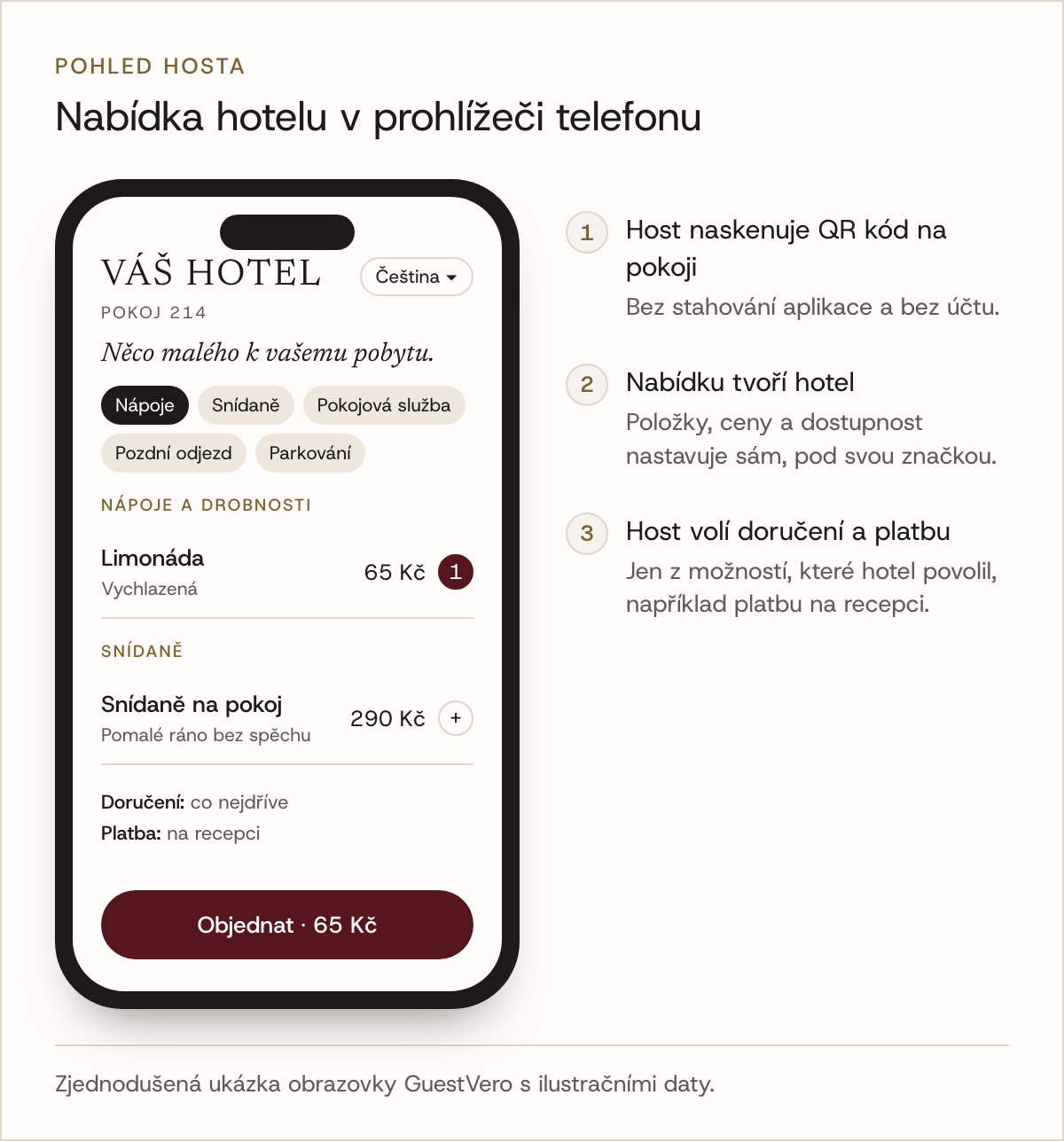
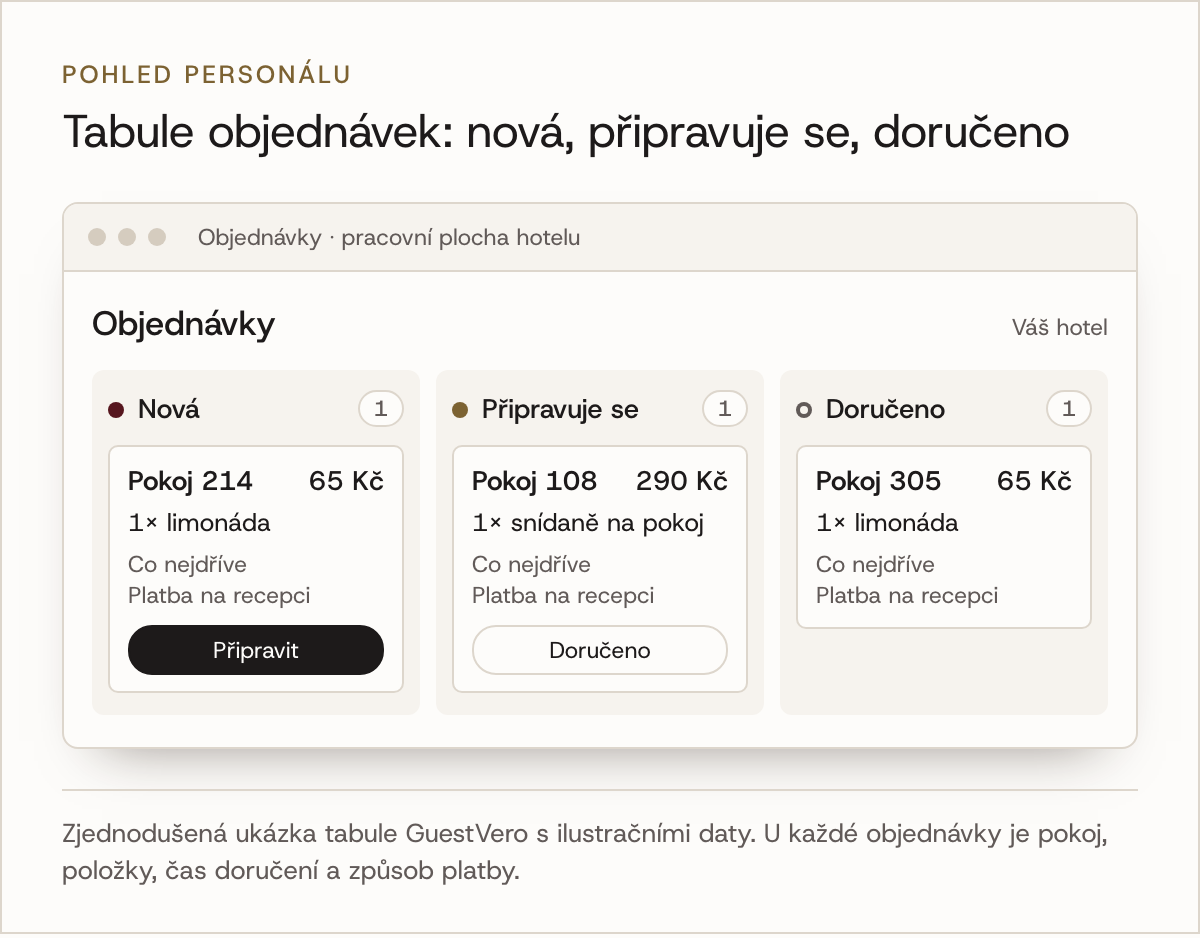
GuestVero is ordering software for hotels. The guest scans the QR code in the room and orders food, drinks or hotel services in their phone’s browser. Staff see the orders on a simple order board with three statuses: New, Preparing, Delivered. Everything runs under the hotel’s brand, with its own logo, colours and offer.2
Does the guest need an app or an account?
No. A phone camera and a browser are all it takes. The guest downloads nothing and does not create an account.2 We describe how an order works, from scanning the code to delivery to the room, in our article on in-room ordering via QR code.
What can guests order?
Whatever the hotel offers. The example on the GuestVero website includes drinks and snacks, breakfast, room service, late checkout, wellness, and parking or transfers. The hotel sets the items, prices and availability itself.2
Pricing and the trial: how to start and what to prepare
How much does GuestVero cost?
CZK 1.60 per active room per day, billed monthly, or about CZK 48 per room per month if the room is switched on every day. GuestVero takes no commission on guest orders. No VAT is charged; the operator is not VAT-registered.2 Converted at the ECB reference rate of 14 October 2026 (CZK 24.357 per euro), this is about €2 per room per month.3 If the hotel has only occupied rooms switched on, it pays CZK 1.60 per occupied night: at the average occupancy rate of 45.9% for Czech hotels and similar accommodation, this comes to CZK 22.3 per room per month by our calculation, and at the EU average of 60.3%, to about €1.20.213 The price list is in Czech koruna for Czechia; the euro figures are only an approximate conversion. For hotel groups and more complex operations, GuestVero offers individual pricing.2
You will find a detailed breakdown of the price and a comparison with platform commissions in our article on what in-room ordering costs.
What is an active room?
A room for which the hotel has guest ordering switched on. Billing is based on active room-days, not occupancy.2 The hotel switches rooms on and off itself as needed. A room it knows will not be occupied does not have to be switched on, and the hotel does not pay for it. Rooms that the hotel deactivates, such as a vacant room or a floor closed out of season, do not generate new charges. Usage that has already taken place is billed. A room that the hotel leaves switched on is billed even on nights when it is empty.2
How long does the trial last, and when do I start paying?
The trial is free and has no time limit, and you do not need a card for it. Paid billing starts only after the hotel administrator confirms activation in the Stripe payment system. Usage before activation is not billed, and there is no long-term commitment.2
Is it worth it?
It depends on your guests and your offer. According to our model, which is an estimate based on Eurostat data and assumptions about guest behaviour, 0.84 drinks orders per room per month cover the price in Czechia in the central scenario if the hotel has all rooms switched on every day. If it switches on only occupied rooms, it pays CZK 1.60 per occupied night, and by our calculation one order of two drinks covers the price of about 36 occupied nights.4 In the low scenario, the margin does not cover the price if the hotel pays for all rooms every day (0.60×). If it switches on only occupied rooms, the contribution covers the price even in the low scenario (1.31×, our calculation); this, however, assumes that the hotel switches off every room it knows will stay empty.413 You will find the full calculation and its assumptions in our main article on how much revenue slips away from a hotel room. That is why we recommend trying GuestVero with your own figures.
What should you prepare before launch?
- A short offer with prices. Five to ten items that you can deliver straight away.
- Hours. When each item can be ordered.
- Delivery. Who takes the orders and who brings them to the rooms, including on the evening shift.
- Payment. Which payment methods you will offer guests, such as payment at reception.
- A place for the QR code. Where in the room you will put it so that it is visible.
Sales, payments and VAT
Who is the seller and who receives the payment?
The hotel. It does the selling itself, receives guest payments and is responsible for delivery. GuestVero only provides the ordering software and receives no money from guest orders. The guest chooses from the payment options the hotel has enabled, such as payment at reception.2
How does VAT work on guest orders?
The hotel, as the seller, accounts for VAT under the rules of its own country. In Czechia, since 1 January 2024, all drinks served, both alcoholic and non-alcoholic, have been taxed at the standard rate of 21%. Food and accommodation, including breakfast, are subject to the reduced rate of 12%. Exceptions include unflavoured tap water and selected milk-based drinks.5 In other EU countries, the rates differ:
| Country | Room | Food | Non-alcoholic | Alcoholic |
|---|---|---|---|---|
| Czechia | 12 | 12 | 21 | 21 |
| Germany | 7 | 7 | 19 | 19 |
| Austria | 10 | 10 | 10/20 | 20 |
| Italy | 10 | 10 | 10 | 10 |
| Spain | 10 | 10 | 10 | 21 |
| France | 10 | 10 | 10 | 20 |
| Poland | 8 | 8 | 8/23 | 23 |
In Germany, the 7% accommodation rate applies only to the room itself; drinks with breakfast or half board are taxed at 19%.1
Does GuestVero charge VAT on its price?
No. GuestVero’s operator is not VAT-registered, so no VAT is added to the price of CZK 1.60 per active room per day.2
Staff and operations
How do staff find out about an order?
The order appears on the staff order board in the New column. It shows the room number, the items, the delivery time and the chosen payment method. Staff move it to Preparing and, once it has been delivered, to Delivered.2 Keep the board open where your staff actually are, such as at reception or the bar.
How much extra work does it create?
Delivery remains the hotel’s job, but the phone call and transcribing the order are no longer needed. Offer only what you can deliver, and only during the hours when you have the staff for it. We look at how we answer the objection ‘we don’t have the staff’, and others, in our article on objections to hotel digitalisation.
Will guests order of their own accord?
Only if they know the option exists. Self-service does not catch on by itself: according to data from the Mews platform for 2025, only 8.6% of reservations worldwide are checked in online via a web portal.6 What helps is a QR code in a visible place and a single sentence from reception at check-in.
Guests, privacy and languages
What details does the guest enter?
The guest does not create an account or install anything. The order contains the room number, the items, the delivery time and the payment method.2 This matters, because guests are careful with their data: in 2025, 63.9% of Czechs aged 16–74 refused to allow their personal data to be used for advertising, compared with 55.2% across the EU.7 We look separately at why ordering without an app or sign-up matters to guests. Before launch, request details of how personal data is processed, for example how long orders are kept, from [email protected].
Which languages does the offer work in?
The GuestVero website states that guests can switch the language, to English, Czech or German among others, while the hotel’s look stays the same.2 Use the trial to check, with your own offer, how the names and descriptions of your particular items are displayed. Languages matter for Czech hotels: in 2025, foreign guests accounted for 53.0% of nights spent in Czech hotels and similar accommodation8 and for 86.4% in Prague.9 We write more about this in our article on the language barrier in hotels.
Hotelstars classification and rules
Will Hotelstars recognise ordering via QR code as room service?
The Hotelstars Union classification is used by 16 EU member states, including Czechia.10 The Hotelstars 2025–2030 criteria set out what room service must offer and for how long (at four stars, food 12 hours a day; at five stars, 24 hours), but they do not say how the guest should order; neither telephone, tablet, app nor QR code is mentioned in connection with room service.1114 According to the methodology of the Association of Hotels and Restaurants of the Czech Republic (AHR ČR), room service is ‘a service delivering à la carte food and drinks to the room’; this definition does not say how the guest should order either.15 An order placed via QR code and brought to the room by hotel staff therefore does not contradict the wording of the criteria.
However, no classification body has explicitly confirmed that ordering via QR code with delivery by hotel staff meets the requirement, and the decision to award stars rests with the classification committee. Before a hotel bases its classification on this, it should check in writing with the national body, which in Czechia is AHR ČR (Hotelstars.cz).
The 2025–2030 criteria explicitly allow a digital format for the guest information directory: from three stars upwards it must be bilingual, ‘printed or digital’ (no. 132). For the room-service breakfast menu, mandatory at five stars (no. 197), they do not mention a digital format, so a breakfast menu offered only via QR code finds no support in the text of the criteria.11 Nor does ordering via QR code replace the device for internal and external communication: at three and four stars it must be available to the guest on request (no. 127),1114 and at five stars directly in the room (no. 128).11 According to the Austrian explanatory notes, it must have a telephone function, and the notes refer to the hotel’s devices, not to the guest’s phone.16
Can ordering via QR code replace the minibar?
Not where the criteria require one. A minibar is mandatory at five stars (no. 184). At four stars, it can be replaced by a maxibar, a self-service shop open 24 hours, or drinks via room service 12 hours a day (nos. 185 and 186). At three stars, an offer of drinks in the room is sufficient (no. 182).11 According to the Austrian explanatory notes, an unchilled bottle of water is enough for this; no text states that a drinks menu via QR code alone would replace it.16 Since 2025, a self-service kiosk can also replace the minibar, maxibar or drinks via room service at four stars.12 This applies only to drinks: for food via room service (no. 200), the criteria list no substitute.11
Didn’t find your answer? Email us at [email protected]. And if you want to see it all in your own rooms, start the free trial.
Sources
- VAT table: rates as of 1 January 2026
- GuestVero: how it works, pricing and FAQ
- Euro foreign exchange reference rates: Czech koruna (CZK)
- How much revenue slips away from the average hotel room: the GuestVero model and its assumptions
- Informace GFŘ ke změnám sazeb DPH od 1. 1. 2024
- 70% of travelers would skip the front desk: Mews survey reveals the rise of self check-in hotels
- Refused allowing the use of personal data for advertising (isoc_cisci_prv20)
- Nights spent in hotels and similar accommodation by guest origin (tour_occ_ninat)
- Nights spent in hotels and similar accommodation by NUTS 2 region (tour_occ_nin2)
- Hotelstars Union: criteria and member countries
- Classification criteria 2025–2030, p. 12 (nos. 127, 128, 132), pp. 15–17 (nos. 182–201)
- Neue Kriterien für die Hotelklassifizierung
- Net occupancy rate of bedrooms in hotels and similar accommodation (tour_occ_anor)
- Kritéria 2025–2030, Czech version, p. 12 (no. 127) and p. 17 (nos. 200, 201)
- Doplňující metodika ke ČSN 76 1110 pro období 2025–2030, p. 5 (Room Service – Etážová služba)
- Explanations on how to apply the Criteria of the Austrian Classification System 2025–2030, pp. 11–12 (nos. 88, 89, 105)
Frequently asked questions
Does the guest need an app or an account?
No. The guest scans the QR code in the room and orders in their phone’s browser, without downloading an app and without an account.
How much does GuestVero cost?
CZK 1.60 per active room per day, billed monthly, or about CZK 48 per room per month if the room is switched on every day. The hotel switches rooms on and off itself as needed. A room it knows will not be occupied does not have to be switched on, and the hotel does not pay for it. GuestVero takes no commission on guest orders. No VAT is charged; the operator is not VAT-registered.
Who is the seller and who accounts for VAT?
The hotel. It does the selling itself, receives guest payments and accounts for VAT. In Czechia, drinks served are taxed at 21% and food at 12%.
How long does the trial last?
It is free and has no time limit. Paid billing starts only after the hotel administrator activates it themselves; usage before activation is not billed.
Will Hotelstars recognise ordering via QR code as room service?
No classification body has explicitly confirmed this yet. The Hotelstars 2025–2030 criteria set out what room service must offer and for how long, but they do not say how the guest should order; ordering via QR code with delivery by hotel staff does not contradict their wording. The decision to award stars rests with the classification committee, so the hotel should check this in writing with AHR ČR (Hotelstars.cz) before classification.