The language barrier in hotels: when guest and reception have no language in common
Foreign guests account for more than half of the nights spent in Czech hotels, and a quarter of adults in the EU speak no foreign language. How the language barrier holds back orders and what to do about it.
In 2025, foreign guests accounted for more than half of all nights spent in hotels in the European Union.1 Every day, then, people meet at reception who share no native language, and often no foreign language either. On arrival, this kind of language barrier in a hotel is usually overcome with a smile, gestures and a translation app on a phone. An order placed by phone from the room, however, has none of these aids.
This article shows how many foreign guests European and Czech hotels have, how well Europeans speak foreign languages and why a written order with prices and photos works better than a phone call. The language barrier is one of the places where a hotel’s revenue slips away; for the full picture, see our article on how much revenue slips away from a hotel room.
European hotels speak many languages: foreign guests account for almost 52% of nights
Hotels and similar accommodation in the EU recorded a total of 1.93 billion nights spent in 2025, 1.7% more than a year earlier. Foreign guests accounted for 51.9% of them (Eurostat; shares are our calculation).1
There are big differences between countries. In Austria, foreign guests accounted for 72.3% of hotel nights, in Spain 66.7%, in Italy 53.6% and in Czechia 53.0%. In France the figure was 37.9%, in Poland 25.4% and in Germany, where domestic guests predominate, 22.1%.1
Capital cities often differ markedly from the rest of the country. In Prague, foreign guests accounted for 86.4% of hotel nights, in Budapest 86.0% and in Vienna 81.8%. Even in Berlin, the share of foreign guests (39.6%) was significantly higher than in Germany as a whole. Madrid, by contrast, is below the Spanish average (58.6% versus 66.7%).2
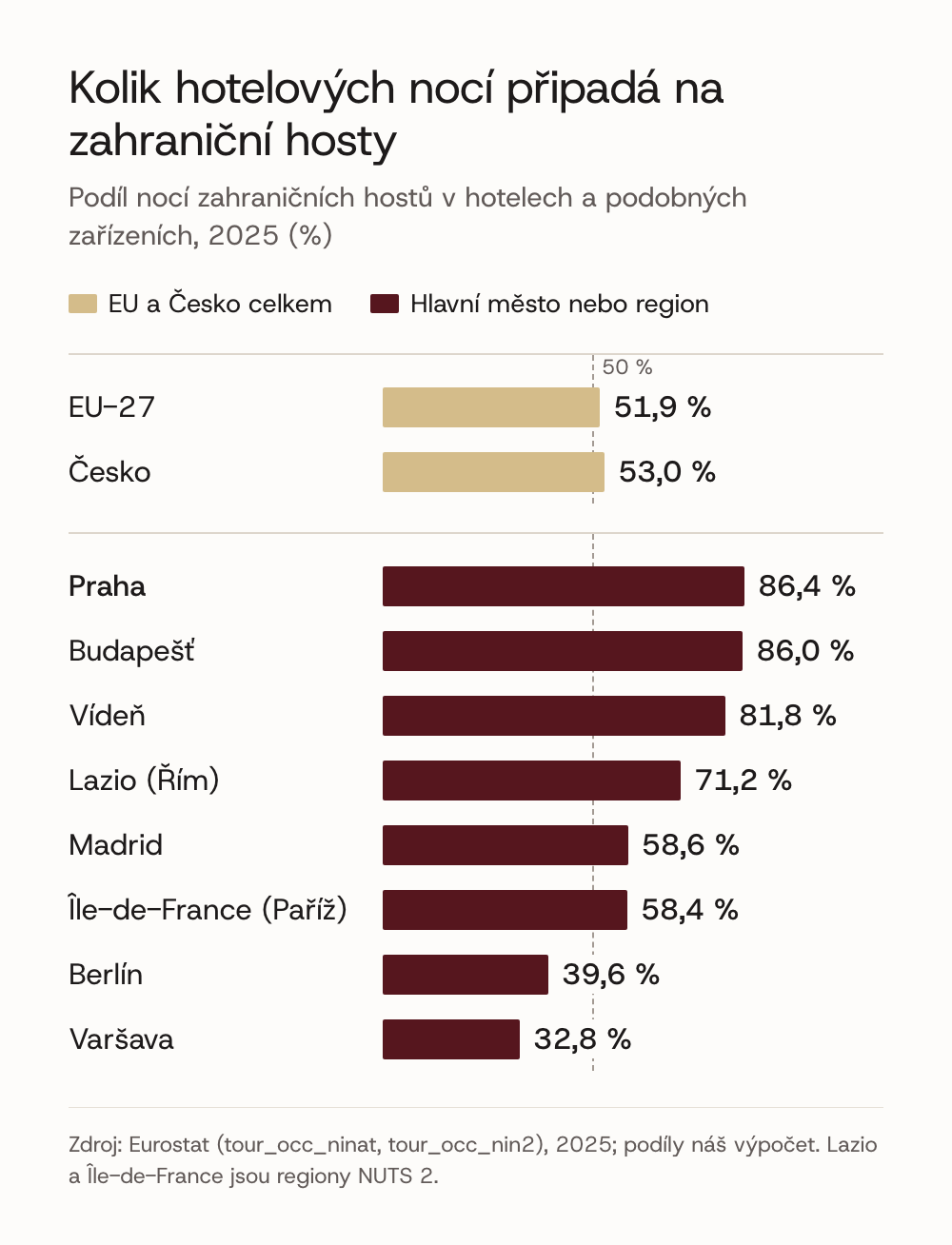
| Country (capital city or region) | Whole country | Capital city |
|---|---|---|
| EU-27 | 51.9% | – |
| Czechia (Prague) | 53.0% | 86.4% |
| Hungary (Budapest) | – | 86.0% |
| Austria (Vienna) | 72.3% | 81.8% |
| Italy (Lazio, Rome) | 53.6% | 71.2% |
| Spain (Madrid) | 66.7% | 58.6% |
| France (Île-de-France, Paris) | 37.9% | 58.4% |
| Germany (Berlin) | 22.1% | 39.6% |
| Poland (Warsaw) | 25.4% | 32.8% |
How many Europeans speak no foreign language, and who staffs reception
According to the 2022 Adult Education Survey published by Eurostat, 25.3% of people aged 25 to 64 in the EU know no foreign language. In Czechia the figure is 22.1%, in Germany 12.3% and in Austria 11.6%. Of the countries we looked at, Spain (43.7%) and Italy (32.1%) fare worst.3
| Country | No foreign language |
|---|---|
| Spain | 43.7% |
| Italy | 32.1% |
| Poland | 27.1% |
| EU-27 | 25.3% |
| France | 22.6% |
| Czechia | 22.1% |
| Germany | 12.3% |
| Austria | 11.6% |
The European Commission’s 2024 Eurobarometer shows the same picture from the other side. English is spoken by 47% of Europeans; among people aged 15 to 24, 79% can communicate in a foreign language.4 Of the EU population, 59% can hold a conversation in at least one foreign language.5
The language barrier affects both sides of the desk. At a smaller hotel, reception is often staffed by just a few people working in turns, and you cannot expect each of them to speak German, English, Polish and Italian. A team with the right language skills is also hard to retain: in a 2025 European Booking.com survey of accommodation businesses, 42% of respondents said that staff turnover makes training their employees harder.6 We have no data on the language skills of hotel staff in Czechia.
Czechia and Prague: 86% of nights spent by foreign guests
Czech hotels and similar accommodation recorded a total of 45.45 million nights spent in 2025, 3.2% more than a year earlier. Foreign guests accounted for 53.0% of them.1 In Prague, the share is 86.4%: of the 17.4 million nights spent in Prague hotels, 15.0 million were by foreign guests.2
Foreign demand, moreover, is growing faster than domestic demand. Across all collective accommodation establishments in Czechia, not just hotels, nights spent by foreign guests rose by 5.0% in 2025 and nights spent by domestic guests by 2.0%.7 According to the consultancy Horwath HTL, Prague accounted for more than 8.3 million arrivals, roughly 35% of all arrivals in Czechia.8
And no single language dominates. The largest source market, Germany, accounted for only 25.1% of nights spent by foreign guests in Czech hotels in 2024. Other large markets are Slovakia (6.9%), Poland (6.4%), the USA (6.0%) and the United Kingdom (5.6%).9 Together, these five countries make up half of the nights spent by foreign guests; the other half comes from guests from many other countries (our calculation).
For a hotel, this means that even good English at reception will not cover all guests, and a German version of the menu is not enough either.

The language barrier in hotels: the phone is the hardest route for foreign guests
Communicating with foreign guests by phone places the highest demands on language skills. There are no gestures, no pictures and no way to point at the menu. The guest has to understand what the hotel offers, pronounce the name of the dish, understand the price and make sure that reception has understood them. If any of this fails, something other than what the guest wanted arrives at the room, or the guest decides not to order at all.
Yet many people find phone calls uncomfortable even in their native language. According to a representative 2025 survey by Bitkom, the German digital industry association, 36% of Germans have put off a necessary phone call out of phone anxiety, and 40% prefer to write, even when it comes to family and friends.10 In a foreign language, this hurdle is probably even higher; we have no direct data on hotel guests, however.
Language affects travel as early as the planning stage. In a 2018 Booking.com survey of more than 20,500 travellers, 28% of respondents said that a language barrier could put them off planning a trip, and 20% worry about getting lost without knowing the local language.11 We look at why guests avoid the phone in general in our article on why guests don’t call reception.
A written order: price, photos, no misunderstandings
A written menu removes most of the points at which a phone call breaks down:
- Names and descriptions can be read at the guest’s own pace, with no need to pronounce them.
- The price is visible in advance, so there is no dispute at checkout.
- Photos explain a dish without words. SuitePad, a supplier of hotel tablets, reports that photos next to main dishes bring in 27% more orders.12
- Translating written text is something the guest’s phone can do. According to a 2025 Booking.com survey, 45% of travellers who turned to artificial intelligence while travelling used it specifically for translation.13 Only 6% of people trust it fully, however, so clear text and photos remain the foundation.
A written order helps staff too. It arrives at reception or in the kitchen as a record with the room number and items from the menu that the hotel has put together itself. So even a colleague who does not speak the guest’s language understands it, and nobody has to write anything down from a phone call or guess what the guest meant.

We describe how such an order works, from scanning the code to delivery, in our article on in-room ordering via QR code. GuestVero works on the same principle: the guest scans the QR code in the room and opens the hotel’s menu in their own phone’s browser, with no app and no sign-up. The hotel remains the seller and receives payments itself, no commission is paid on orders, and the price is CZK 1.60 per active room per day.14
What to prepare: a short menu, prices, photos, translations
A written menu only helps if the guest understands it. Before launch, it is worth going through these six points:
- A short menu. Fewer items are easier to read, translate and deliver. Start with what the hotel can deliver straight away.
- Simple names and a description of the ingredients. Instead of the local name of a dish, write what it is made of, for example ‘toast with ham and cheese’.
- A price for every item, including any delivery charge.
- Photos of the main dishes and drinks, so that the guest knows what they will get.
- Languages that match your own guests. Before you prepare a menu in a foreign language, look at where your guests actually come from. In Czechia, it makes sense to start with English and German, because Germans account for a quarter of nights spent by foreign guests.9 Add further languages based on your own statistics.
- Reception as a fallback. Anyone who wants to talk can call or come to the desk. A written menu does not replace the phone; it simply spares guests a call where calling does not work.
Bilingual guest materials are, in fact, already required by the star rating. The Hotelstars 2025–2030 criteria, which are also used to classify hotels in Czechia (where certification is voluntary), require three- to five-star hotels to provide a bilingual guest information directory, printed or digital (criterion 132).15 An in-room menu of food, drinks and services is a natural complement to it.
We summarise answers to practical questions about setting up your menu in our GuestVero FAQ. Try it for free, with no time limit, and see how your menu will look on a foreign guest’s phone.
We checked the data in this article on 15 October 2026.
Sources
- Nights spent in hotels and similar accommodation by guest origin (tour_occ_ninat), 2025 data
- Nights spent in hotels and similar accommodation by NUTS 2 region (tour_occ_nin2), 2025 data
- Number of foreign languages people know (edat_aes_l21), Adult Education Survey 2022
- Europeans strive toward multilingualism and value language diversity, according to latest Eurobarometer
- New Eurobarometer shows Europeans’ positive attitude towards language learning
- Booking.com research reveals widening gap between future skills ambitions and current training priorities in Europe’s hospitality sector
- Cestovní ruch – 4. čtvrtletí 2025
- Czechia Hotel & Chains Report 2026
- Nights spent by non-residents by country of origin (tour_occ_ninraw), Czechia, 2024 data
- Angst vor dem Telefonieren: Anrufe werden aufgeschoben (press release)
- Lost in translation? Survey on language barriers when travelling
- Room Service Benchmark Report 2026
- Booking.com releases the Global AI Sentiment Report
- GuestVero: in-room ordering and pricing
- Classification criteria 2025–2030
Frequently asked questions
How many guests in Czech hotels are from abroad?
In 2025, foreign guests accounted for 53.0% of nights spent in Czech hotels and similar accommodation, and for 86.4% in Prague (Eurostat; shares are our calculation).
Where do foreign guests in Czechia come from?
The largest market, Germany, accounted for only 25.1% of nights spent by foreign guests in Czech hotels in 2024. Other large markets are Slovakia (6.9%), Poland (6.4%), the USA (6.0%) and the United Kingdom (5.6%).
How many Europeans speak English?
According to the European Commission’s 2024 Eurobarometer, 47% of Europeans speak English. Of the EU population, 59% can hold a conversation in at least one foreign language.
Do guests use translation tools when travelling?
According to a 2025 Booking.com survey, 45% of travellers who turned to artificial intelligence while travelling used it for translation. Only 6% of people trust it fully, however.